Three days before my wedding, I drove back to my future mother-in-law’s house in Redmond to pick up my grandmother’s ring. I wasn’t suspicious. I wasn’t worried. I was just a woman in love who had accidentally left behind the most precious thing she owned.
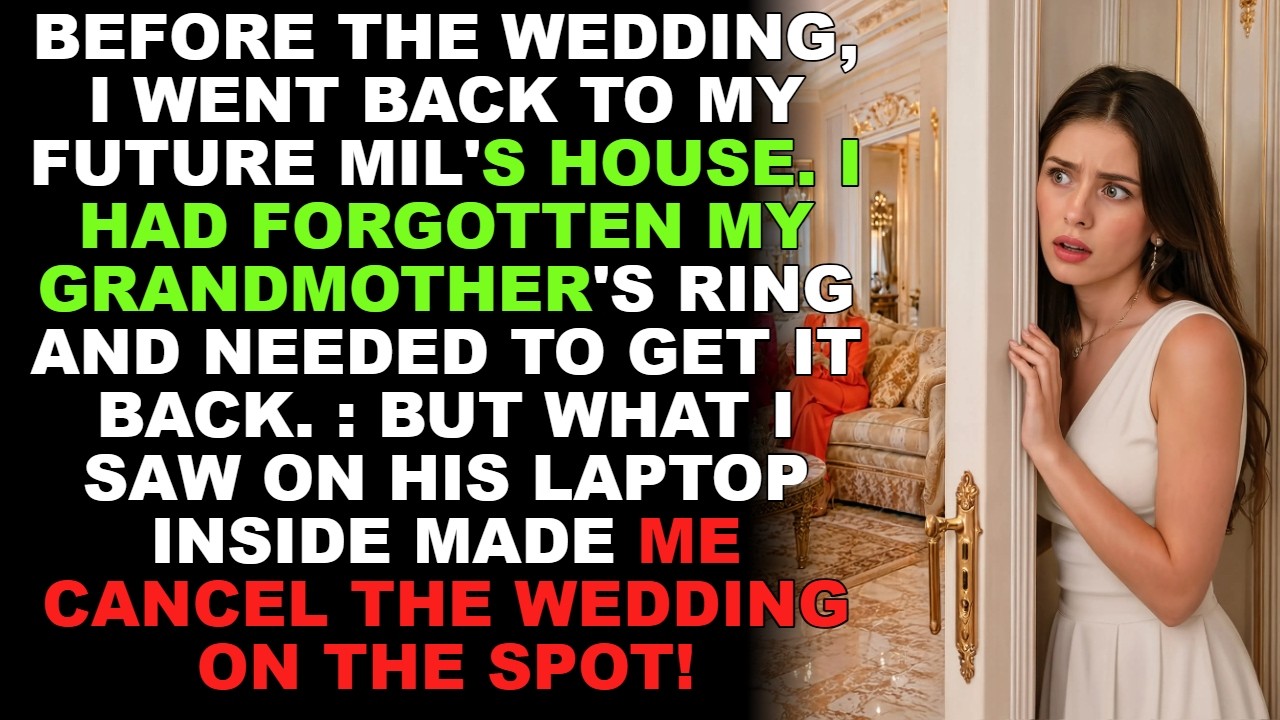
I was twenty minutes into the drive home when I reached down out of habit and felt bare skin instead of gold. I turned the car around without thinking twice. I had no idea that going back for that ring was going to save my life. My grandmother gave me that ring seven months before she died.
Pancreatic cancer, the kind that moves fast and doesn’t negotiate. Near the end, she started giving things away with the focused deliberateness of someone who had decided to be intentional about every remaining act. She called me into her room one afternoon, pressed the ring into my palm, and closed my fingers around it slowly, like she was sealing something. It was a pearl set in a thin gold band with tiny diamonds around the setting.
She told me my grandfather had added those on their thirtieth anniversary because he wanted to mark the occasion with something that would outlast him. “This ring has seen a real marriage,” she said. “A real one. The messy, hard, worth it kind.
I want you to have it, not necessarily for your wedding. Just to keep. To remind yourself what you’re actually looking for. ”
I cried.
She patted my hand and told me not to be dramatic about it. She passed eight months ago, in January, in the house she’d lived in for thirty-four years. I wore the ring at her funeral. I wore it through every planning meeting, venue deposit, and final dress fitting that followed.
I wore it to every Sunday dinner at Ryan’s mother’s house in Redmond, sliding it off only when I helped clear the dishes and setting it in the little blue ceramic bowl Beverly kept by the kitchen sink for exactly that purpose. That Sunday, three days before the wedding, I forgot to put it back on when I left. I had been with Ryan for four years. We met at a company kickoff event downtown.
I was newly promoted to senior project manager at a structural engineering firm. He was working in urban development consulting, and we ended up at the same table during a panel discussion about infrastructure funding. He was funny in the way that catches you off guard, the kind of funny that comes from actually paying attention to the world rather than performing for it. On our second date, I mentioned my grandmother offhand.
Something small. Something I immediately wanted to take back because it felt too personal too soon. And he asked me to tell him about her. He listened for forty minutes.
He didn’t check his phone once. I thought, this is someone who wants to know the real thing, not just the surface. I thought I had found it. His mother, Beverly, I met about six weeks in.
She was warm in a way that felt abundant, almost theatrical. She grabbed your hands when she said hello. She laughed with her whole body. She said things like “I feel like I already know you” within thirty seconds of meeting me.
I told myself I was being uncharitable for noticing how performed it felt. Not every generous person has something behind the generosity. His younger sister, Amber, was finishing her MBA and could talk for an hour about her dream of opening a boutique event planning business. She texted memes at midnight.
She called me “girl” like we’d been friends since high school. I liked her. I let myself like her fully, without reservation, the way I later understood I shouldn’t have. Over four years, I became part of the rhythm of that household in all the small ways that feel like belonging.
Sunday dinners that stretched past nine. Christmas mornings. The time I drove Amber to urgent care at seven in the morning because Beverly was out of town and Ryan was in a meeting. I lent Amber three thousand dollars once when she said she needed it for a professional certification and was embarrassed to ask her mother.
She said she’d pay me back within six months. I told her there was no rush. I genuinely meant it. That’s the part that’s hard to look at now.
Not that I was naive, exactly, but that I was generous in a way that required absolutely nothing in return. And I never once thought that might be something someone would take advantage of. My condo in Capitol Hill I had bought three years earlier entirely on my own. Seven years of careful saving, a modest inheritance from my grandmother’s estate, and a mortgage I had run the numbers on so many times I could recite the terms in my sleep.
One bedroom on the third floor, good light, original hardwood floors, a small balcony where I kept a container of herbs that mostly survived. It was in my name alone. Ryan had mentioned maybe four or five times over the course of our relationship that we should think about adding him to the deed after the wedding. Just to make things cleaner, he said, for when we eventually looked at something bigger together.
I had put it off each time. I had a vague, unnamed hesitation that I filed under overthinking and never went back to examine. I should have examined it. That Sunday dinner was completely normal.
Beverly made pot roast. Amber showed everyone photos from a venue she was considering for a client. Ryan and I sat next to each other, and I remember thinking during dessert that this was going to be my family, that I was lucky. That my grandmother would have found Beverly a little much but ultimately approved of the household’s warmth.
I helped clear the table, took off the ring, set it in the blue bowl, and forgot it entirely until I was on the highway heading back toward Seattle with my hand on the gear shift. When I turned back and pulled into the driveway, the house was still lit. The front door was unlocked. They rarely locked it before ten.
I let myself in the way I always did, calling out as I crossed the threshold that it was just me, I had forgotten something. No one answered. There were voices upstairs, television or conversation muffled through the ceiling. I went to the kitchen, found the ring exactly where I’d left it, and slid it back onto my finger.
I should have left right then. Instead, I turned back toward the hallway and walked past the study. The study was a small room Beverly used as a home office. A desk, a printer, a wall of shelves.
The door was half open, the light was on, and Ryan’s laptop was sitting open on the desk with the screen facing directly toward the doorway. I wasn’t meaning to look. I was just passing. But the screen was bright and the room was otherwise still.
And the first thing my eyes registered was my own name in large text in what appeared to be a group message. I stopped walking. I stood in the doorway and looked at the screen and understood in about three seconds what I was seeing. A group chat titled “family.
” Three participants. Beverly, Amber, and Ryan. The messages were from that afternoon, time-stamped while we had all been sitting at the same dinner table or close enough to it that it made no difference. I stepped into the room.
Beverly’s message was at the top of the visible thread, sent at 4:47 p. m. “Leah is still stalling on the deed. We need to move this along.
Once they’re married, she won’t have a reason to keep delaying. Ryan needs to apply more pressure this week, not next week. This week. ”
Amber had replied with a string of emojis and then, “Honestly, it’s almost too easy, Mom.
She just wants everyone to be happy. She’ll sign whatever he hands her and thank him for it. ”
I read that sentence twice. I kept my breathing steady.
Then my fiancé’s message. The man who had asked about my grandmother on our second date and listened without checking his phone. The man whose hand I had held at her funeral. The man I had chosen.
“I know, I know. Give me two weeks after the wedding. Once the deed is updated, we can look at refinancing just in my name. Capitol Hill property at her location is going for at least 540K right now, probably more.
That’s more than enough to get Amber set up with seed money and still leave breathing room for us. ”
Beverly: “Good. Just don’t give her any reason to hesitate. She’s sentimental, but she’s not a pushover.
Be careful. ”
Ryan: “She trusts me completely. Stop worrying about it. ”
The last message had been sent at 5:19 p.
m. We had sat down to eat at 5:30. I stood there for a long time. My hand was resting on the edge of the door frame.
The ring was on my finger. The dinner dishes were still in the rack by the sink, fifteen feet away, draining dry. Everything was very quiet. I took out my phone.
My hands were cold. My mind was not. I opened the camera app, held the phone up to the laptop screen, and methodically photographed every message visible on the screen. Six photos.
Every name, every timestamp, every word. Then I lowered the phone, turned around, and walked back down the hallway exactly the way I had come. I kept my steps even. I closed the front door behind me with almost no sound at all.
I sat in my car in the driveway for a long moment. The house was lit behind me. Somewhere upstairs, my future mother-in-law was probably watching television. Ryan was in his old childhood bedroom on his phone, having no idea I had been in that study.
I put the car in drive and pulled away from the curb. In my rearview mirror, the house lights got smaller and then disappeared. I drove back to Capitol Hill in the dark. I didn’t turn the radio on.
I just drove and let the facts arrange themselves clearly in my mind, one by one, the way you sort through documents when you need to understand exactly what you’re looking at. Four years. A sixty-person guest list. A venue deposit already nonrefundable.
A grandmother who had pressed a ring into my hand and told me to remember what I deserved. She trusts me completely. I got home, sat down on my couch, and called my best friend from college, a woman I had known for twelve years who had become a real estate and estate law attorney in Seattle. She answered on the second ring.
“I need help,” I said, “with something that happened tonight. Something urgent. ”
She was quiet for a moment. “Tell me.
”
I told her. While we were still on the phone, I sent her all six photographs. She went quiet again, longer this time. I could hear the faint sound of her scrolling through them.
“Leah,” she said finally. “I know. ”
“Okay. ” Her voice had shifted into something precise and calm.
Here’s what you’re going to do. She talked for twenty-five minutes. I wrote everything down on a notepad I grabbed from the kitchen drawer, the one I used for grocery lists. She told me what to do in the morning, who to contact, what not to sign under any circumstances, and how the documented loans could be recovered through formal demand.
When she finished, she asked if I was okay. “I’m not sad,” I said. “That’s the strange part. I thought I would be.
I’m just very awake. ”
“That’s not a bad place to be right now,” she said. “Try to sleep. I’ll make some calls first thing.
”
I didn’t sleep much. I sat at my kitchen table with tea I forgot to drink and thought about the ring on my finger and my grandmother’s hands when she placed it there. And what she had known that she never said outright, only implied through the careful way she had framed it. A real marriage.
The messy, hard, worth it kind. She had spent forty-one years inside one. She understood the difference between a person who works to earn your trust and a person who simply locates it and plans around it. She trusts me completely.
I went to bed around two. I woke up at six fifteen without an alarm, dressed deliberately in a blazer, dark pants, and flat shoes, and drove back to Redmond. I hadn’t called ahead. Beverly answered the door in her robe, and her expression moved through surprise and then automatic warmth in about one second.
“Leah, honey, what are you—” She reached for my arm. I stepped past her and into the kitchen. Ryan was at the table with coffee. Amber was leaning against the counter eating toast.
They both looked up, and I watched their faces register that something was different. “Sit down,” I said. “All three of you. Please.
”
Ryan started to say something with a small, confused smile. I said his name once, and he sat down. I placed my phone on the table face up, displaying the first message at the top. Timestamp 4:47 p.
m. The room went very quiet. Beverly opened her mouth. I looked at her, and she closed it.
“I came back for my ring last night,” I said. “The study door was open. Ryan’s laptop was on the desk. ” I let that sit for a moment.
“I didn’t read it on purpose. My name was already on the screen. ”
Ryan was looking at the table. He didn’t say it was out of context.
He didn’t say his mother had been joking or that I had misunderstood the tone. He just sat there, and in his silence I understood something I had been gently not understanding for longer than I wanted to admit. He had known that I would trust him. He had counted on it specifically, deliberately, the way you account for a known variable in a calculation.
He had woven four years of carefully remembered details and patient listening into something he intended to use. Beverly tried once more. “Leah, sweetheart, you have to understand that this was—”
“Please don’t,” I said. I wasn’t angry, exactly.
I was something past that, in the cold, clear place on the other side of it. “I’ve already spoken with an attorney. She’ll be sending formal correspondence this week regarding the three thousand dollars Amber borrowed eighteen months ago and the five thousand Ryan asked me for when his car was totaled last year. Both were described as loans at the time.
Both will be treated as such going forward. ”
Amber made a sound. I didn’t look at her. I looked at Ryan.
“I’m not getting married,” I said. I said it directly to him because I wanted him to understand it was his specifically, not just a general announcement. Not to someone who sat across from me at this table and sent those messages forty minutes earlier. Not to someone who told his mother I trust him completely, like that was a resource he was managing, not a person he was supposed to love.
He finally looked up. His expression wasn’t defensive. It was smaller than that, almost embarrassed. The embarrassment of being caught rather than the remorse of having done wrong, which is a distinction I understand now in a way I didn’t before.
“Leah,” he said quietly. “I wasn’t actually going to go through with all of it. It was just talk. ”
“Ryan.
” I said his name the way you say something you are finished with. “You wrote the messages. I have the photographs. You told your mother I trust you completely, and you were right.
That was the only true thing in that conversation. ”
I picked up my phone and put it in my bag. I stood up. “The venue deposit is in both our names,” I said.
“My attorney will be in touch about the details. I’d appreciate it if all further communication about financial matters goes through her office. ”
I walked out. The front door made almost no sound when I closed it behind me.
The drive home was long and quiet and mine, and I did not cry. My attorney filed the formal demand that week. The documentation on both loans was clear. Text messages, bank transfer records, a Venmo transaction with a written note that said “loan, will repay.
” Ryan’s family did not contest it. Beverly called twice. Amber sent a message that ran to several paragraphs, which I read once and deleted without responding. Ryan texted three times in the first ten days.
After the third, my attorney sent a formal request that all contact go through her office. After that, nothing. Six weeks after the wedding that didn’t happen, both loans were repaid in full. I didn’t celebrate.
I just felt the particular quiet that arrives when a long noise finally stops and you can hear yourself think again. My condo is still in my name. My grandmother’s ring is still on my finger. Four months after all of this, I was offered a promotion at work.
A senior director role I had been circling for over a year but hadn’t fully pursued, partly because I’d been spending so much of my energy managing a relationship that was quietly, steadily taking from me. I accepted it without hesitation. The hardest part was never the confrontation or the canceled venue or calling sixty people to explain that there wasn’t going to be a wedding. The hardest part was the week afterward, when I sat alone in my apartment, my apartment bought with seven years of my own careful work, and let myself acknowledge how long I had been looking away from things I could have seen.
The way he brought up the deed so regularly, always framed as practical, never quite landing. The way Beverly always praised my independence with an emphasis I had chalked up to her being old fashioned. The way Amber had never, in eighteen months, mentioned paying me back. Red flags don’t wave.
They just sit there and wait for you to stop explaining them away. My grandmother understood this. I think the ring was her way of handing me something to hold on to when I finally needed it. Not a warning exactly, but a kind of permission.
Permission to value myself the way she valued the forty-one years she had spent with someone who had earned every single one of them. She knew the difference between love that sustains and love that consumes. She wanted me to know it, too. I wear the ring every day.
I wear it to work and on Saturday mornings at the farmers market and on Sunday evenings when I cook dinner for one in my kitchen and do not feel particularly sorry about it. Sometimes people notice it and ask about it. I tell them it was my grandmother’s. They always say it’s beautiful.
It is. It’s also honest. That little pearl on its thin gold band was given freely, with full clarity, by someone who knew exactly what she was giving and why. It was never offered as a performance.
It was never calculated. It was just love in the purest form I’ve ever held in my hands. The morning I would have been married, I woke up without an alarm, made coffee, stood at my kitchen window, and looked out at my street in the early light. My street.
My window. My apartment. My grandmother’s ring on my finger. And my life intact ahead of me.
I went to work. I was not afraid of what came next. If that’s not everything, it’s close enough.