When you dream, the place you find yourself walking through does not exist anywhere in the physical world—or in any single specific location inside your brain. Scientists studying the neuroscience of dreaming have found that dreams emerge from a distributed network of brain regions working together in real time, not from one control center that could be pointed to on a brain scan. The default mode network, which stays active during REM sleep, appears to help generate the narrative flow of dreams, while the parietal lobes support the immersive, walk-through quality of dream spaces. The hippocampus plays a particularly heavy role.
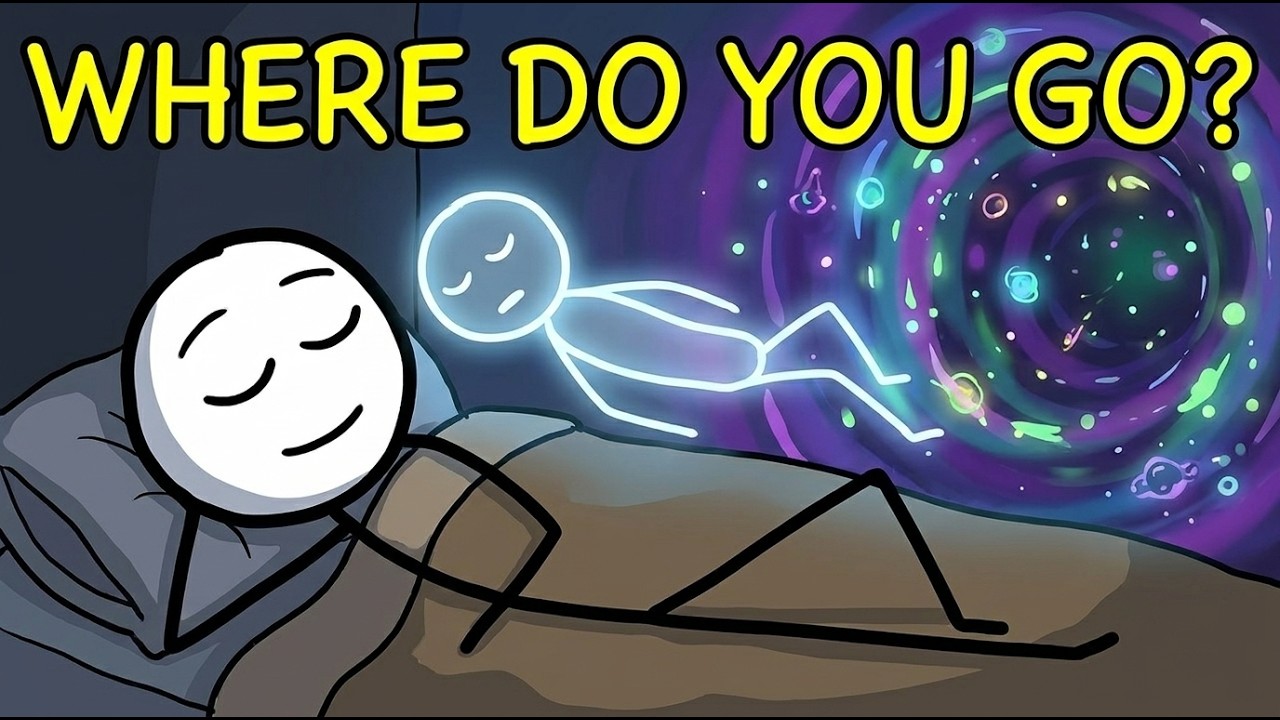
While awake, it binds places, times, and experiences into retrievable memories; during REM sleep, it stays active but pulls fragments of real places you’ve been and splices them together into composite locations that never existed as a single coherent place. That is why a dream school can somehow also be your childhood kitchen, or why a familiar street appears with bizarre additions bolted onto it. The dream geography feels eerily familiar and completely wrong at the same time. But the brain does more than generate static imagery.
Researchers at the University of California, San Francisco, led by Massimo Scanziani, discovered that during REM sleep, the brain’s internal compass—the dedicated system that tracks direction and movement in the real world—keeps running and updating its readings, even though the sleeping body does not move an inch. Specific neurons in the anterodorsal thalamic nucleus and postsubiculum remained measurably active and shifted their firing patterns exactly as they would during actual physical movement. The brain’s motor center also kept issuing commands to turn the head left or right, while the physical head remained perfectly still. This suggests the brain is not passively hallucinating a static picture.
It is actively running a continuously updating internal model of spatial position and movement, applying the same machinery used to navigate a real bedroom to a fictional, internally generated space with no physical counterpart. Scanziani’s team has even begun experimentally manipulating this internal steering system mid-dream in animal studies, and early results suggest the rest of the dreaming brain faithfully follows along. This connects to a broader theoretical framework in modern dream science: the idea that REM sleep functions as an innate, biologically built-in virtual reality generator. Neuroscientist Allan Hobson proposed the theory of proto-consciousness, framing REM as a virtual reality system the brain uses to refine its internal predictive model of how space, time, and physical interaction work in the real world.
Under this view, the brain is not replaying old memories like a passive film reel; it is running a fully generative simulation and inhabiting it as if it were physically real. Neuroimaging evidence supports this. Brain activation tightly time-locked to rapid eye movements shows up in regions associated with generating dream imagery, language, semantic association, somatosensory cortex, premotor cortex, and vestibular cortex. This implies that rapid eye movements during REM sleep may not be meaningless byproducts.
They may be functionally similar to scanning an actual room—visually palpating the virtual scene the brain has constructed. Dreaming, in this model, uses the same predictive processing machinery as waking perception, just running on internally generated input instead of external sensory data. If the brain is running this simulation, what happens to the physical body lying motionless in bed? Dream experience becomes genuinely glitchy and incomplete.
Researchers such as Jennifer Windt have noted that bodily sensations in dreams—the feeling of having hands, of walking, of exertion—are typically limited, fragmentary, and distorted compared to waking awareness. This is a predictable consequence of muscle atonia, the deliberate near-total paralysis during REM sleep that prevents the body from acting out dreams. With normal physical feedback shut down, the dream self runs on a bare-minimum, loosely sketched body representation. External physical sensations can shape dream content in predictable ways.
Stimulating the vestibular system during sleep increases the frequency of gravity-related dreams like flying, falling, and floating. One study found that patients with vestibular diseases reported dream sensations of sinking, rocking, flying, and jumping more than three times as often as healthy controls. Another study used a custom-built virtual reality flying simulation before a nap and successfully increased the rate of flying dreams afterward. The sense of where you are in a dream is shaped by the same sensory systems that anchor you in real space, even though those systems are receiving no genuine external input during sleep.
Sleep paralysis reveals just how deeply this spatial processing matters. When a person wakes up while REM-related paralysis is still active, the vestibular nuclei—implicated in spatial orientation during dreaming—produce the disorienting floating sensations and out-of-body experiences commonly reported. People describe a profound sense of not being located anywhere certain at all, neither fully in bed nor fully transported elsewhere. There is a final twist in this process.
Memory itself falls apart when you wake. Functional imaging shows that areas associated with working memory and sustained attention are suppressed during REM sleep. That is why dreams feel coherent while inside them but evaporate within seconds of waking unless immediate effort is made to rehearse what just happened. The dreaming brain was never built to preserve the information past the moment of waking.
The entire elaborate spatial simulation is constructed fresh every night and then almost entirely discarded. Lucid dreamers offer one of the few windows into bypassing this amnesia in real time. When self-awareness appears mid-dream, the prefrontal machinery responsible for waking self-reflection becomes available, allowing experienced dreamers to deliberately test the simulation—spinning to summon a new scene or pushing against a wall to see if it holds shape. They can essentially perform live experiments on the brain’s spatial model from inside the model itself.
So where are you when you dream? The honest scientific answer is strange. You are not in any single physical place, not inside a movie theater hidden in your skull, and not floating outside your body, no matter how convincing that sensation can feel. You are the emergent product of a distributed network of brain regions working together to construct a fully immersive internal simulation, complete with its own functioning internal compass, its own updating sense of movement and spatial direction, and its own fragmented version of your physical body.
The brain’s navigational systems keep running throughout the night, steering you through a constructed world that exists nowhere except in the neural activity generating it moment by moment. Your sense of where your body is located stays loosely tethered to the physical body lying still in bed, fed by sensory systems that are offline yet still shaping exactly what you experience—before nearly all of it quietly vanishes the moment you wake.