Sleepwalking is far more common than most people realize, affecting between 15 and 30 percent of children at some point and between 1 and 7 percent of adults, a phenomenon that scientists have studied for decades but which still remains stubbornly strange, but the brain science behind it reveals something surprising: the human brain does not work like a simple light switch that turns off during sleep and on during wakefulness. About three percent of adults experience sleepwalking, and those episodes are often more complex and potentially more dangerous than childhood cases. Before diving into what happens in the brain, several popular myths about sleepwalking deserve correction. The most persistent myth suggests waking a sleepwalker could cause a heart attack or severe psychological damage, but this is entirely false.
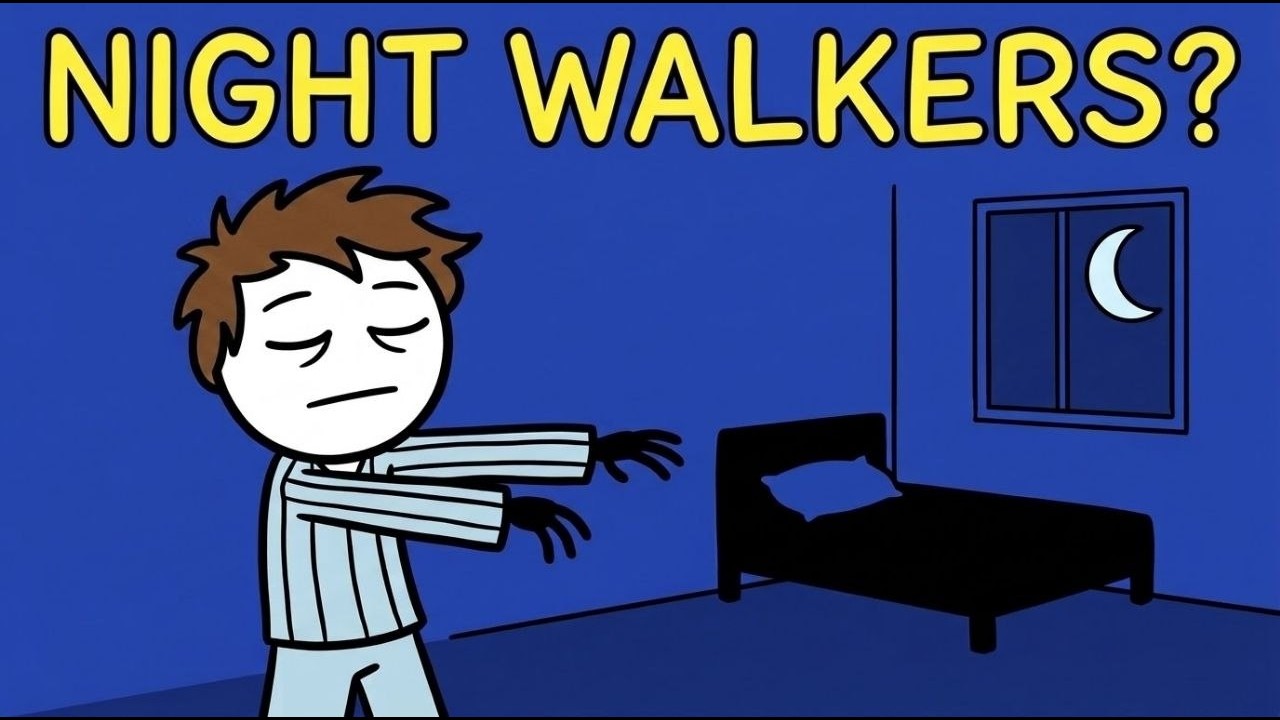
Waking a sleepwalker carries no medical risk, though it can be difficult since affected individuals are often confused and disoriented when roused. More practical guidance, according to sleep researchers, is that gently redirecting a sleepwalker back to bed is usually easier and less disruptive, but waking them for safety reasons is perfectly acceptable. Another myth claims sleepwalkers possess supernatural navigational precision, but in reality they move through familiar spaces because the route from bedroom to kitchen is stored in motor memory and does not require conscious thought. In unfamiliar environments, their navigational abilities deteriorate quickly.
The ability is based on environmental familiarity, not enhanced awareness. The modern understanding of sleep architecture began in 1953 when researchers Eugene Aserinsky and Nathaniel Kleitman at the University of Chicago discovered REM sleep using electroencephalography and electrooculography, showing that sleep is not a uniform state but rather a structured cycle recurring four to six times nightly. Sleep cycles through light non-REM stages, deep slow-wave sleep during which brain activity slows dramatically, and REM periods that lengthen as the night progresses. Sleepwalking occurs almost exclusively during slow-wave sleep, the deepest phase of non-REM sleep when the brain performs essential maintenance work, consolidating memories, clearing metabolic waste, and restoring neural connections.
Brain imaging studies of spontaneous sleepwalking episodes in laboratory settings reveal a phenomenon that challenges conventional assumptions about consciousness. During an episode, the brain is not uniformly in deep sleep. Regions associated with conscious awareness, self-reflection, and integration of complex experience remain in sleep-like states, while regions involved in locomotion, spatial navigation, and automatic behaviors show activation patterns typical of wakefulness. The result is a person who is moving and executing behaviors while the part of the brain that would normally observe and record that experience remains offline.
The mechanisms behind sleepwalking involve several established contributing factors. Genetics plays a substantial role, with studies showing that children with two sleepwalking parents have roughly a 60 percent chance of sleepwalking themselves, while the risk drops to 22 percent when neither parent sleepwalks. Identical twins show significantly higher concordance rates than fraternal twins, indicating a heritable component. Sleep deprivation dramatically increases episode frequency because the brain compensates by driving deeper into slow-wave sleep, which appears to increase the probability of partial arousal events.
Fever, stress, certain medications, and alcohol are also recognized triggers in susceptible individuals. Children sleepwalk far more often than adults primarily because they spend considerably more time in slow-wave sleep, which can make up 40 to 50 percent of a young child’s sleep, a proportion that drops significantly with age. The developing brain also runs less fully integrated sleep-wake regulation systems than adults, making partial arousal events more likely. As children age into adolescence and adulthood, sleepwalking typically decreases as maturation occurs in the prefrontal cortex and sleep-wake regulatory networks.
The spectrum of sleepwalking behaviors extends far beyond simple wandering. Documented cases include individuals cooking complete meals, leaving their homes and walking long distances, driving vehicles, sending text messages, and making phone calls with no memory of these actions. Sleep-related eating disorder is a recognized variant in which people consume foods while sleeping. Sexomnia, sexual behavior during sleep, has been documented in both men and women and has been presented as a defense in legal proceedings involving assault allegations.
Rare but medically established cases of sleepwalking-related violence have also been documented in which individuals injured themselves or others with no waking memory and no apparent waking-state motivation. Sleepwalking is often confused with dreaming, but the two are distinct phenomena. REM sleep behavior disorder, in which people act out vivid dreams because normal muscle paralysis fails, is a different condition entirely. Sleepwalking occurs in slow-wave sleep when dreaming regions of the brain are largely inactive.
When awakened during an episode, sleepwalkers typically report complete mental blankness or fragmentary non-narrative content, such as a vague sense of needing to do something, rather than a proper dream scenario. Some researchers have proposed an evolutionary explanation for sleepwalking, suggesting that partial arousal during deep sleep may represent a vestigial remnant of ancestral protective mechanisms. Early humans sleeping in predator-rich environments may have benefited from the capacity for partial activation during deep sleep, enough to respond to threats without requiring full wakefulness. Many prey animals sleep with one brain hemisphere at a time while maintaining environmental monitoring, and many birds use brief sleep episodes to preserve rapid response capacity.
Whether sleepwalking represents a functional ancestral trait or a system malfunction remains uncertain, but this context helps explain why the human brain has the architectural complexity that makes sleepwalking possible. Treatment approaches depend on episode severity. For most people with infrequent, brief episodes that pose no safety risk, environmental precautions such as door alarms, stair gates, and removing trip hazards are the appropriate response. Clinical options for frequent or dangerous episodes include scheduled awakening, in which the person is deliberately roused shortly before their usual episode time, and benzodiazepine medications, which suppress slow-wave sleep.
Addressing underlying contributors such as sleep deprivation, stress, alcohol use, and medication side effects can also significantly reduce episode frequency. Cognitive behavioral therapy for insomnia can improve overall sleep architecture. No treatment yet exists that precisely targets the partial arousal mechanism while preserving restorative slow-wave sleep intact. Sleepwalking raises difficult questions about consciousness and personal identity.
The version of a person who walks through the house at 2 a. m. , navigates furniture, responds to their name with a blank look, wears the same face, and moves with the same gait, all without the part of the brain that generates first-person narrative consciousness, challenges assumptions about the self being unified, continuous, and present whenever the body is active. This question extends into legal debates around responsibility for behaviors executed while consciousness was absent by medical evidence.
The neurological reality is that the brain never actually turns fully off, and sleep represents a system running on multiple partially independent subsystems that occasionally allow some to activate while others remain in deep maintenance mode. The brain does not function like a light switch, and sleepwalking stands as proof.