The sun had already climbed above the horizon on the morning of September 8, 1914, casting long shadows across the fields east of Paris. The temperature was rising, the sky was clear, and the men of the First Cheshires and the First Dorsets were formed into a hollow square, ordered to witness a spectacle that would mark a grim milestone in British military history. At precisely 7:07 a.
m. , a firing party drawn from the Bedfordshire Regiment raised their rifles and aimed at a 19-year-old private from Kent. The volley rang out, and Private Thomas James Highgate crumpled to the ground, becoming the first British soldier executed by his own side in the First World War.
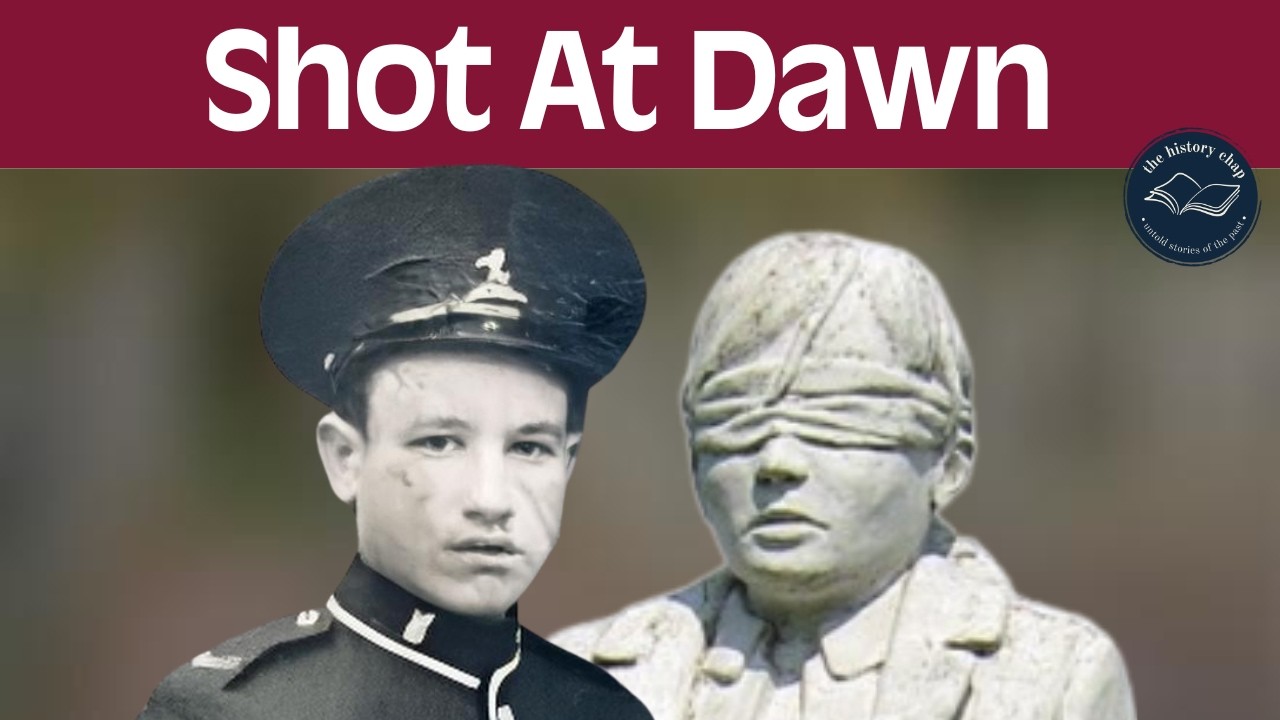 His death, just one month and four days after Britain entered the conflict, was not a moment of justice but a calculated act of deterrence, a message to an army already bleeding from the shock of retreat.
Highgate’s story begins not on the battlefields of France but in the grim institutions of Edwardian England. Born in 1895 in the village of Shoreham, just north of Sevenoaks in Kent, his childhood was far from the pastoral idyll often associated with the Garden of England. His parents, John and Alice, were poor, and their search for work in London led them, along with their children, into the Lewisham workhouse.
At the age of 14, Thomas was sent to the Metropolitan Asylum Board’s training ship, the Exmouth, anchored in Essex. There, up to 500 boys from workhouses and orphanages were drilled in the arts of seamanship, their futures predetermined by their circumstances. A year later, he joined the passenger liner SS Oriana, a ship that would later serve as a troop transport, but which in those pre-war years carried passengers between the UK and South America.
The 1911 census recorded him as a deck boy lodging in Liverpool, his work record noting him as a hard worker but prone to absenteeism. That pattern of instability would follow him into the army.
In February 1913, at the age of 17 years and 19 months, Highgate enlisted in the British Army, joining the First Battalion of the Queen’s Own Royal West Kent Regiment. Standing just 5 feet 4 and a half inches tall, with brown hair, hazel eyes, and naval tattoos on both forearms, he was not the stuff of military legend. His service record was soon marred by minor infractions: lateness to a military tattoo, exchanging duties without permission, and carrying a rusty rifle.
Then, on the anniversary of his enlistment, he went absent without leave from his battalion while stationed in Ireland. He resurfaced nearly five weeks later in Kent, where he was apprehended while attempting to fraudulently reinlist in the army at Woolage. This was not an uncommon practice in the pre-war British Army, where men would disappear and rejoin to claim a fresh start or a signing-on bounty.
But there was another possibility noted in his file: a memorandum from Captain Tate, the medical officer at Richmond Barracks in Dublin, recording that Highgate appeared to suffer from amnesia. That note would never be referenced again.
Highgate was punished with 48 days of detention and returned to his battalion, which was then stationed at Richmond Barracks. On August 14, 1914, just ten days after Britain declared war on Germany, the West Kents marched to the docks and sailed for France. They landed at Le Havre and moved toward the front as part of II Corps.
On August 23, during the Battle of Mons, the West Kents shot the advancing Brandenburg Grenadiers to pieces in the open and captured enemy artillery pieces. But the heroics of the British Expeditionary Force could not halt the German juggernaut, and the army was forced into a retreat that would last two weeks and cover 200 miles. By the end of August, the BEF reported nearly 3,000 stragglers, men separated from their units in the chaos of the withdrawal.
Private Thomas Highgate was one of them.
By September 6, the BEF was holding a line east of Paris, with II Corps centered around the village of Touquin. That morning, at around 8:15 a. m.
 , a British-born gamekeeper on a local estate found Highgate in a barn, wearing civilian clothes and without his rifle. Highgate told him he had lost his regiment and wanted out of the war. The gamekeeper handed him to local police, who informed the British army.
Whether Highgate genuinely intended to desert or whether his documented amnesia played a role remains unknown. What is certain is that he was court-martialed that very afternoon, with no defense to speak of, and found guilty of desertion. The sentence was death.
His medical record was never raised, and Highgate himself did not use it as a defense.
The execution was not inevitable. During the First World War, only 10% of those sentenced to death were actually executed. But General Smith-Dorrien, commanding II Corps, faced a crisis of discipline.
With 3,000 stragglers out of an army of 90,000, he wanted an example made. Highgate, unlike most stragglers who returned to their units, had discarded his uniform and rifle, making him a clear target for the harshest punishment. News of his execution was read out to every battalion in the BEF, and the men of the First Dorsets and First Cheshires were ordered to watch as he was led out to face the firing squad.
The phrase “shot at dawn” has entered public consciousness, but technically, not all executions occurred in the half-light of dawn. Highgate’s took place at 7:07 a. m.
, well after sunrise, on a bright, clear morning.
Highgate was the first, but he was far from the last. Over the course of the war, 346 British soldiers were executed by their own side. Of those, 309 were later pardoned, a campaign that culminated in 2006 when the British Parliament cleared their names.
But the story behind these executions is far more complicated than a simple dichotomy of cowardice versus pity. Popular history tends to bundle these men together as shot for cowardice, but only 11 were specifically charged with that offense. The vast majority, 266 in all, were like Highgate, executed for desertion.
Seven committed the offense of quitting their post, six for striking a superior officer, five for disobedience, two for sleeping at their post, and two for casting away their guns. Thirty-seven, or a tenth of all those executed, were convicted of murder.
 The ages of the executed men also defy the stereotype of the frightened teenager. Only 20 of the 346 were teenagers, though many would argue that even that number is too many. The majority were in their twenties, and 46 men were over 30.
The oldest was 46-year-old Private Harry Hrix of the Second Battalion, the Leinster Regiment, a US citizen who enlisted in February 1917, before America entered the war. Hrix went missing in September 1917, was picked up in Boulogne in November, spent months in hospital, escaped custody twice, and finally returned to his battalion in July 1918. He absconded again within days and was arrested by French police under a false name.
His brigade commander called him one of the worst characters in the army. He was executed for desertion on August 23, 1918.
The youngest was Private Herbert Burden, born in 1898 in Lewisham, ironically the same area where Highgate and his family had been in the workhouse. Burden enlisted at 16 by lying about his age and joined the First Battalion of the Northumberland Fusiliers. He was shot on July 21, 1915, at Ypres for desertion, four months after his 17th birthday.
He became the model for the blindfolded figure in the Shot at Dawn statue at the National Memorial Arboretum. But the executions were not limited to the ranks. Three officers were among those shot, including Second Lieutenant John Harry Patterson of the First Essex Regiment.
Patterson, who may have enlisted under a false name, deserted in March 1918, lived under a false identity, cashed forged checks, and shot a military policeman who tried to arrest him. He was executed for murder on September 24, 1918.
Three men were executed for mutiny, including Corporal Jesse Short, a miner from Felling in the northeast. Short signed up with the 24th Northumberland Fusiliers, the Tyneside Irish, who lost over 600 men on the first day of the Battle of the Somme. During the Étaples mutiny, he was arrested for inciting the guard to lay down their arms, attack an officer, and throw him in the river.
Three other men received ten years, 33 received field punishment, and the rest were fined or reduced. Short alone was sentenced to death despite a previously good record. He was executed on October 4, 1917, leaving a wife and two daughters.
The rationale for these executions lay deep in British military tradition. The punishment for desertion had been on the statute books for over 200 years, with roots stretching back to medieval England. The army had historically recruited from the lowest rungs of society, and it was felt that discipline needed to rest on fear.
But the First World War radically changed the makeup of the British army. It became a massive citizen army of students, bank clerks, managers, engineers, and artists. A different form of discipline was arguably needed for a different army in a different type of war, but the rule book remained stuck in the Victorian age.
 The statistics tell a more nuanced story than the image of heartless generals sending men to their deaths. During the war, there were over 200,000 courts-martial in the British army, resulting in 20,000 convictions for offenses that carried the death penalty. Of those, just 3,080 were actually sentenced to death, and only 346 were executed.
That figure was less than half the number executed by France and a third of the Italian total. The Germans officially executed just 48 men, having set higher legal standards of proof for desertion. The United States executed none, as President Wilson refused to sign the death sentences of the 24 men convicted of desertion.
Australia, serving under the British Empire, also executed none, having passed a law forbidding execution without government approval.
Ninety-one of the 346 men executed were already on suspended sentences when they were shot, meaning for at least 20% of them, this was not their first offense. Of those 91, 40 were on suspended death sentences. When they transgressed again, senior commanders had little room to maneuver.
The names of the executed men were excluded from most war memorials, but questions about the justice of these executions began almost immediately. In 1930, an act of parliament abolished the death penalty for everything except murder and mutiny. Had that been in place before 1914, 277 soldiers might not have faced the firing squad.
During the Second World War, there were no British soldiers shot for desertion or cowardice, though some were executed for murder and one for treachery. The campaign to clear the names of the First World War men went on for decades, led by relatives like the daughter of Private Harry Farr, who was shot for cowardice in October 1916 after being hospitalized for shell shock. Her campaign finally succeeded in 2006, when all the men except those convicted of murder were pardoned.
The act covered 309 men, including the three mutineers, added at the last minute.
The Shot at Dawn statue at the National Memorial Arboretum commemorates these men, surrounded by 309 symbolic wooden stakes. Among them is Private Thomas James Highgate, the very first man to be executed on September 8, 1914. His death was a warning, a brutal calculus of war that sought to hold an army together through fear.
But it also stands as a testament to the complexity of human behavior under unimaginable stress, where the line between cowardice and illness, desertion and desperation, was often impossible to draw. Highgate was 19 years old, a product of the workhouse, a man with a documented history of amnesia, and a soldier who lost his way in the chaos of a retreat that broke thousands of others. He was not a hero, nor was he a villain.
He was a casualty of a war that consumed millions, and his execution was a decision that history has since judged with far more nuance than the generals who ordered it.