The fall of the Western Roman Empire is one of history’s most examined turning points, but the story is far more complex than the simple image of barbarian hordes smashing through gates. The deeper truth is that Rome was not destroyed by a single act of violence but overwhelmed by a slow, relentless wave of human migration and survival pressure. For centuries, the Germanic peoples lived along Rome’s northern frontier in the forests beyond the Rhine. Their world was one of cold rivers, scattered villages, wooden halls, and small fields.
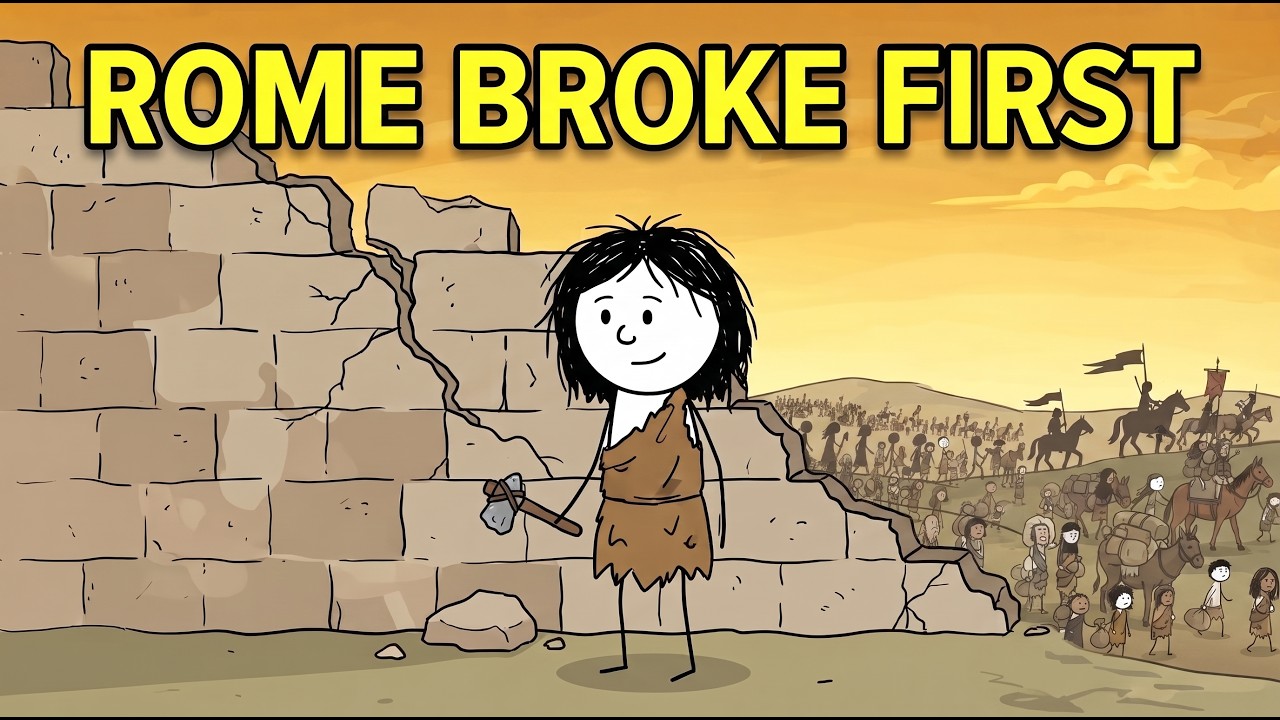
They were not citizens of a great civilization—they were survivors of uncertainty, adapted to hunger, kin, and movement. When soil failed or enemies came, they packed up and moved on. This was not weakness; it was a survival strategy. The first false answer to Rome’s fall is the claim that Germanic tribes invaded because they simply wanted Roman gold and luxury.
Desire was only the surface. What pushed them westward was far older and more desperate: pressure. The kind of pressure that forces mothers to carry children across unknown forests and warriors to fight not for glory, but for a place to sleep. That pressure arrived from the east in the late 4th century in the form of the Huns.
Mounted riders with short bows and deadly hit-and-run tactics, they appeared almost unreal to Roman writers. They made borders meaningless and turned distance into fear. When they entered Eastern Europe, the first people caught in their path were the Goths. The Goths, a Germanic people living north of the Black Sea and along the edges of the Roman world, faced the oldest question in human history: stay and die, or move and risk everything.
Thousands of them—men, women, children, elders, carts, and animals—flooded toward the Danube River. They came to the Roman border and asked to be allowed inside. This is where the second false answer appears. The story is often told that Rome was too kind, that it let the barbarians in and was betrayed.
The ugly truth is more complicated: Rome let them in, but then failed them. On paper the empire was powerful, but power on paper does not feed hungry refugees. Roman officials exploited the newcomers. Food was withheld.
Corruption spread. Desperate families were pushed into such humiliation that some were forced to trade their children for dog meat just to survive another day. This was a breaking point for entire communities. The Goths rebelled not because they hated civilization, but because trapped humans become dangerous.
In 378, the Roman army met them near Adrianople. Rome expected discipline and armor to win, but hunger changes men, and desperation hardens them. Gothic cavalry returned at the worst possible moment. The Roman army was crushed, and Emperor Valens was killed on the battlefield.
A Roman emperor had died fighting barbarians, and the myth of Roman invincibility was cracked. After Adrianople, the border was no longer a wall—it was a wound. Germanic groups began moving deeper into Roman territory. Some came as enemies, some as soldiers, some as settlers.
This was the migration period, but that name sounds far too clean. This was a chain reaction. The Huns pushed the Goths. The Goths pushed into Rome.
The Vandals moved. The Suebi moved. The Burgundians moved. The Franks expanded.
The Angles and Saxons crossed into Britain. The old map began to tear. The third false answer is that the barbarians destroyed Rome from the outside. The reality is that many of these groups were already inside the Roman system.
Germanic warriors had served in Roman armies for generations. They knew Roman weapons, roads, and pay. Some held Roman titles. The line between Roman and barbarian became blurred.
A warrior might wear Roman gear, follow a Germanic king, and settle on Roman land. This was not a simple invasion—it was a collision, a slow replacement of one survival system by another. When Rome was strong, it absorbed these groups. When Rome weakened, they absorbed Rome.
That is the real reversal. In 410, the Visigoths sacked Rome itself. For the Romans, it felt like the end of the world. For the migrants, it was not the end but a demand for land, recognition, and survival inside a system that had used them, feared them, and failed to control them.
The Vandals took an almost impossible journey—from central Europe across the Rhine, through Gaul, into Spain, and then across the sea to North Africa. Their goal was not random. North Africa was rich. It fed Rome.
Grain was power. Whoever controlled the grain controlled the future. When the Vandals took North Africa, Rome lost one of its great food sources, and the body of the empire began to starve. The Franks took a different approach in Gaul.
They did not just raid—they settled and adapted. They made deals, fought, married into local power, and used Roman administration when it suited them. This is why they lasted. Survival does not reward purity; it rewards adaptation.
The tribes that only destroyed often vanished. The tribes that blended became kingdoms. For ordinary people, this transformation was brutal. A farmer in the fifth century did not care who claimed the imperial title.
He cared whether soldiers burned his field, whether his children survived winter, and whether the road was safe. The fall of Rome was lived in villages, in empty granaries, in broken walls, in families walking behind carts, and in the silence after an army left. The deepest truth is that the Germanic tribes did not simply end Rome—they became the ancestors of medieval Europe. The Franks gave rise to the future kingdoms of France and Germany.
The Angles and Saxons reshaped Britain. The Visigoths ruled in Spain. The Ostrogoths ruled in Italy. The Vandals ruled in Africa.
The so-called barbarians became the framework of a new world. Rome died in the west, but its bones remained—its roads, its church, its language, its dream of empire—and Germanic kings built on top of them. One side had an empire and stone cities; the other had mobility and flexible war bands. One side had written law; the other had personal loyalty.
Rigid systems dominate stable worlds, but flexible systems survive unstable ones. Rome was built for control, and the migration age was built from chaos. By 476, the Western Roman Empire was gone, and the last Western emperor was removed. But there was no single thunderclap.
It happened border by border, village by village, army by army. The people who once stood outside the empire now ruled inside it. The refugee had become the king. The outsider had become the founder.
Rome was not smashed by one savage wave. It was overwhelmed by human survival under pressure. The Huns lit the fire, the Germanic tribes ran, fought, settled, and adapted, and from that terrifying movement came the kingdoms that shaped Europe for the next thousand years.
That is the barbarian domino—not one invasion or one villain, but millions of ancient human choices: move, fight, join, betray, settle, and survive.