In 186 BC, the Roman Senate confronted what it saw as an existential threat: a wine cult that had swept through Italy, attracting women, freedmen, slaves, and the urban poor. The Bacchanalia, dedicated to the god Bacchus, was so popular that the Senate issued the Senatus Consultum de Bacchanalibus, ordering mass arrests and executions. According to the historian Livy, more than 7,000 people were involved, and the executions outnumbered the imprisonments. The original bronze tablet of the decree still survives, unearthed in southern Italy in 1640 and now displayed in a Vienna museum.
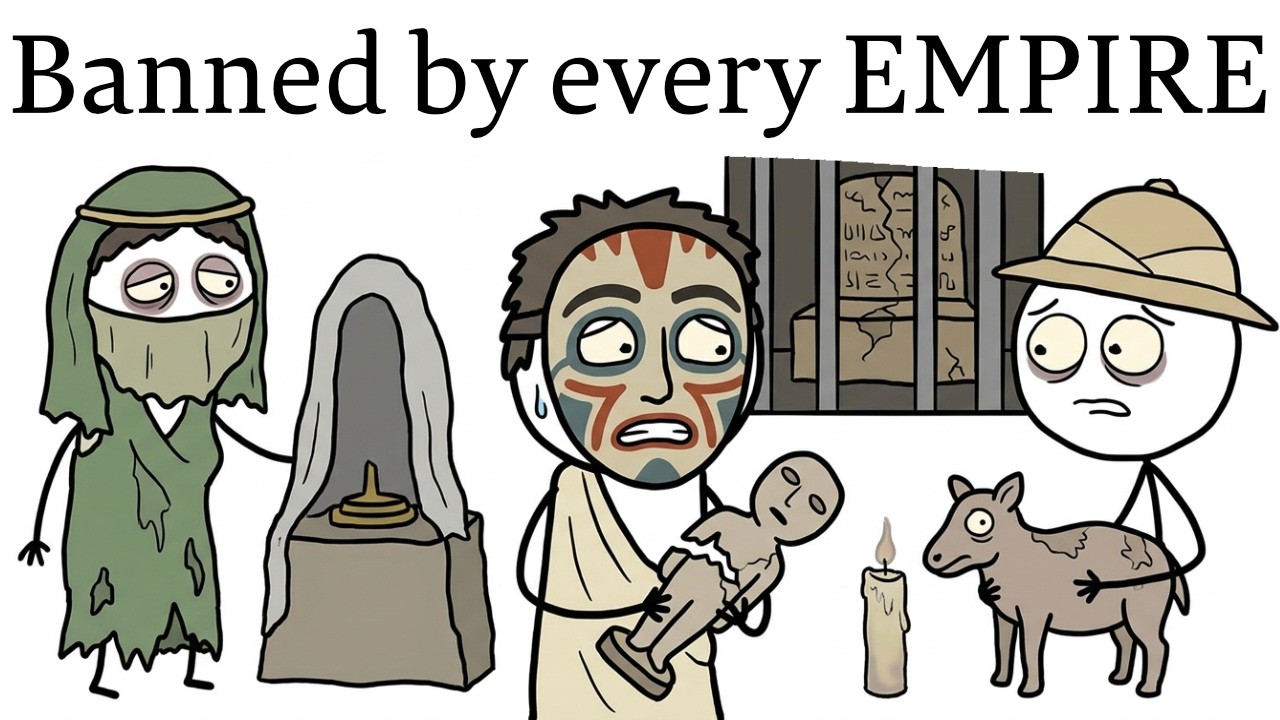
Julius Caesar described the druids of Gaul as priestly intellectuals who memorized decades of oral law and burned prisoners inside giant wicker statues. But the druids were also judges, ambassadors, and organizers of resistance against Rome. Augustus banned Roman citizens from practicing druidism, and Emperor Claudius abolished it completely around 54 AD. In 60 AD, Roman legions under Suetonius Paulinus marched across the Menai Strait to the island of Anglesey, where they massacred the druids gathered on the shore and cut down their sacred groves.
By around 80 AD, the druids of Britain were essentially gone, leaving no written record of their traditions. In 216 AD, a child named Mani was born in what is now southern Iraq. By his mid-twenties, he claimed visions, and within decades his religion, Manichaeism, stretched from Roman North Africa to China. Mani’s theology divided the universe between light and darkness, drawing from Zoroastrianism, Christianity, Buddhism, and Gnosticism.
He illustrated his own scriptures so beautifully that “Mani” became a Persian word meaning “great painter. ” The Sasanian king Shapur I allowed him to preach, but his successor, Bahram I, had Mani arrested and imprisoned. Mani died in prison around 274 AD; his followers called it his “crucifixion. ” Bahram had Mani’s body decapitated, stuffed with straw, and hung over a city gate.
Rome treated Manichaeism harshly as well. Emperor Diocletian issued an edict in about 302 AD ordering its leaders burned alive with their books. After Christianity became dominant, the persecution only intensified. In China, Manichaeism spread along the Silk Road and briefly became the state religion of the Uyghur Empire, but a Tang Dynasty purge in 843 saw Manichaean priests killed and temples destroyed.
A striking historical footnote: Saint Augustine of Hippo, the most influential Christian theologian in Western history, spent nine years as a Manichaean before converting. Before Christianity became the religion of the empire, it was the religion the empire tried to erase. The Great Persecution, launched by Emperor Diocletian in 303 AD, ordered churches demolished, scriptures surrendered, and Christians stripped of legal status. Later edicts required all inhabitants of the empire to sacrifice to Roman gods, and the killing began.
Modern scholarship, including historian Candida Moss’s 2013 book, puts the verifiable death toll at around 3,000 to 3,500, far below the millions claimed by tradition. The persecution was uneven: in Gaul and Britain, almost nobody died, while in Egypt and Palestine, executions were constant. Diocletian, the architect of the persecution, abdicated in 305 AD, the only Roman emperor in 500 years to retire voluntarily. He moved to Croatia and grew cabbages.
Eight years later, his successors signed the Edict of Milan, granting Christians full legal toleration. Within 70 years, Christianity was the official religion of the empire. In the 10th century, a Bulgarian priest named Bogomil began preaching a dualist theology that rejected the physical world as evil. His followers, the Bogomils, believed the Catholic Church was a fraud and considered the cross an instrument of torture.
Bulgarian ruler Tsar Peter I was horrified and sought advice from Constantinople; mass burnings followed. Around 1100, Byzantine Emperor Alexios Komnenos watched the Bogomil leader Basil the Physician burned alive in the Hippodrome. Bogomilism spread westward and influenced the Cathars of southern France. The Latin word for Bulgarian, “Bulgarus,” evolved into the Old French “bougre,” meaning a dualist heretic.
English imported the word as “bugger,” first appearing in court documents in 1330 as a term for abominable heresy. The sexual meaning did not appear until 1555, likely because medieval church propagandists accused the heretics of refusing procreative sex. The Cathars, also called Albigensians, flourished in Languedoc with women preachers, strict vegetarianism, and austere religious elites. In 1208, after Pope Innocent III’s envoy was murdered, the pope called for a crusade against fellow European Christians.
In 1209, when crusaders asked the papal legate Arnaud Amalric how to distinguish Cathars from Catholics in the city of Béziers, he is reported to have said, “Kill them all, the Lord will know his own. ” Amalric’s letter to the pope boasted of killing nearly 20,000 people, including 7,000 who had taken refuge in a church that the crusaders burned. The crusade dragged on for 20 years. In March 1244, after a nine-month siege of the fortress of Montségur, 210 unrepentant Cathars were burned alive on a single pyre.
In 1233, Pope Gregory IX founded the Inquisition to root out remaining heretics. In 845 AD, Tang Dynasty Emperor Wuzong, a Taoist who drank mercury elixirs for immortality, launched a purge of Buddhism. The numbers are staggering: 4,600 monasteries demolished, 40,000 smaller shrines destroyed, and 260,500 monks and nuns forced back into lay life. The edict also targeted Manichaeism, Zoroastrianism, and Nestorian Christianity, all of which vanished from China for centuries.
A Japanese monk named Ennin kept a diary of the persecution, watching soldiers come for temples and monks abandon their robes. Wuzong died in 846 at age 32, likely poisoned by the mercury elixirs his Taoist priests gave him. His successor immediately reversed the persecution. On July 12, 1562, Spanish Franciscan friar Diego de Landa burned a large number of Maya books in the town of Maní in the Yucatán.
He recorded burning 27 codices and about 5,000 religious idols, though scholars suspect the real number was higher. The Maya had been writing for over a thousand years; today only four Maya codices survive on Earth. Landa also tortured an estimated 4,500 Maya, with at least 158 dying under torture. He was recalled to Spain, acquitted, and promoted to Bishop of Yucatán in 1572.
In his defense, he wrote a book recording what he thought was the Maya alphabet. It was wrong, but in 1952, Russian linguist Yuri Knorozov used that flawed work as the key to crack Maya hieroglyphs. The man who burned a civilization’s literature accidentally left the key to reading what survived. In 1883, the U.
S. Secretary of the Interior issued the Code of Indian Offenses, criminalizing the Sun Dance, the Ghost Dance, the Potlatch, and traditional burial practices. Penalties included jail time or denial of food rations, a slow death sentence on starving reservations. In January 1889, a Northern Paiute man named Wovoka had a vision during a total solar eclipse, teaching a round dance that would bring back the dead ancestors and make the world whole.
The Ghost Dance spread to dozens of tribes, and the Lakota added ghost shirts believed to stop bullets. The government panicked. Sitting Bull was killed by Indian police on December 15, 1890, at Standing Rock. Two weeks later, the Seventh Cavalry surrounded Spotted Elk’s band of about 350 Lakota at Wounded Knee Creek and opened fire.
Estimates of the dead range from 250 to 300 Lakota, more than half of them women and children. Twenty soldiers received the Medal of Honor for that day; the medals were formally rescinded only in 2024. The Sun Dance ban remained in effect for almost 90 years until the American Indian Religious Freedom Act was signed in 1978. Zoroastrianism, the official state religion of the Persian Empire for over a thousand years, collapsed after the last Sasanian Shah, Yazdegerd III, was assassinated in 651 AD.
Persia fell to the Arab Muslim conquest, and Zoroastrians became refugees in their own land. They were classified as protected non-Muslims but required to pay special taxes. Fire temples were torn down or converted to mosques. Over centuries, pressure grew: restrictions on clothing, housing, and even riding horses.
In Yazd, Zoroastrians had to carry a shawl to lay under their feet so they would not pollute a Muslim’s carpet. The jizya tax on Iranian Zoroastrians continued until 1882, when a Parsi philanthropist lobbied the Qajar government to end it, by which point only 7,711 Zoroastrians remained alive in Iran. Some had fled earlier to India, where a Hindu king allowed them to stay on the condition that they adopt local customs and never proselytize. Their descendants are the Parsis, who number around 50,000 in Mumbai today.
Their most famous member was a man born Farrokh Bulsara, who became professionally known as Freddie Mercury. Today, there are roughly 125,000 Zoroastrians on the entire planet.