Chickens produce roughly 93% of the world’s poultry eggs, and in most of the world the word “egg” needs no qualification. Yet this dominance was not a natural inevitability. The wild ancestor of the domestic chicken, the red jungle fowl of tropical Asia, lays small seasonal clutches like most wild birds. The chicken became a breakfast machine because humans spent centuries breeding it into one.
A major reassessment published in 2022 placed the earliest unambiguous domestic chickens at Ban Non Wat in central Thailand, roughly between 1650 and 1250 BCE. Researchers linked their emergence to the spread of dry rice and millet farming. Red jungle fowl naturally lived around forest edges, and early farming villages created a new habitat: cleared ground, stored grain, spilled seeds, insects, and food waste. The boldest birds fed closest to settlements, and over generations a loose relationship became management, then domestication.
Early chickens offered more than eggs. They provided meat, feathers, alarm calls, ritual value, and roosters for cockfighting. They spread through trade partly as unusual or prestigious animals before becoming everyday food producers in many regions. Several traits made chickens uniquely suited to human households.
They spend most of their time on the ground, making them easy to manage with a simple fence or coop. They are social, tolerate group living, and establish a dominance hierarchy. Their diet is flexible, allowing them to forage for seeds, insects, and scraps while converting materials humans cannot eat into meat and eggs. They are also small enough to be affordable, unlike a cow, which represents an enormous investment.
A hen is a renewable protein source: an egg is food obtained without killing the animal that made it. Hens ovulate whether or not a male is present, so a keeper can maintain many females and very few roosters. The chicken egg itself was also conveniently sized. It is large enough to feel substantial but small enough to serve one person.
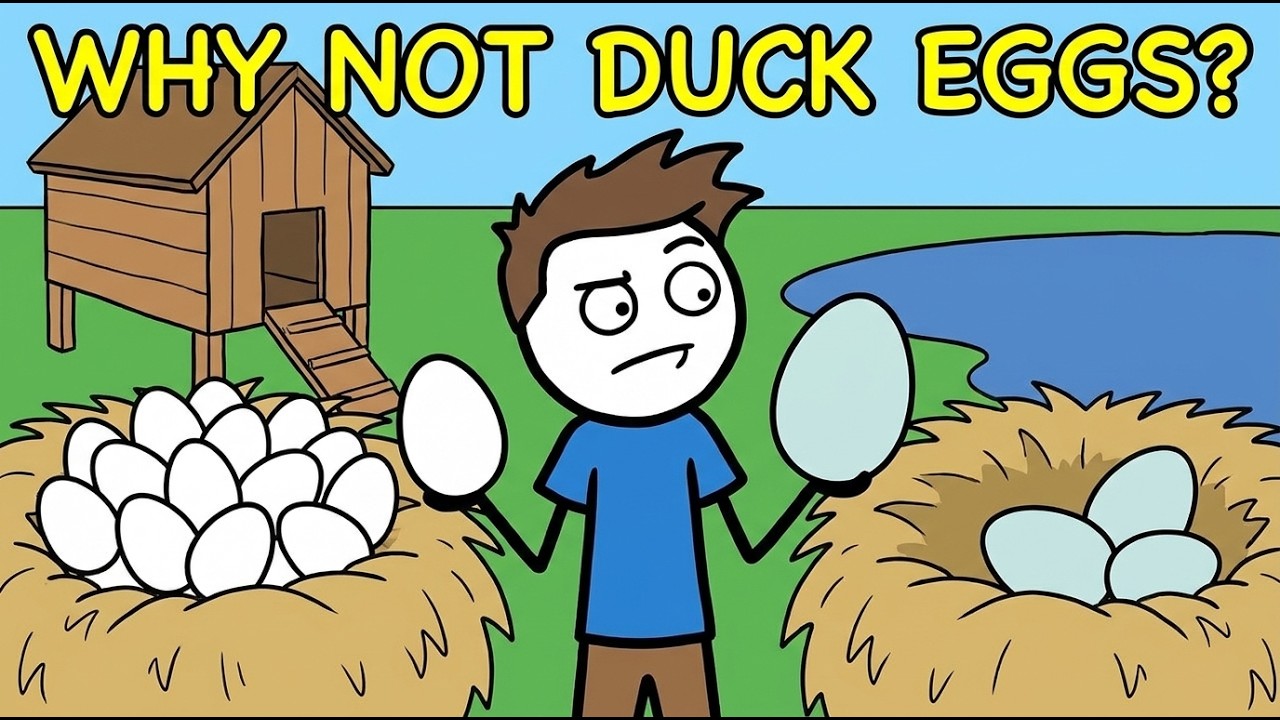
Its structure makes it versatile: the yolk contains emulsifiers like lecithin that help water and fat mix, while heat unfolds the proteins in the white, allowing eggs to bind, thicken, set custards, and strengthen baked goods. Beaten whites stabilize air bubbles for foams and meringues. Quail eggs are too small for convenient mass use, goose eggs require recipe adjustments, and an ostrich egg can take over an hour to boil. Ducks are the strongest alternative.
Some breeds lay large numbers of rich, durable eggs, and they remain culturally important across parts of Asia, where salted duck eggs, preserved eggs, and balut are established foods. But ducks foul water, produce wetter droppings, and create messier housing conditions. Their eggs taste richer and less familiar to people raised on chicken eggs. That preference is learned, not biological, but once recipes and markets center on the chicken egg, even a small difference becomes commercially important.
Geese are larger, louder, more seasonal, and produce far fewer eggs. Turkeys mature slowly and produce fewer eggs than commercial chickens. Quail lay prolifically but require several eggs to equal one chicken egg, meaning more shells and more handling. Ostriches and emus produce few eggs and need specialized facilities.
Pigeons typically lay only two eggs per clutch and historically were kept for squab rather than eggs. The biological advantage humans amplified in chickens is their ability to lay sequences of eggs. Inside a hen, a mature yolk is released into the oviduct, where albumen, membranes, and shell are added. The process usually takes a little more than 24 hours, which is why a hen cannot reliably lay two normal eggs every day.
Wild birds stop after completing a clutch and become broody, but humans interfered by removing eggs and selectively breeding birds that laid larger clutches, paused less, and showed less broodiness. Modern commercial layers can exceed 300 eggs per year. The United States averaged about 290 eggs for every layer on hand in 2024. This output requires carefully balanced feed, controlled lighting, disease control, and genetic planning.
The familiar supermarket egg is less a natural product than a highly engineered biological event. Scale then reinforced itself. Farmers chose chickens because chicks, feed, knowledge, buyers, and equipment were available. Businesses invested in chicken systems because farmers already chose chickens.
Consumers expected chicken eggs because shops stocked them. Size categories allowed recipes to predict how much yolk and white each egg would contain, turning chicken eggs into a standardized ingredient in noodles, mayonnaise, pastries, sauces, and processed products. The entire chicken infrastructure grew from a dual demand: humans wanted both the eggs and the body. For most of history, a household could keep hens for eggs, hatch chicks, eat surplus males, and slaughter older birds.
Modern industry later split the species into light, efficient layer breeds and fast-growing broiler breeds. Other regions still reveal different answers. Duck eggs remain important in China and Southeast Asia, quail eggs appear widely in East Asian dishes, and goose and guineafowl eggs are eaten where the birds are kept. But these products occupy niches inside a market whose default unit is chicken.
Wild bird eggs never became regular foods because nests are scattered, seasonal, and difficult to find, and collecting them can damage small populations. Chicken dominance also carries hidden costs. Producing hundreds of eggs places enormous demands on a hen’s body. High output can contribute to skeletal weakness, fractures, and reproductive disorders.
Industrial systems have raised concerns about confinement, crowding, beak trimming, male chicks from egg-laying lines, and disease outbreaks. Hens may live in conventional cages, enriched cages, barns, free-range, organic, or backyard systems, each with different tradeoffs. The chicken’s success changed what humans consider normal. We expect an egg to weigh roughly what a chicken egg weighs, cook within minutes, stack in standard trays, and be cheap enough to bind meatballs.
Every rival egg is judged against that standard. The chicken no longer needs to prove it is best; every alternative must prove it is better enough to justify new farms, new supply chains, and new cooking habits. Chickens began with a fortunate collection of traits: they lived on the ground, ate flexible diets, tolerated human settlements, reproduced quickly, fitted inside small farming systems, and produced eggs of a convenient size. Rice and millet agriculture may have drawn their wild ancestors toward people.
Trade carried them outward, and meat, rituals, and fighting males gave humans reasons to keep them even before maximum egg production became the goal. Selection then took over. People kept the better layers, removed eggs to encourage continued laying, reduced broodiness, and supplied food through seasons when wild birds would stop reproducing. Each improvement made chickens more useful, their abundance attracted more improvement, and the chicken egg became the default because it was large enough to matter, small enough to handle, frequent enough to sell, mild enough to disappear into thousands of foods, and attached to a bird cheap enough for ordinary households to keep.
Today, the absence of a species label on an egg is itself the answer. Chicken dominance has become so complete that the species name feels unnecessary. Other birds still lay eggs that are larger, smaller, richer, tougher, or rarer, but the most successful egg in history does not need an introduction.
It arrives in a shell, fits in one hand, and is known simply as an egg.


