Martha Raye Made Millions Laugh — But Behind That Famous Smile Was A Life Filled With Heartbreak And Hidden Pain
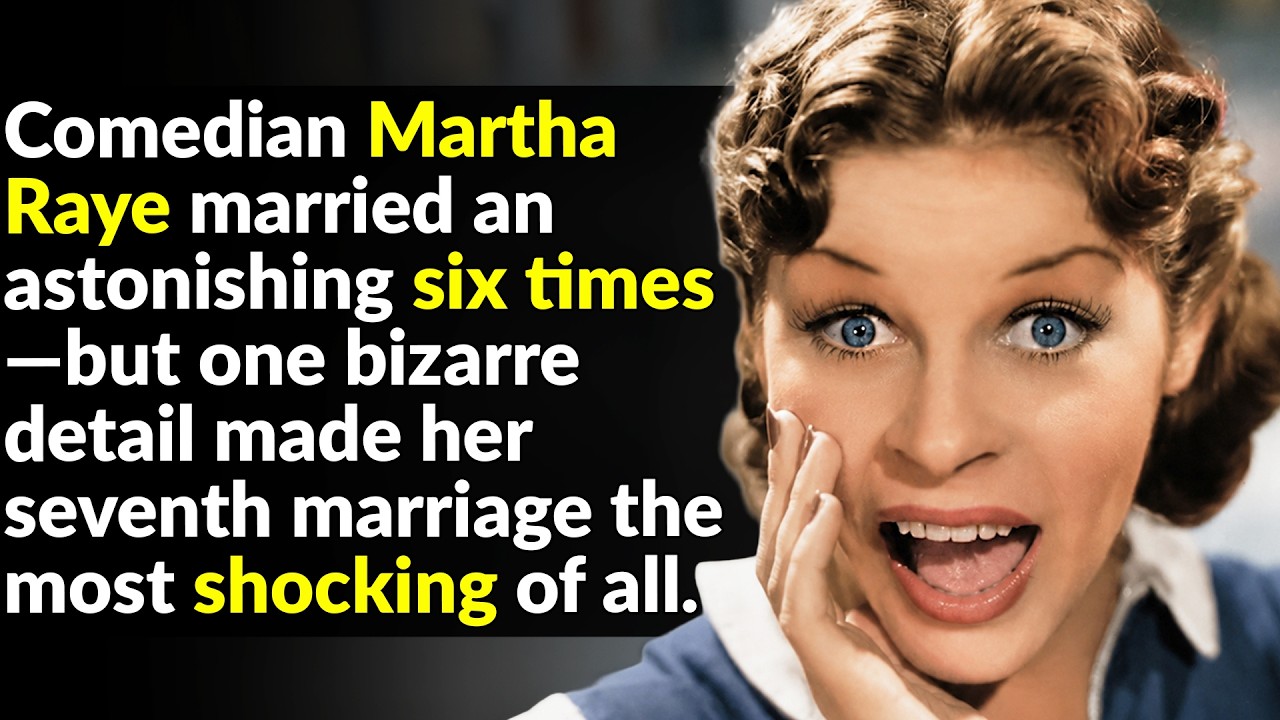
Martha Raye, the beloved comedian whose oversized smile and zany antics made millions laugh, lived a private life so tragic that her final days were marked by tears, not laughter. The woman known as “Big Mouth” to her adoring fans married six times in less than two decades, but it was her seventh marriage at age 75 that proved the most shocking of all—a union to a man 33 years her junior that would ultimately define her heartbreaking final chapter. Born literally on a stage in Butte, Montana, to vaudeville performers Mabel and Peter, Ray entered the world backstage before her mother returned to work just two days later. This inauspicious beginning set the tone for a life spent desperately seeking approval from audiences and partners alike, a pattern that would spiral into a devastating cycle of failed relationships and self-destruction. By the time she was a child, Ray and her brother Bud were already performing as a duo, captivating crowds with her remarkable singing voice and expressive features. But her hunger for the spotlight masked a deep vulnerability that would later be exploited by those closest to her. Her big break came in 1936 when producer Norman Taurog saw her in a nightclub and immediately cast her opposite Bing Crosby in “Rhythm on the Range.” Paramount signed her on the spot, and her enormous smile earned her the lasting nickname “Big Mouth.” She became a caricature of herself in Warner Bros. and Disney cartoons, but behind the laughter, Ray was hiding a painful secret: she had almost no formal schooling and often needed scripts read aloud to her. At just 20 years old, Ray began a tragic pattern of impulsive relationships. She got engaged to orchestra leader Johnny Torrence in 1936, only to break it off two months later. Then came makeup artist Hamilton “Buddy” Westmore, whom she married in May 1937 and divorced four months later, citing extreme cruelty. The spiral continued with three more marriages in just six short years, each ending in heartbreak. Her fourth marriage to Nick Condos in 1940 brought a brief respite. They had a daughter, Melody, and the union lasted longer than any before it. But even as her personal life stabilized temporarily, Ray’s career took a transformative turn when she joined the USO during World War II. She became a beloved figure to troops, flying into combat zones despite a paralyzing fear of flying. Bob Hope once said she was “Florence Nightingale, Dear Abby, and the only singer who could be heard over the artillery fire.” To cope with her terror of flying, Ray began drinking heavily on those trips, a coping mechanism that would eventually consume her. Despite her soaring professional success—including co-starring with Charlie Chaplin in “Monsieur Verdoux” and launching her own popular television show in 1954—her personal life remained a wreck. By 1956, a series of tragedies struck. Her fifth marriage to Edward T. Bagley ended after just two years, and her show was canceled. Alone and depressed, Ray took a handful of sleeping pills in Miami. She was saved just in time, and the outpouring of love from fans gave her hope again. She treasured religious medals sent by strangers and signed off her TV shows with “Goodnight, sisters” in gratitude to the nuns who cared for her. But hope was fleeting. She married for the sixth time to Robert Osborne just months after her hospitalization, and that marriage ended quietly in 1960. For the next 30 years, Ray remained single, focusing on her career and her USO work, which took her to Vietnam and earned her honorary military ranks, including colonel in the Marines and an honorary Green Beret. Yet her health deteriorated. Anemia, blood pressure problems, and circulation issues plagued her. In 1962, she was found unconscious on a Malibu beach. Still, she kept working, guest-starring on shows like “The Love Boat” and even becoming a spokesperson for Polident denture cleaner, using her big mouth as a selling point. The final tragedy unfolded in the early 1990s. After a series of strokes left her wheelchair-bound, Ray met Mark Harris, a 42-year-old who became her manager and press liaison. Within a month, she married him—her seventh husband. Friends and the press were alarmed by the age gap and the speed of the union. In December 1991, Ray had a disturbing breakdown while watching the film “For the Boys,” starring Bette Midler. She sobbed uncontrollably, convinced Midler had stolen her life story and her USO legacy. Urged on by Harris, she sued Midler, but the case was dismissed, damaging Ray’s reputation in Hollywood. Her health continued to fail. Gangrene in her foot led to amputation. On October 19, 1994, Martha Raye died of pneumonia at age 78, still married to Harris. The U. S. Army gave her a final tribute: burial with full military honors at Fort Bragg Main Post Cemetery, a fitting end for a woman who gave so much to the troops. But her personal legacy remains complex. She made countless people laugh, but she only made herself cry, right up to her bitter final moments. The woman who was born to entertain died alone in many ways, a cautionary tale of fame, vulnerability, and the relentless pursuit of love in all the wrong places.
20 August 2026

Bea Arthur Hid A Dark Side For Years… The Truth Surprises Everyone

The woman America knew as the towering, sharp-tongued Dorothy Zbornak on The Golden Girls carried a secret so deeply buried that even her own sons did not learn the full truth until after her death. Bea Arthur, who died in 2009 at age 86, spent 64 years denying a single, startling fact about her past. She was a United States Marine. The paperwork, surfacing without her permission after she passed, reveals a life far more complex than the cold, difficult persona she cultivated for decades. Born Bernice Frankle on May 13, 1922, in New York City to Jewish immigrant parents, she grew into a girl who could not disappear. At five feet nine and a half inches by her teenage years, she learned that height made her a target. She developed humor as armor and sharpness as control. When a person cannot hide, she reasoned, the next best thing is to ensure no one else gets the first word. Her enlistment paperwork, filled out at age 20, listed hobbies that seem jarring now. She played the piano. She also hunted with a . 22 caliber rifle. That detail feels strange because almost nobody would connect it with the elegant, sardonic Dorothy. Yet her height shaped the career waiting for her, casting her as the friend, the aunt, the battle-ax, the comic relief, never the romantic lead. Before acting became her life, Arthur trained as a medical laboratory technician at the Franklin School of Science and Arts in Philadelphia. She worked in a hospital lab, but the pay was too low to support herself. Then came a letter dated February 23, 1943. In it, she explained she was leaving that work because she heard women could now enlist in the Marines. She wrote that she was eager to do whatever was needed. The Marine Corps recruiting slogan in February 1943 was blunt: Be a Marine. Free a man to fight. Every woman who signed up understood the meaning. By the war’s end, more than 20,000 women had earned the title Marine under that message. Bernice Frankle began with typing at headquarters in Washington, but she looked at the situation and decided the corps was not using her well enough. In June 1943, the Marine Corps accepted her request to attend motor transport school at Camp Lejeune. Her reason was direct: based on her previous experience, she believed she could offer more value in motor transport. That small fact says a lot. At 21, she told the United States military that her talents were being placed in the wrong job. Then she proved it. For the next two years, she drove trucks and helped run a dispatch operation at an air station. By the time her service ended, she had become a staff sergeant, a real rank earned in only 30 months by a young woman who had entered from ordinary civilian life. The woman America would later know as a perfectly dressed 60-year-old delivering brutal one-liners spent 1944 in coveralls at a Marine Corps Air Station in North Carolina. During that same period in 1944, she married a fellow Marine named Robert Allan Arthur. The marriage lasted three years and produced no children. She kept the surname, changed the spelling, and carried it into her professional life. That is how Bernice Frankle became Beatrice Arthur, the name that followed her for the rest of her career, coming from a man she was married to for only 36 months in her early twenties. The question that followed her for decades was simple: why deny the Marine Corps service? She was asked about it more than once. Interviewers raised the rumor, and she usually said it was untrue before moving the conversation toward drama school. In some footage, she looks clearly uncomfortable. After her death, the records became public. The denial could no longer hold. One explanation is political. Arthur spent much of her later life as one of the most visibly progressive people in American entertainment. She played Ma Findlay, a character who had an abortion on network television in 1972 in an episode that caused national outrage and affiliate boycotts. She fought seriously for animal rights. She supported gay rights long before it was safe or easy for celebrities to do so. A military record would have complicated the public image people had built around her. She may have preferred to leave that part of her life out of the conversation. Another explanation feels more personal. Arthur was extremely private, and even her family described her that way. She also came from a generation where women’s war service was often treated as a side note. The culture remembered the men who fought and pushed many women into the background even when their service had been demanding and meaningful. So she may have refused to discuss it because she considered it private. She may also have understood that once the story entered public conversation, other people would decide what it meant. There is also the possibility that she was not trying to hide as much as she was refusing to perform the story for strangers. The personnel file gives another clue. One assessment described her as argumentative, overaggressive, officious, and probably a good worker if she had her own way. That was written about a 20-year-old woman by a man whose job was to judge her fitness for service. The language is harsh, but it also reveals the kind of institution she had entered. A young woman who did not defer was easily marked as a problem. The same kind of words followed Arthur for the rest of her life: difficult, prickly, impossible, a pain in the neck. Maybe she simply refused for 64 years to give anyone the paperwork they could use to label her all over again. One of the clearest descriptions of Arthur came from Marsha Posner Williams, a co-producer on The Golden Girls. In 2022, she described Arthur with affection and with no attempt to soften the edges. Arthur was exactly who she was. She hated makeup. She hated shoes. She hated washing her hair. She did not like being touched. She drank a lot of vodka. That was the person people worked with. Then Williams added the professional truth behind it: when a show is a hit and everyone wants it to keep going, people learn to make peace with the situation. No ordinary scandal sits behind her name. Records do not point to financial wrongdoing, arrests, lawsuits, settlements, or abuse claims from colleagues or family. During a long period of cultural re-examination, many public figures from her era were revisited. Nothing serious surfaced about Arthur. What did surface again and again was the same kind of memory: she was hard work. Rue McClanahan explained it well in her memoir and in interviews. Arthur could get fixed on certain things and suddenly dislike them. Nobody could always explain why. One example was simple: Arthur hated when people wore baseball caps backwards. It bothered her deeply. During director interviews, McClanahan said, a man who walked in wearing his cap backwards had almost no chance with Arthur. That leads to the question people still ask most: Arthur could not stand Betty White. The evidence is wide, steady, and mostly comes from people who liked both women. Betty White spoke about it herself in 2011 in interviews and in her book, If You Ask Me. What stands out is how confused she still sounded after so many years. White said she did not know what she had done. White believed her positive attitude made Arthur angry. Sometimes when White was happy, Arthur became furious. People around them had different theories, and several of them seemed possible at the same time. Marcia Posner Williams said Arthur would call her at home to complain about White. On one occasion, Arthur ran into White at a supermarket and later wanted to write her a brutal letter. Jim Valle, another co-producer, gave a simpler theory: Betty White got more applause during cast introductions. Then there were the Emmys. In the first season of The Golden Girls, all four main actresses were nominated. Betty White won. Rue McClanahan later wrote that Arthur was distraught and furious about it. McClanahan won the following year. Estelle Getty won in 1988. Arthur won in 1988 as well. Eventually, each woman received one. Still, the order mattered. Arthur had already been a major television star for 15 years before The Golden Girls existed. Watching White win first may have cut deeper than anyone on the outside could fully understand. The deepest difference may have come from training. Betty White came from live television. Between takes, she would talk to the studio audience, flirt with them, and enjoy their energy. Arthur came from the theater. In her world, the audience stayed beyond the wall of the performance. She did not acknowledge them between takes. She stayed inside the work. Those two traditions lived in the same room for seven years. The way this story is remembered is also uneven. Betty White lived to 99 and became one of the most beloved figures in American entertainment. Arthur died in 2009 before that final wave of Betty White worship fully took over. So the version that survived is simple and damaging: a national treasure was disliked by a woman who is no longer here to explain herself. Every retelling makes Arthur look colder, sharper, and more unreasonable. She never gave her side in a memoir. She never sat down for a long interview about Betty White. The show ended because Arthur ended it. That is the sharpest part of this whole story because it does not arrive with softness or mystery. It arrives with one blunt answer. According to the co-producer, the contracts were finished. The executives went to all four women one by one. Estelle Getty wanted to continue. Rue McClanahan wanted to continue. Betty White wanted to continue. Then they went to Arthur. She refused. The word she placed before that refusal was so direct that the documentary does not even repeat it in full. In the co-producer’s version, that single answer is the reason the show stopped. Her son, Matthew Saks, has given a calmer version of the same ending. He has said his mother wanted to leave because she felt ready for new projects and fresh ideas. After seven years of playing Dorothy, she had reached the end of what she wanted from that role. Both accounts can sit together. Arthur was 69 years old. … Read more

20 August 2026

„Gerald, ich brauche dich, damit du endlich einen echten Beitrag zu diesem Haushalt leistest.“ Das sagte meine Frau an einem Dienstagmorgen im März, während ich frischen Kaffee gekocht hatte. Kein…

„Ist der deiner? ” Sie stand vor der Kaffeemaschine und deutete auf die Kanne. Ich hatte sie vor vierzig Minuten gekocht. Frisch, heiß, genug für uns beide. „Es ist genug da”, sagte ich. Diane stellte die Kanne zurück, verschränkte die Arme und sagte etwas, das ich seither jeden Tag abspiele. Nicht weil es das Schlimmste … Read more

19 August 2026

Fünf Jahre lang vertraute ich meiner Stiefmutter, die das Leben meines gelähmten Vaters vollständig kontrollierte. Dann kam die Routineuntersuchung. Dr. Reeves schloss die Tür und verglich die…

Fünf Jahre lang hatte ich der Frau vertraut, die das Leben meines gelähmten Vaters vollständig kontrollierte. Dann brachte ich ihn zu einer Routineuntersuchung, und die Wahrheit holte mich ein. Dr. Reeves studierte die frischen MRT-Aufnahmen auf seinem leuchtenden Schaukasten, verglich sie mit den alten Traumaberichten aus der Zeit vor fünf Jahren. Er schloss die Tür … Read more

19 August 2026

Um 22:35 Uhr waren die Kerzen auf unserem Jubiläumstisch restlos heruntergebrannt. Mein Mann schickte mir nur: „Dringender Notfall bei einem Großkunden. Wir feiern später.“ Eine Woche darauf lagen…

Um 22:35 Uhr waren die Kerzen auf unserem Jubiläumstisch vollständig heruntergebrannt. Das Einzige, was mein Mann mir an diesem Abend schickte, statt nach Hause zu kommen, war eine E-Mail: „Dringender Notfall bei einem Großkunden. Wir feiern später. “ Ich wusste damals nicht, was ‚später‘ bedeuten würde: dass eine Woche darauf die Scheidungspapiere auf dem Küchentisch … Read more

19 August 2026

Meine Mutter legte die Gabel mitten ins Weihnachtsessen und sagte: „Du musst ausziehen.“ So einfach war das. Drei Jahre hatte ich in diesem Haus gelebt, hatte Miete, Strom und Lebensmittel…

„Du musst ausziehen“, verkündete meine Mutter mitten ins Weihnachtsessen. Sie legte die Gabel hin und sagte es, als würde sie das Wetter kommentieren. Ich blinzelte. „Echt jetzt? “ Sie nickte. „Du bist lange genug hier. Es ist Zeit für Rin und Jess, etwas Abstand zu gewinnen. “ Ich sah Jess an. Sie lächelte, als wäre … Read more

19 August 2026

45 Millionen Euro – die Nachricht kam, während ich im Tantris saß. Mein Sohn hatte auf das Essen bestanden, meine Schwiegertochter lächelte. Dann hielt mich ein Kellner am Ärmel fest:…

45 Millionen Euro – die Bestätigung kam, während ich im Tantris saß. Mein Sohn Markus hatte auf das Fest bestanden: „Vater, du hast es dir verdient. “ Als ich nach dem Anruf meines Anwalts an den Tisch zurückkehrte, hielt mich ein junger Kellner am Ärmel fest. „Entschuldigen Sie, Herr Schmidt“, flüsterte er, das Gesicht angespannt. … Read more

19 August 2026

„Du bist Müll“, sagte mein Vater, als er mich nach der Beerdigung meines Großvaters auf der Treppe abfing. Unten klirrten die Champagnergläser, oben stand ich vor dem Mann, der mich nie als Sohn…

„Du bist Müll“, herrschte mein Vater mich an. Er hatte mich nach der Beerdigung an der Treppe abgefangen, während unten im Festsaal die Champagnergläser klirrten. „Ich habe dich heute nicht erwähnt, Grant. Weißt du, warum? Weil du nutzlos bist. Ich werde deine hohlen Ideale nicht mit 620 Millionen Dollar füttern. Du bist bis Sonnenaufgang aus … Read more

19 August 2026

Der Anwalt hatte kaum das Testament meines Vaters zu Ende gelesen, als mein Bruder Trevor mich vor der ganzen Familie anstarrte. „Bevor wir das Erbe verteilen, sollten wir über die fehlenden…

„Bevor wir das Erbe verteilen, sollten wir über die fehlenden 260. 000 Dollar sprechen“, sagte Trevor. Er trug einen anthrazitfarbenen Anzug, der wahrscheinlich mehr gekostet hatte als meine letzte Hochzeitskampagne. Amanda saß neben ihm, eine Hand besitzergreifend auf seinem Arm. Mama am Kopfende des Tisches, daneben der leere Stuhl meines Vaters. Der Anwalt Richard Morrison … Read more

19 August 2026

„Du willst über Familie reden, Walter? Du hast noch nie einen einzigen Cent von dem verdient, was du zu haben glaubst.“ – Diese Worte meines Schwiegersohns standen vor unserer Familie am Esstisch….

„Du willst über Familie reden, Walter? Du hast noch nie einen einzigen Cent von dem verdient, was du zu haben glaubst. Dein ganzes Leben bist du Lastwagen gefahren und hast von der Großzügigkeit meiner Familie gelebt. “ Mein Schwiegersohn Derek stand vor mir im Wohnzimmer seiner Eltern, laut genug, dass die Caterer in der Küche … Read more

19 August 2026