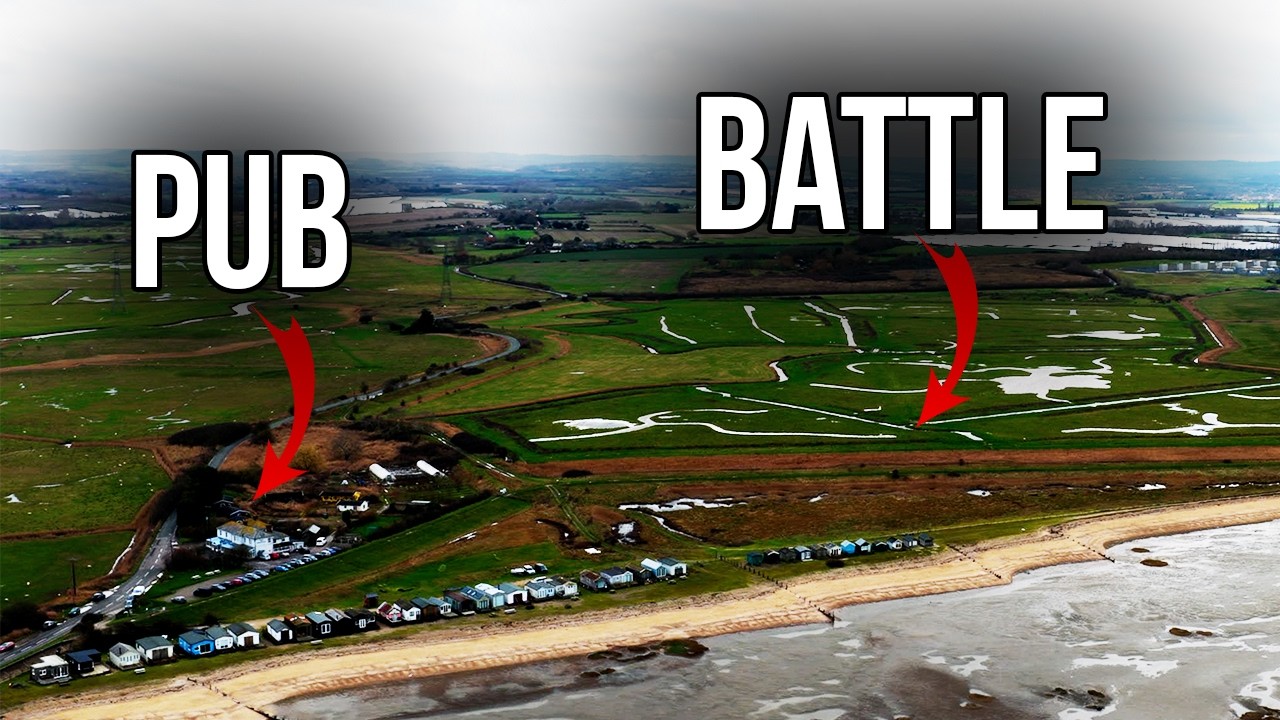
The quiet, flat expanse of Graveney Marsh in Kent, England, looks today like an unassuming patch of windswept countryside, a place where the only sounds are the cries of seabirds and the rustle of reeds. But on the afternoon of September 27, 1940, this soggy, remote landscape became the stage for a firefight that would etch its name into the history books as the last ground engagement between British and enemy forces on mainland British soil. It was a bizarre, almost surreal clash that began in the skies above the Battle of Britain and ended not with a bloody stalemate, but with the vanquished enemy being marched to the local pub for a pint.
The story begins high above the rolling hills of Kent, where the Royal Air Force was locked in a desperate, life-or-death struggle against the Luftwaffe. That day, a massive German raid of around 300 aircraft was heading for London, but they were intercepted by 20 RAF squadrons in a furious aerial melee. Among the German formations was a Junkers Ju 88 A-1 bomber, a cutting-edge aircraft nicknamed “Euler” (Owl), which was only two weeks old.
 This was no ordinary bomber; it was a technological marvel that the British government was desperate to capture intact, specifically for its secret onboard equipment.
The Ju 88 was a versatile and formidable machine, capable of serving as a bomber, night fighter, dive bomber, and reconnaissance platform. Its performance was so impressive that in a dive, it could reportedly outpace the legendary Spitfire. But the real prize for the British was the BZA, an analog computer used for dive bombing—a piece of top-secret technology that could give the Allies a significant advantage.
As the German crew, consisting of Unteroffizier Fritz Ruland, observer Gotthard Richter, radio operator Erwin Richter, and gunner Jakob Reiner, flew their raid, they had no idea they were about to become the center of a desperate ground battle.
The raid on London was a disaster for the Luftwaffe. The RAF’s resistance was fierce, and the German bombers were scattered and harried. The “Euler” was struck by anti-aircraft fire over Upnor Castle, knocking out one of its engines.
As the bomber slowed and fell out of formation, it became easy prey for British fighters. Two Spitfires, piloted by Sergeants Claude Arthur Parsons and Hugh Bowen Morris, swooped in for the kill. Parsons’ combat report details the attack: “I attacked from the rear, giving him a short burst.
I broke to the left and carried out a quarter attack on the port engine. This immediately smoked and stopped.” The bomber was mortally wounded, and the pilot, Ruland, knew he had to get his crippled aircraft down.
 With both engines failing and the aircraft losing altitude rapidly, Ruland made a split-second decision to crash-land on the flat, soft marshland between Faversham and Whitstable. The belly landing was surprisingly smooth; the Ju 88 slid for about 300 yards, shearing off its propellers but coming to rest relatively intact. For the German crew, who had survived the ordeal with only minor injuries—except for radio operator Richter, who had been wounded in both eyes by glass splinters—the immediate priority was clear: they had to destroy their aircraft and its secrets before the British could get their hands on it.
They scrambled out of the wreck, armed with machine guns and a 1 kg charge of TNT with a delay fuse, and began the frantic work of sabotage.
Unbeknownst to the Germans, their crash site was within sight of the Sportsman pub, where a detachment of soldiers from the London Irish Rifles was billeted. These men were part of the first line of defense against a potential German invasion, tasked with patrolling the coast and delaying any enemy advance. For months, they had been waiting for action that never came, but now, a real German plane had practically landed in their backyard.
Lieutenant John Canterfer, who was heading to the pub for a weapons inspection, saw the bomber come down and immediately realized the situation. When he arrived, he found the soldiers had already rushed out, but in their excitement, they had left their rifles behind.
Canterfer’s question to Sergeant Allworth, “They took arms, I hope?” was met with a sheepish, “No, sir. The arms inspection, sir?”
 The soldiers, eager to capture the prize crew, had run out empty-handed. As the British approached the wreck, they were met with a hail of machine-gun fire. The Germans, knowing they had minutes before being overwhelmed, were firing at the approaching troops to buy time to set their explosives.
The British soldiers, armed only with World War I-era SMLE bolt-action rifles, were caught off guard. They had expected a simple surrender, but instead, they found themselves in a genuine firefight—the first of its kind on British soil in centuries.
The battle raged for about 20 minutes, with the British taking cover in the drainage ditches that crisscrossed the marsh. These ditches, normally used for irrigation, became makeshift trenches. Lieutenant Yearsley led a group of men through the muddy channels to get within 50 yards of the bomber, while others laid down covering fire.
The Germans, realizing they were outnumbered and that their pilot had been shot in the foot, finally waved a white cloth in surrender. As the British closed in with fixed bayonets, the German crew emerged from the wreck, their sabotage attempt incomplete. The battle was over, and remarkably, no one had been killed.
The immediate aftermath was as strange as the battle itself. The German crew was taken back to the Sportsman pub, where they were given pints of beer in exchange for souvenirs. One British soldier recalled getting a pair of brass wings from one of the Germans.
 It was a scene that harkened back to a more chivalrous era of warfare, a stark contrast to the brutal conflict raging across the globe. Meanwhile, Lieutenant Canterfer discovered a black box in the wreck that he suspected might be an explosive. In a moment of quick thinking, he hurled it into a drainage ditch, a decision that would later earn him the George Medal for bravery.
There is speculation, however, that the box he threw may have actually been the prized BZA dive-bombing computer, lost forever in the mud.
The captured Ju 88 was later removed to RAF Manston, where it was presumed the British finally got their hands on the secret technology they had been so desperate to acquire. But the story of the Battle of Graveney Marsh was immediately hushed up by the British government, who did not want Nazi Germany to know they had captured one of their advanced aircraft intact. The incident faded into obscurity, known only to the men of the London Irish Rifles and the local residents.
It was only decades later that the full story came to light, and in 2011, surviving veterans of the regiment returned to the marsh to unveil a plaque at the Sportsman pub, commemorating the unlikely battle.
The RAF Air Historical Branch later downplayed the event, stating that “to characterize this skirmish as a battle would be something of an exaggeration.” But for those who were there, and for historians today, it remains a fascinating footnote in World War II history. It was the last time a foreign enemy force engaged British troops in a ground combat on the mainland, and it ended with a handshake and a pint rather than a body bag.
The story of the “Euler” and its crew is a testament to the strange, unpredictable nature of war, where a desperate aerial duel can end in a muddy field, followed by a friendly drink at the local inn.