The 24 Hours of Le Mans has always sold itself on the promise of immortality, the idea that a driver can etch his name into the annals of motorsport history by conquering the most brutal endurance race on Earth. But on June 22, 2013, the Circuit de la Sarthe delivered a brutal reminder that the line between glory and tragedy is measured in millimeters and milliseconds. At 3:09 PM local time, the 81st running of the great race was transformed from a celebration of speed into a scene of profound grief, as Danish driver Allan Simonsen was killed in a crash that looked, to the untrained eye, like a routine racing incident.
The irony of the moment was almost too cruel to comprehend. The 34-year-old Aston Martin driver, who was set to celebrate his 35th birthday the following week, had made a promise to his family just hours before the start. Having become a father for the first time the previous year, Simonsen had pledged to drive with caution, to bring the car home safely, to prioritize survival over victory.
 He knew the risks of Le Mans better than most, having finished on the podium in his debut appearance in 2007 and repeated that success in 2010. This was his seventh time at the legendary circuit, and he knew every secret of the Tertre Rouge corner, the high-speed left-hander that leads onto the Mulsanne Straight.
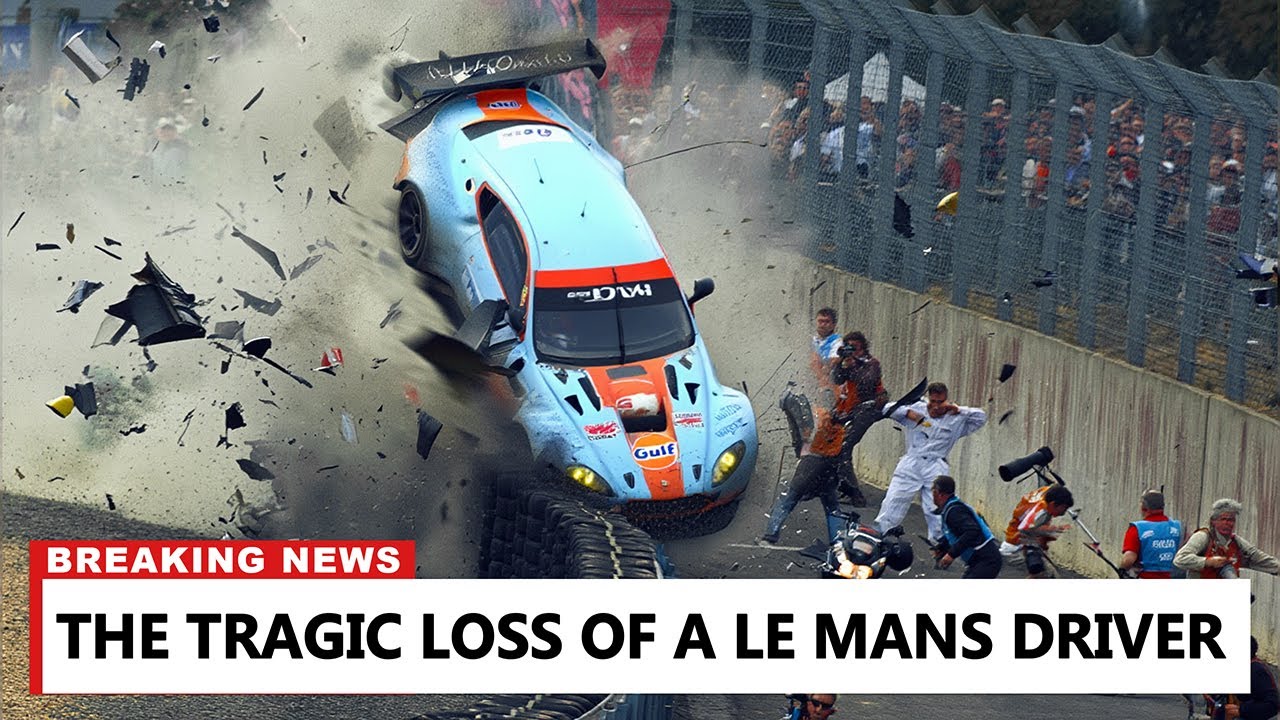
The crash itself was deceptively simple. On the second lap of the race, under damp conditions that had made the track treacherously slick, Simonsen’s number 95 Aston Martin Vantage GTE drifted slightly wide. The left rear tire clipped the painted blue line on the apex, a surface that becomes dangerously slippery when wet.
A small twitch, a quick correction, and then the car veered violently to the right, sliding across the track and hitting the Armco barrier on the outside at a near head-on trajectory. There was no fire, no explosion, no multi-car pileup. From the broadcast angle, it looked like the kind of incident that happens dozens of times during a 24-hour race, a car brushing the wall and pulling off to the side.
The initial response was textbook. Marshals rushed to the scene, and early reports suggested Simonsen was conscious and speaking with medical personnel. The race continued under a yellow flag, and the Danish driver was transported to the infield care center for evaluation.
But minutes later, the atmosphere in the paddock shifted from concern to horror. The official announcement came through the race control channel, and the words hung in the air like a physical weight: Allan Simonsen has passed away because of injuries sustained in an accident at the beginning of the race. He was immediately attended to on the scene by doctors and taken to the infield care center where he succumbed to his injuries.
The news sent shockwaves through the motorsport world. It was the first fatality at Le Mans since 1997, and the first death during a race at the circuit in over a decade. The question on everyone’s lips was the same: How could such an ordinary-looking crash, without fire or chaos, claim the life of a fit, experienced, professional driver?
The answer, as investigators would later determine, lay not in the car but in the environment. The Armco barrier at the Tertre Rouge exit had minimal energy absorption margin because a mature tree sat directly behind the guard rail. There was simply not enough give behind the steel.
The impact pulse stayed brutally short, producing deceleration forces that the human body could not survive, despite the factory-sponsored Aston Martin being equipped with every possible modern piece of safety equipment.
In the immediate aftermath, the Aston Martin team faced an impossible decision. The race was still running, and the family of Allan Simonsen made a specific request: they wanted the team to continue. The family’s wish was to honor his memory in the best way possible, to do what he would have wanted.
Team principal John Gaw addressed the media with a heavy heart, explaining the decision. “The specific request of his family, the team will continue to participate at the 24 Hours of Le Mans in tribute to Allan Simonsen. We ask for your sympathies in a slightly reduced program.
We’ll keep the music a little bit down and we won’t serve any more champagne. And yeah, we’re going to do our very best to win this race for Allan.”
The loss hit the entire paddock, but it struck with particular force in the garage of the sister car, number 97, where Allan’s close friend and teammate Tom Kristensen was preparing to take over driving duties. Kristensen, already a legend with eight Le Mans victories to his name, was aiming for a record ninth win. But now the race had taken on a completely different meaning.
 “There was that intensity and awareness of what had happened, what had taken place,” Kristensen later recalled. “Of course, that was part of it, but I would say that in this situation, it maybe just heightened my focus on the fact that sure, I might have had to win over my father before, but now there was absolutely no way I was going to have to win anymore.”
Kristensen’s words revealed the depth of the emotional burden he carried. He had won his first Le Mans in 1997, dedicating that victory to his father, who had passed away just before the race. Now, sixteen years later, he was being asked to carry the weight of a friend’s memory.
The Danish driver did not just carry that weight; he transformed it into fuel. Over the next 22 hours, Kristensen and his co-drivers Allan McNish and Loïc Duval drove a flawless race, pushing through the darkness and the rain, never faltering, never allowing the grief to break their focus.
When the checkered flag fell on Sunday afternoon, Kristensen had done it. He had claimed his ninth Le Mans victory, cementing his status as the greatest endurance driver in the history of the sport. But the celebration was muted, suffused with sorrow.
In the podium ceremony, Kristensen dedicated the victory to his fallen friend. “This one is for Allan Simonsen,” he said, his voice thick with emotion. “It’s hard.
My father gave me strength, and he knew that I could win this. He’s not here anymore. So, this was really for him.
But he can still claim this victory. This was for Allan Simonsen. A great day of togetherness, unity.”
The victory was a testament to the resilience of the human spirit, but it could not erase the questions that lingered in the air. The crash triggered a civil inquiry under French law, because the Tertre Rouge corner sits on a public road. Local prosecutors and police took charge exactly as they would for a serious road accident.
The investigation examined every frame of footage, every telemetry reading, every component of the car. The conclusion was unanimous: the crash was recorded as a racing incident under difficult early race conditions at a high consequence corner whose barrier and runoff arrangement offered too little energy management.
Anthony Davidson, who was driving the sister Aston Martin, confirmed the treacherous nature of the conditions. He said the most difficult thing was to carry on driving after hearing the news about Allan. “I’ve ran off the curbs myself many times in that same corner,” Davidson said.
“You realize it can happen to anyone. That was a really tough moment for all of us. I think to carry on driving, to carry on pushing in those conditions, that was a really tough moment.”
 The left rear tire was on the painted blue line, which gets very, very slick in damp conditions. It was a tiny mistake, a momentary lapse, but the consequences were catastrophic because of the unforgiving nature of the barrier.
The aftermath of the tragedy brought about tangible changes to the circuit. The Armco barrier at Tertre Rouge was reinforced and moved further back from the track, and additional runoff was added to provide more energy absorption. The tree that had sat directly behind the guard rail, a silent accomplice to the tragedy, was removed.
The changes were a direct response to the facts demanded by the investigation, a recognition that the sport had to do better, that the line between survivable and fatal had to be pushed back further.
Inside the Aston Martin garage, there were moments that never made social media. Mechanics standing still, headsets off, eyes down. A crew chief quietly changing the run plan to match a family’s request.
The cameras caught what the public needed to see: the black bands, the quiet, the Danish flags. The cars kept circulating. Each lap was not closure; it was respect.
The team raced on because the family asked, and the paddock, from Kristensen at the top to friends in GT tents, carried him the only way racers know how: forward.
The grief extended far beyond the Circuit de la Sarthe. In Denmark, the news hit like a thunderbolt. Simonsen was a national hero, a beloved figure who had represented his country with pride on the world stage.
The funeral in Odense was filled with people who had raced with him and people who only waved the flag for him. The entire nation mourned the loss of a champion taken way too soon. In Australia, where Simonsen had spent significant time racing in the V8 Supercars series, the motorsport community marked his passing in the way racers do, by tying his name to the thing he did better than almost anyone.
Since 2014, the Bathurst 12 Hour pole position award has been named the Allan Simonsen Pole Position Trophy. It is a small piece of metal with a big story, a permanent reminder that speed can be a tribute. Every year, when a driver claims that pole, they are not just securing the best starting position; they are honoring a man who lived for the sport and died doing what he loved.
The trophy ensures that his name will never be forgotten, that his legacy will live on in the very fabric of endurance racing.
The 2013 Le Mans race was a watershed moment for the sport. It forced everyone, from officials to drivers to fans, to confront the uncomfortable truth that motorsport, despite all its advancements, remains inherently dangerous. The changes made to the circuit were necessary, but they could not bring back Allan Simonsen.
 They could only ensure that his death was not in vain, that future drivers would be protected by the lessons learned from his tragedy.
Tom Kristensen’s ninth victory was a moment of triumph, but it was also a moment of profound reflection. He had dedicated the win to his father in 1997, and now he was dedicating another to his friend. The pattern was heartbreaking, a reminder that the sport he loved had a dark side.
But it also showed the incredible strength of the human spirit, the ability to channel grief into achievement, to honor the fallen by pushing forward.
As the years have passed, the memory of Allan Simonsen has remained vivid in the minds of those who knew him and those who only knew of him. The Aston Martin team has continued to race, carrying his legacy with them. The circuit at Le Mans has been made safer, but the ghosts of the past still linger.
Every June, when the grid rolls out for the 24 Hours, the sport quietly leaves a seat for the ones who should still be here.
The question that emerged from that tragic day in 2013 remains unanswered: Was this bad luck or proof that even here, with better cars, better barriers, better protocols, the line we all pretend is thick is still thin? The answer won’t satisfy. The changes help, the memory matters, and every June when the grid rolls, the sport quietly leaves a seat for the ones who should still be here.
Allan Simonsen was a champion driver, a devoted father, and a beloved friend. He was taken too soon, but his spirit lives on in every lap, every victory, every moment of courage on the track.
The crash changed Le Mans forever, not just in the physical alterations to the circuit, but in the collective consciousness of the sport. It reminded everyone that the pursuit of speed is a pursuit of risk, and that those who accept that risk deserve our deepest respect. The 2013 race was a testament to the resilience of the human spirit, a demonstration that even in the face of unimaginable grief, the race must go on.
And it did, with Kristensen leading the way, carrying his friend’s memory across the finish line, and into the history books.
Allan Simonsen’s promise to his family was to drive carefully. He did. But the circumstances conspired against him, and the sport lost a shining star.
His legacy is not defined by the crash that took his life, but by the life he lived before it. He was a racer’s racer, a man who loved the sport with every fiber of his being. And in the end, that love was returned by the community that mourned him, honored him, and carried him forward.
The 24 Hours of Le Mans will never be the same, and that is both the tragedy and the tribute of Allan Simonsen’s story.