Prehistoric love was probably messy. Not primitive, not simple, but messy—two people could desire each other, share food, raise children, sleep beside the same fire, become jealous, separate, reunite, or spend 20 years quietly irritating one another. In that sense, very little has changed. But almost everything surrounding the relationship was different.
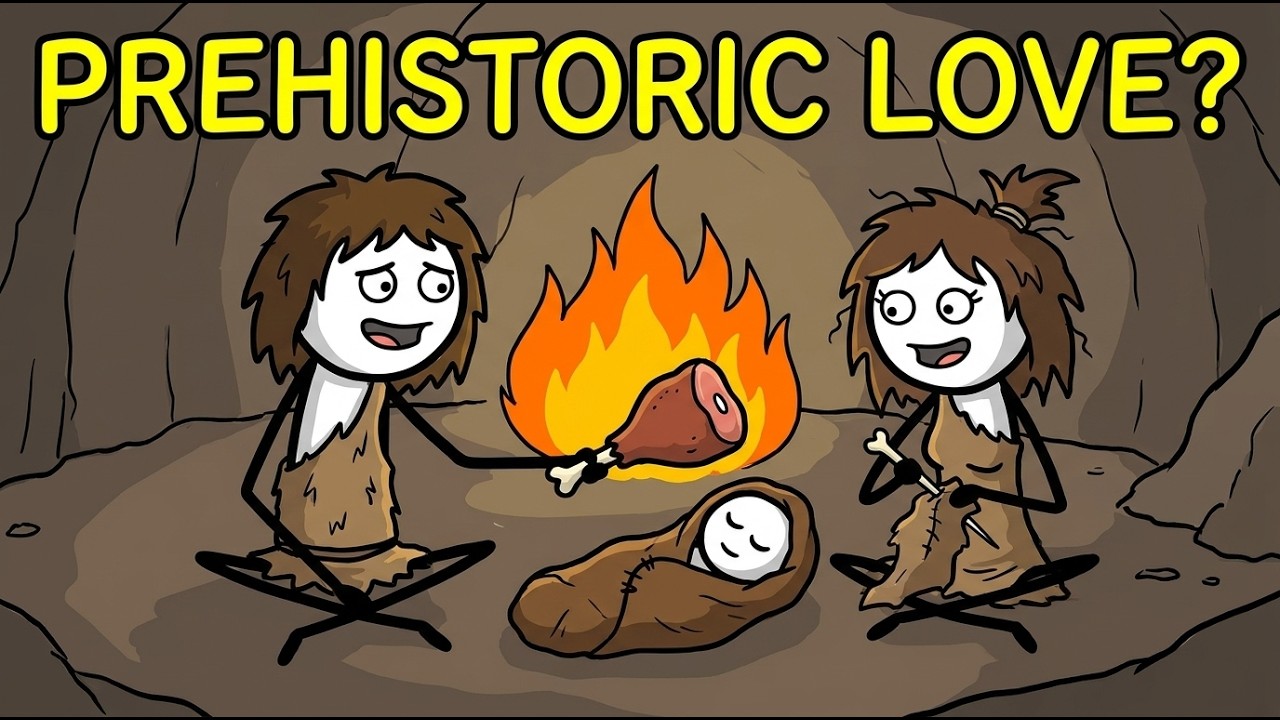
There were no dating apps, marriage certificates, private apartments, or messages left on seen. There were also no strangers. In a small mobile community, everyone knew who had been flirting, fighting, sharing meat, or suddenly choosing the same sleeping place. Privacy was less a human right than an ambitious theory, and a relationship was rarely just about two individuals.
It connected families, food, children, alliances, obligations, and the future of the group. The honest answer to what relationships were actually like in prehistoric times begins with a problem: prehistory is enormous. It covers millions of years, several human species, and societies ranging from small foraging bands to permanent farming villages and early cities. A Neanderthal couple living in Ice Age Eurasia did not follow the same social rules as farmers in Neolithic Anatolia.
People on a tropical coast faced different pressures from mammoth hunters on a cold steppe. Bones do not record romance. Archaeologists can examine burial positions, injuries, food remains, house sizes, ornaments, ancient DNA, and chemical signatures showing where a person grew up, but none of that can confirm that two skeletons once whispered beneath the stars. Love leaves terrible archaeological evidence.
Still, human biology, primate comparison, ancient genomes, and the enormous diversity of recent hunter-gatherer societies allow researchers to build a careful picture. The first surprise is that long-term pair bonds are probably ancient. Humans are unusual primates. Our children develop slowly, need food and protection for years, and remain expensive long after they have mastered the skill of asking why.
Human mothers can also have another dependent child while an older one still requires substantial care. One adult alone can do it, but help changes everything. A long-term partner could contribute food, protection, knowledge, social connections, and direct child care. That does not prove prehistoric humans lived in perfectly faithful lifelong couples, but it suggests that recognizable partnerships, socially acknowledged bonds lasting beyond a sexual encounter, became important deep in human evolution.
Modern hunter-gatherer societies almost universally recognize some form of marriage or long-term union, although the rules vary enormously. Some favor one spouse at a time. Some allow a successful person, usually a man, to have multiple spouses. Some expect unions arranged or encouraged by relatives.
Some give young people greater choice. Divorce may be easy in one society and costly in another. That diversity is the clue. The prehistoric human relationship system was probably flexible rather than fixed.
Pair bonding was common, but strict lifelong monogamy was not necessarily universal. A person might have several partners across a lifetime. Even the word “marriage” must be used carefully. There was no government office.
A union became real because other people recognized it. Partners might begin living together, share food, exchange gifts between families, perform a ritual, or have children. Social recognition mattered because the group had to know who owed what to whom. How did people choose partners?
Sometimes through attraction. Humans had faces, voices, humor, skill, generosity, confidence, smell, and terrible judgment long before civilization. A capable hunter, knowledgeable gatherer, excellent tool maker, patient caregiver, or person with strong social allies could be attractive for obvious reasons. Yet choice was never purely individual.
In a small community, pairing with someone joined networks. Parents, siblings, cousins, elders, and allies could support or oppose a match. A partner from another band might strengthen peaceful contact, create access to distant resources, or provide somewhere to go when local conditions failed. Romance could also be diplomacy wearing body paint.
Hunter-gatherer bands were often fluid. People moved between camps, visited relatives, gathered seasonally, exchanged materials, and maintained relationships across a larger social landscape. Ancient DNA from humans spanning tens of thousands of years suggests that unions between first cousins or closer relatives were generally uncommon in most sampled ancient populations. Tiny groups did not simply reproduce randomly with whoever happened to be standing near the fire.
People often belonged to wider mating networks and appear to have avoided very close relatives. They did not need genetics. They needed memory. Who was whose mother, father, sibling, aunt, uncle, or clan relative could be preserved through names, stories, rules, and repeated contact.
This does not mean incest never happened, but the popular image of every isolated prehistoric band continuously mating within one tiny family is wrong. Once a partnership formed, where did the couple live? There was no universal answer. They might settle near the woman’s relatives, near the man’s, move between both, or join a camp containing a mixture of kin and non-kin.
Recent hunter-gatherer communities often show flexible residence rather than one rigid rule. A couple’s decision could depend on food, labor, conflict, births, deaths, season, and who currently had the more tolerable relatives. That flexibility helped prevent camps from becoming closed clusters of one family. The household was not necessarily a mother, father, and two children occupying a tasteful cave.
The group was the safety net. This becomes obvious when a baby enters the story. Human infants are spectacularly helpless. They cannot cling as effectively as other primate infants, cannot feed themselves, and object loudly to being placed almost anywhere.
Carrying one while collecting food is costly. Nursing requires energy. Sickness, injury, or another pregnancy makes the burden heavier. So humans developed cooperative child care.
Fathers could help, but they were only part of the system. Grandmothers, older siblings, aunts, uncles, cousins, and unrelated campmates could carry, protect, feed, teach, and supervise children. Anthropologists call this allo-parenting. Grandmothers may have been especially important.
Humans are unusual because women often survive for decades after reproduction ends. The prehistoric family was therefore stacked across generations. Archaeological skeletons sometimes show people surviving serious injuries, disabilities, tooth loss, or illness for years. Survival does not prove tenderness.
Care may have involved duty, status, usefulness, or reciprocity, but someone provided food, protection, or physical help. Still, relationships were not a permanent festival of communal affection. Jealousy almost certainly existed. In small groups, suspected infidelity could threaten trust, paternal confidence, alliances, and household cooperation.
There was no anonymous escape from the person involved. Tomorrow, everyone still had to gather food together. Communities likely developed rules about acceptable partners, adultery, courtship, separation, and remarriage. Neither did pair bonding guarantee equality.
Coercion, abduction, assault, and intimate violence are sadly ancient possibilities. Mobile foragers usually owned fewer accumulated material resources than settled farmers. Frequent movement limited how much anyone could store and control. That could reduce extreme wealth inequality and make domination more difficult.
If an arrogant leader became unbearable, others might ignore him, ridicule him, leave camp, or form another group. Mobility gave relationships exits. Not always easy exits, but when land and food were shared through flexible networks, leaving a partner did not automatically mean abandoning a permanent house, field, herd, and entire legal identity. Divorce among many foraging societies has been socially possible and remarriage common.
Serial monogamy may be deeply human—one partner at a time, with terms and conditions subject to change. Polygyny also likely occurred, the socially recognized union of one man with multiple women, but permission is not frequency. Even where polygyny is accepted, most men may have only one partner because supporting multiple households requires resources, skill, and status. Women may also have had multiple partners in some systems.
The safe conclusion is not that prehistoric people were naturally monogamous or naturally promiscuous. They were naturally flexible, then culturally specific. Sex itself served more than reproduction. Humans have sex across the reproductive cycle, during pregnancy, and in contexts where conception is impossible.
Prehistoric people did not have modern concepts of sexual identity. Same-sex attraction and behavior almost certainly existed, but categories such as gay, straight, bisexual, or queer belong to particular cultural histories. The same applies to gender. Archaeologists once had a bad habit of finding weapons and declaring “man,” finding jewelry and declaring “woman.
” Better research combines skeletal biology, DNA, burial context, wear patterns, isotopes, and artifacts. Women hunted in numerous foraging societies. Men gathered, cooked, made tools, or cared for children in different contexts. Relationships were partnerships in production.
One person might bring meat unpredictably while another supplied more reliable plant foods. Generosity was visible. Laziness was visible. Skill was visible.
Cruelty was visible. The person choosing a partner could observe them under hunger, danger, child care, travel, and conflict before making anything resembling a long-term commitment. Prehistoric dating offered fewer restaurants. It provided more relevant data.
People certainly loved. We cannot excavate the sensation, but the human capacity for attachment did not suddenly appear with writing. Grief offers indirect evidence. Careful burials, repeated visits to graves, offerings, pigments, ornaments, and bodies placed close together show that death carried social and emotional meaning.
But a joint burial is not automatically a married couple. They could be siblings, parent and child, companions, or individuals buried centuries apart. Even when ancient DNA identifies a male and female buried side by side with children, biology alone does not describe their emotional lives. Still, imagine the ordinary evidence that vanished: hands touching in darkness, food saved for someone returning late, a familiar voice during childbirth, private jokes, desire, resentment—these behaviors do not fossilize, yet they fit the minds and bonds modern humans inherited from prehistoric ancestors.
Neanderthals complicate the picture further. They cared for injured individuals, lived in small groups, used pigments and ornaments in some contexts, and sometimes buried their dead. Genetic evidence shows that Neanderthals and modern humans interbred on multiple occasions. The event was not clinical.
At least some encounters involved proximity, communication, attraction, coercion, alliance, or ongoing social contact. DNA cannot tell us which, only that the boundary between human groups was occasionally intimate enough to produce descendants. Some of those descendants joined modern human populations, carrying Neanderthal ancestry forward. Prehistoric relationships literally altered our genomes.
Then, around 12,000 years ago in several parts of the world, the social landscape began changing. People increasingly settled, cultivated plants, managed animals, stored food, and built permanent houses. Where agriculture expanded, relationships acquired new pressures. Land could be inherited, animals could be inherited, stored grain could be inherited.
Suddenly, knowing whose children belonged to which lineage had larger economic consequences. Marriage became a mechanism for transferring property, labor, rights, and alliances between households. Families could control whom children married because the union affected fields, herds, and inheritance. A partner was still a person.
They were now also a political arrangement with legs. Some communities developed patrilocal systems, where women moved to live near the husband’s family. Others were matrilocal, with men moving toward the wife’s relatives. Ancient DNA is beginning to expose this diversity.
At a Neolithic cemetery in Gurgy, France, researchers reconstructed large pedigrees extending through several generations. The community was mainly patrilineal and patrilocal—male lines remained while many women arrived from elsewhere. Yet a Neolithic community at Fuja in China was organized around two maternal clans lasting roughly 10 generations. Ancient genomes from Copper Age sites in the Carpathian Basin reveal one community that was relatively diverse and another that was more genetically closed, patrilineal, and patrilocal, despite living in the same broad region and sharing similar material culture.
Similar pottery did not mean similar marriages. Gender inequality appears to have intensified in many later prehistoric farming and herding societies, though not uniformly. Control of livestock, land, warfare, and inheritance could concentrate power among particular male lineages. Women moved between communities in many patrilocal systems, leaving their childhood relatives and becoming dependent on a husband’s household.
That could make marriage a source of security, or a trap. At the same time, women were not passive objects. They produced food, textiles, pottery, children, knowledge, and relationships connecting communities. A woman arriving from another village could carry language, techniques, stories, seeds, styles, and alliances.
Marriage moved culture. Sometimes it moved genes across astonishing distances. Isotope analysis can identify people buried far from the geology where they grew up. Someone left familiar parents, paths, foods, and voices.
Someone entered a household where every custom felt slightly wrong. Someone learned new jokes. Someone never went home. As wealth accumulated, elite relationships became especially strategic.
Powerful families arranged marriages to secure alliances, absorb territory, end conflict, or preserve status. Multiple wives could signal wealth. Control over women’s sexuality could become tied to legitimate inheritance. Love did not disappear.
It simply gained administrators. By the Bronze Age, some ancient communities revealed detailed patrilineal pedigrees, female exogamy, monogamous norms in certain places, and multiple partnering in others. The variety remains the central fact. Were prehistoric relationships better than modern ones?
That question assumes a single prehistoric condition, which never existed. Mobile foragers may sometimes have enjoyed more flexible residence, stronger communal support, less accumulated inequality, and easier separation than people in later agricultural states. They also faced high mortality, interpersonal violence, dangerous childbirth, limited treatment for infection, and social rules that could be coercive. Farming created food surpluses, larger communities, and durable homes, but also enabled property concentration, inherited status, stricter control, and marriages shaped by assets.
Every system solved problems. Every system created new ones. Did people marry for love? Sometimes attraction and affection probably led.
Sometimes families and practical needs did. Most unions likely mixed emotion with economics. Did prehistoric people stay together for life? Some did.
Death separated many early. Others divorced, remarried, or formed new partnerships. Lifelong marriage is easier to achieve when life itself is shorter. What did they fight about?
Food sharing, work, sex, jealousy, relatives, children, movement, risk, and reputation are excellent candidates. In other words, the classics. The deepest difference was not emotion. It was scale.
A modern couple can attempt to build a private world. Prehistoric partners lived inside a visible web of dependence. The spouse mattered, but survival also depended on the spouse’s relatives, your relatives, skilled elders, generous hunters, knowledgeable gatherers, older children, trusted friends, and neighboring groups. Food was affection.
Labor was commitment. Carrying a child was intimacy. Sharing warmth was protection. The person beside you could be lover, co-parent, work partner, political link, traveling companion, nurse, and the reason another family tolerated your presence.
The most honest reconstruction is neither a cave wedding nor a chaotic free-for-all. Prehistoric relationships were recognizable but differently organized. People formed attachments. They desired.
They chose and were chosen. They negotiated obligations. They raised children through networks larger than the pair. Their societies decided which relationships counted, who moved after union, who inherited, who could leave, and whose desires mattered.
Beneath the rules was the same dangerous experiment: trust another person, depend on them, let them depend on you, and build a future without knowing whether winter, sickness, childbirth, conflict, or simple incompatibility will destroy it. The bones cannot tell us who whispered what beside the fire, but they reveal who traveled, who stayed, who was fed, who had children, and who was placed carefully among the dead. The rest has vanished—not because it was unimportant, but because the most important parts of relationships have always been made from things archaeology cannot preserve: a voice, a promise, a touch, and someone returning to the same fire.