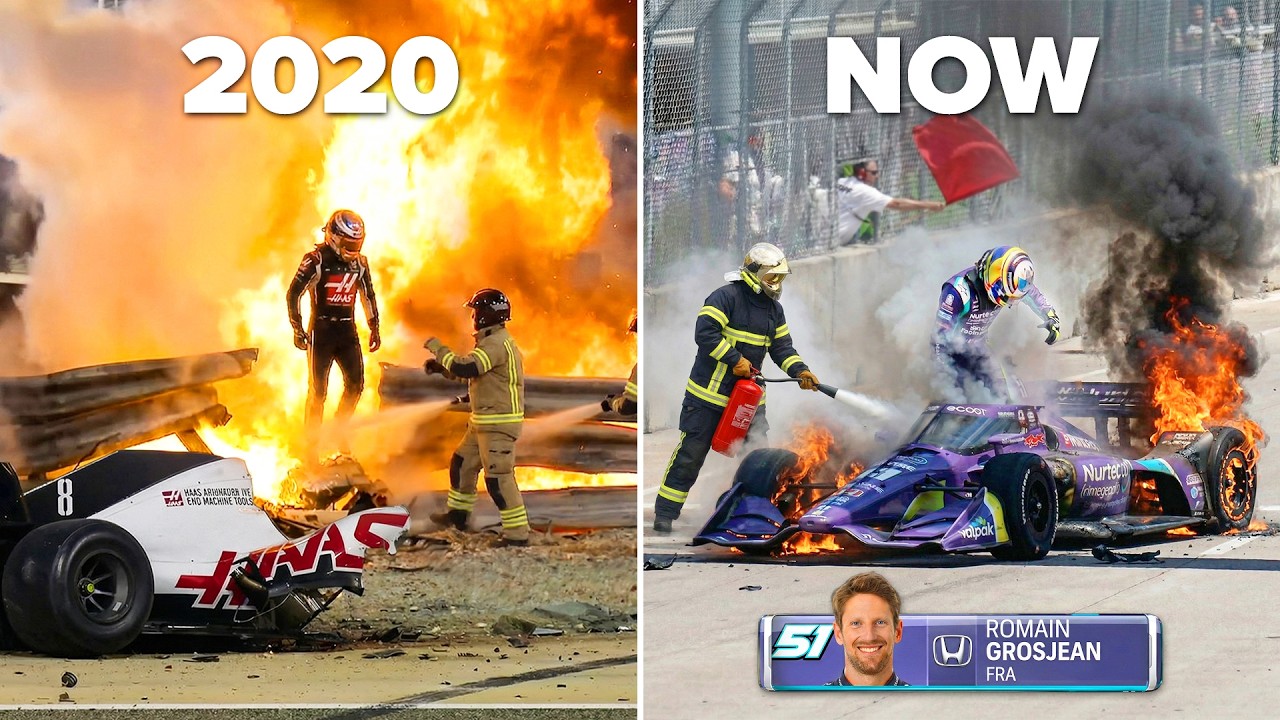
The scorched, carbon-fiber shell of what was once a Formula 1 car lay split in two across the Bahraini tarmac, a plume of orange fire roaring into the desert night sky, as the world held its breath waiting for confirmation that Romain Grosjean had somehow cheated death. It was November 29, 2020, and the sport had just witnessed its most terrifying accident in decades, a violent, fiery explosion that should have been a fatality. Yet, five years later, the narrative has shifted from a harrowing near-miss to a story of improbable survival, relentless reinvention, and a final, emotional reconciliation with the very world that nearly took his life.
The incident unfolded on the very first lap of the Bahrain Grand Prix, a race that was supposed to be a quiet, unremarkable end to a difficult season for the French-Swiss driver. Grosjean, then 34, was fighting for position in the midfield, having started a lowly 19th on the grid in his underperforming Haas. As he swept through the high-speed Turn 3 complex, he moved right to find a gap, unknowingly driving directly into the path of Daniil Kvyat’s AlphaTauri.
 The contact was instantaneous and catastrophic, shearing Grosjean’s car in half and sending the front section, containing the driver, hurtling nose-first into the steel Armco barrier at 192 kilometers per hour.
The impact registered a staggering 56 Gs, a force that turned his body into a projectile weighing nearly four tons. The car sliced through the triple-layer barrier like a knife through paper, wedging itself deep within the metal, while the rear half of the chassis, including the engine and fuel cell, broke away and came to rest in the middle of the track. What followed was the stuff of nightmares: the fuel tank ruptured, spraying high-octane fuel onto the red-hot engine and instantly igniting a massive fireball that engulfed the cockpit where Grosjean was trapped, his left foot pinned beneath the crumpled survival cell.
For 28 agonizing seconds, the world watched in horror as flames consumed the wreckage. Television cameras captured the inferno, and commentators, visibly shaken, struggled to find words as they pleaded for any sign of life. Inside the blaze, Grosjean was fighting for his very existence.
He later recounted how he tried to lift himself out, only to be stopped by the steering wheel, and how he attempted to escape to the right and left before realizing his foot was stuck. The heat was unbearable, and as he looked at the orange glow around him, a terrifying realization dawned: it was fire, and he was burning alive.
In that moment of absolute despair, Grosjean thought of his children. He described the agonizing decision to accept his fate before a primal instinct kicked in, a refusal to die that day. He placed his burning hands into the flames, feeling his gloves melt and the skin on his hands and feet sear, as he desperately tried to free himself.
The Halo device, the very safety innovation he had vocally opposed just a few years earlier, was the only thing keeping the barrier from decapitating him, and it was that titanium ring that ultimately provided the space for him to finally wrench himself free from the inferno.
 The sight of Grosjean emerging from the fire, his overalls charred and smoking, his face blackened with soot, was nothing short of miraculous. He stumbled, then walked, then insisted on making his way to the medical car under his own power, a defiant act of humanity that broadcast to the world that he was alive. He was airlifted to a Bahraini hospital with second-degree burns to the backs of his hands and feet, but remarkably, no broken bones and no internal injuries.
Medical experts and drivers alike called it an act of God, a sentiment echoed by Lewis Hamilton, who dedicated his eventual race win that day to his fallen rival.
The aftermath of the crash sent shockwaves through the FIA, prompting an exhaustive investigation into how the fuel tank had ruptured and why the barrier had failed so catastrophically. The left fuel tank latch was found to have burst open, while the U-shaped headrest had broken loose, nearly trapping Grosjean in the cockpit. These findings led to sweeping safety changes, including stricter load tests for headrests and improved fire-resistant materials for gloves, ensuring that the lessons learned from Grosjean’s brush with death would protect future generations of drivers.
He himself became a convert, stating unequivocally that he would never race a car without the Halo again.
His F1 career, however, was over. The crash prematurely ended his final season with Haas, and he was replaced for the remaining two races by Pietro Fittipaldi. But Grosjean’s story was far from finished.
 Just four months after the crash, he announced his return to racing in the American IndyCar Series, a move that surprised many but perfectly encapsulated his unyielding spirit. He joined Dale Coyne Racing and immediately proved his mettle, securing multiple podiums and finishing 15th in the championship, earning the nickname “The Phoenix” for his ability to rise from the ashes.
His time in IndyCar was a mixed bag of brilliance and frustration. A move to the powerhouse Andretti Autosport for 2022 and 2023 promised title contention but ended in a messy divorce, with Grosjean even taking legal action over his dismissal. Yet, he never lost his passion for racing, finding a new home in the World Endurance Championship with Lamborghini and even competing at the legendary 24 Hours of Le Mans.
Alongside his racing, he built a successful sim racing team, RHG Esports, and remained a beloved figure in the motorsport community, known for his candor and his incredible story of survival.
The most poignant chapter of his comeback, however, was written in 2025, when he was invited back to Formula 1 for a private test with his old team, Haas, at the Mugello circuit in Italy. It was a chance to close the circle, to drive the new generation of cars that had evolved so much since his fiery exit. The event was an emotional homecoming, with his former race engineer, Ayao Komatsu, now the team principal, overseeing the session.
Grosjean’s helmet for the test was designed by his children, a poignant reminder of the family he almost left behind, and a symbol of how far he had come.
 As of the end of 2025, Grosjean’s story has taken yet another turn, proving that his resilience knows no bounds. He has signed a full-time return to IndyCar with Dale Coyne Racing for the 2026 season, a team he describes as the “Haas of IndyCar,” fittingly returning to his roots. In the season opener, he qualified sixth and finished eighth, immediately silencing any doubters who questioned whether he could still compete at the highest level.
His return coincides with the IndyCar debut of another former F1 driver, Mick Schumacher, creating a fascinating narrative of redemption and new beginnings.
Romain Grosjean’s journey from the fiery wreckage of Bahrain to his triumphant return to racing is not just a story of survival; it is a testament to the human spirit’s capacity for courage, adaptation, and forgiveness. He faced his own mortality in the most visceral way possible and chose to keep racing. He confronted the sport that nearly killed him and found a way to embrace it again, even returning to the very team and circuit that witnessed his darkest moment.
His legacy is no longer defined by the crash, but by how he chose to live after it, a phoenix who truly rose from the flames.


