A patient lying on an emergency room gurney, bleeding heavily, needs a blood transfusion within minutes. But that bag of blood hanging beside the bed can either save a life or end one, depending on whether it matches the patient’s blood type. The difference rests on four letters and a plus-or-minus sign, a system that appears deceptively simple yet remains one of the most puzzling and deeply rooted biological mysteries in human evolution. The story of blood transfusion begins long before modern medicine understood its dangers.
In 1667, French physician Jean-Baptiste Denis transfused calf’s blood into a mentally ill man, reasoning that the animal’s calm temperament might settle his violent fits. The patient appeared to improve after the first transfusion, but died after a later one. Denis faced a murder accusation, though an investigation later found the man’s widow had been slowly poisoning her husband with arsenic. He was cleared, but the damage was done.
Blood transfusion was effectively banned in France for more than a century. During the 1800s, physicians resumed human-to-human transfusions with inconsistent and often fatal results. Some patients recovered, while others went into violent shock and died within minutes. No one could detect a pattern, and the outcomes seemed almost random.
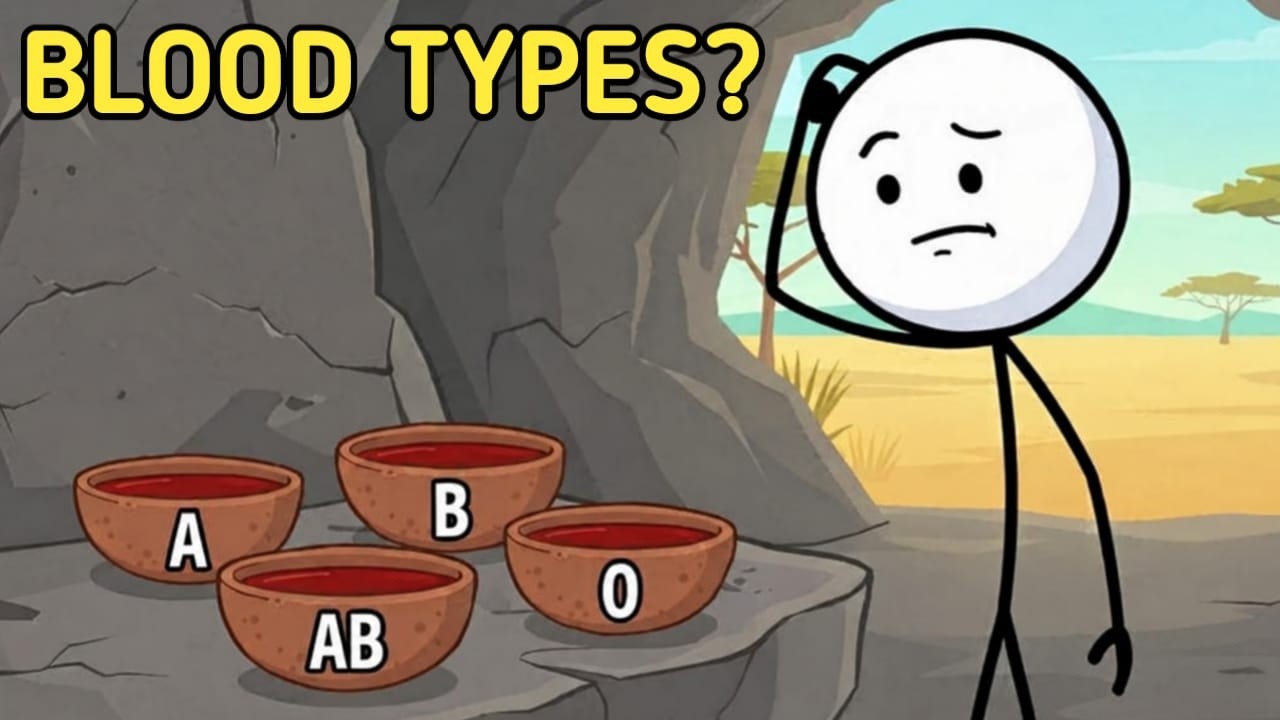
In 1900, Austrian scientist Karl Landsteiner began mixing blood samples from his colleagues in test tubes. Some mixed smoothly while others clumped instantly, with red cells clotting together like curdled milk. He recognized that blood fell into distinct incompatible categories, which he named A, B, and O. A fourth type, AB, was identified a year later by his students.
Landsteiner had solved a deadly medical mystery that had been claiming patients for two centuries, and he received the Nobel Prize for the discovery in 1930. But his work raised a deeper question. Why do blood types exist at all? Organs like the liver and heart do not come in multiple incompatible varieties, so why should blood?
Scientists have since proposed several evolutionary explanations, each tied to a different disease that shaped human survival. One major factor is malaria. Blood type O appears to offer some protection against the most severe form of malaria caused by the parasite Plasmodium falciparum. Red blood cells with A or B antigens clump together more easily in blood vessels, a process known as rosetting, which can block blood flow and turn a survivable infection into a deadly one.
Type O cells resist this clumping, giving their carriers an advantage in malaria-endemic regions over thousands of years. The second factor is cholera, where the advantage reverses. Type O blood, helpful against malaria, appears to leave people more vulnerable to severe cholera. The toxin produced by Vibrio cholerae binds more efficiently to type O cells, causing more violent and dehydrating illness.
In regions with repeated cholera outbreaks, particularly parts of South Asia, evolutionary pressure favored A and B types instead. A third possible factor is smallpox, though the evidence is less certain. Some research suggests that individuals with type A blood may have faced higher smallpox mortality, possibly because the virus shares surface similarities with the A antigen, allowing it to evade immune detection more easily. Scientists remain unsure how strong that effect was compared to malaria and cholera, but the pattern consistently points to the same conclusion.
The antigens carried on red blood cells quietly determined which invisible diseases an ancestor was more likely to survive. Blood type, however, is not exclusively human. The genetic machinery behind the ABO system is at least 20 million years old. Chimpanzees and gorillas carry their own versions, and some researchers argue that the basic blood type variation existed in a common ancestor long before anything resembling modern humans walked upright.
Blood type is not a human invention but a molecular fossil inherited across an enormous stretch of evolutionary time. There is an additional layer to the story. When modern humans expanded out of Africa, they interbred with Neanderthals and Denisovans. Some immune-related genetic variations circulating in human populations today, including elements connected to blood chemistry, appear to trace back to that interbreeding with other hominin species that no longer exist.
The blood running through human veins now carries DNA borrowed from extinct branches of humanity. The science of blood type evolution was eventually hijacked by popular pseudoscience. In the 1990s, naturopath Peter D’Adamo published a book claiming that blood type should dictate diet, suggesting that type O individuals were hunters requiring high protein and type A individuals were farmers thriving on vegetables. The book sold millions of copies.
Rigorous testing since then has found no meaningful connection between blood type and dietary response. Large-scale studies have failed to support the theory, which borrowed real evolutionary science and repackaged it into an unsupported wellness myth. The real scientific story continues. In 2020, during the early spread of COVID-19, several studies suggested a possible link between blood type and infection severity.
Early data hinted that type A patients may have faced somewhat higher risk while type O patients faced somewhat lower risk. Later research complicated that picture, and scientists are still determining how much of the signal was real versus statistical noise. The fact that the question arose during a live global pandemic demonstrates that blood type research is far from settled. The blood type on a donor card is not a random biological accident.
It is a living historical record, shaped by malaria in one region, cholera in another, smallpox somewhere else, and genetic inheritance older than the human species itself. The history runs from a poisoned man in 17th century France, through Landsteiner’s test tubes in 1900, through disease-scarred coastlines and river deltas, back to a shared ancestor with chimpanzees millions of years before the concept of blood existed. Every transfusion depends on a system that has been quietly negotiated between humans and pathogens for hundreds of thousands of years.


