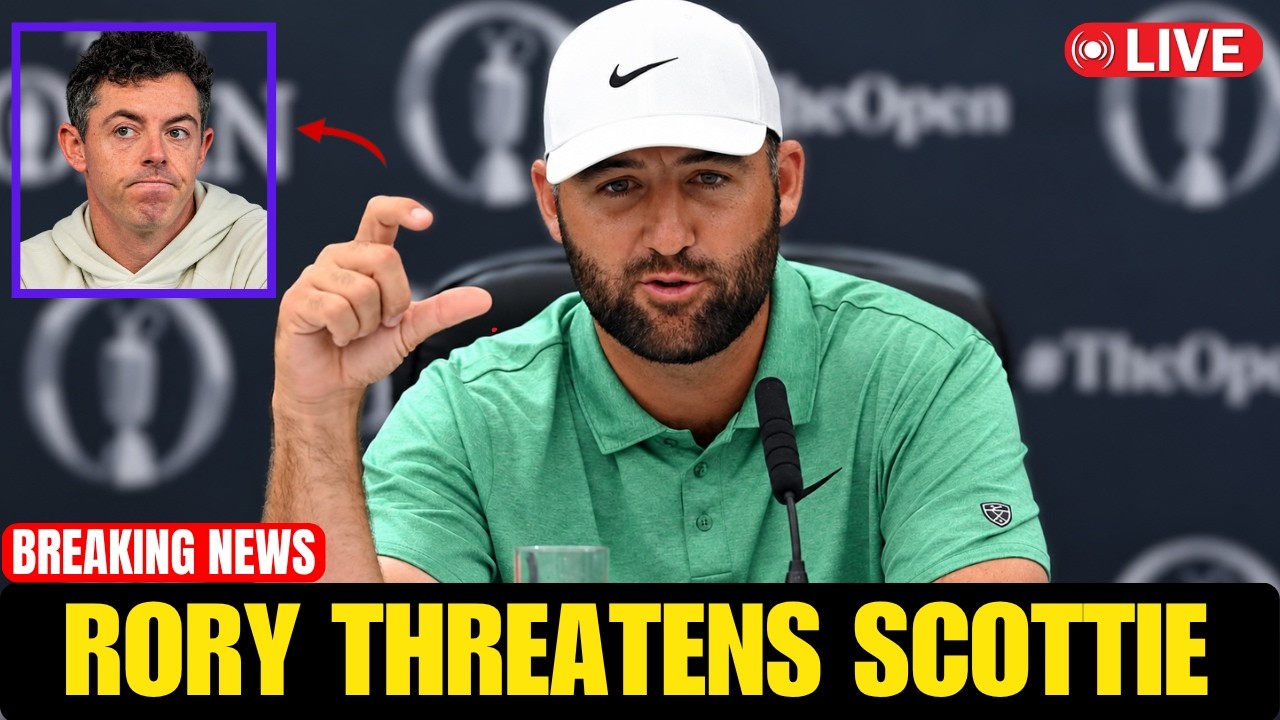
The debate tearing through the locker rooms at East Lake Golf Club has escalated into a full-blown civil war, threatening to upend the most predictable coronation in modern golf history. Scottie Scheffler, the reigning world number one and a man who has treated the PGA Tour’s top honor like a personal possession for four consecutive years, is facing a threat he never anticipated.
It is not coming from a statistical anomaly or a surge in ball-striking data. It is coming from the only trophy that matters in the eyes of his most important critics: his peers.
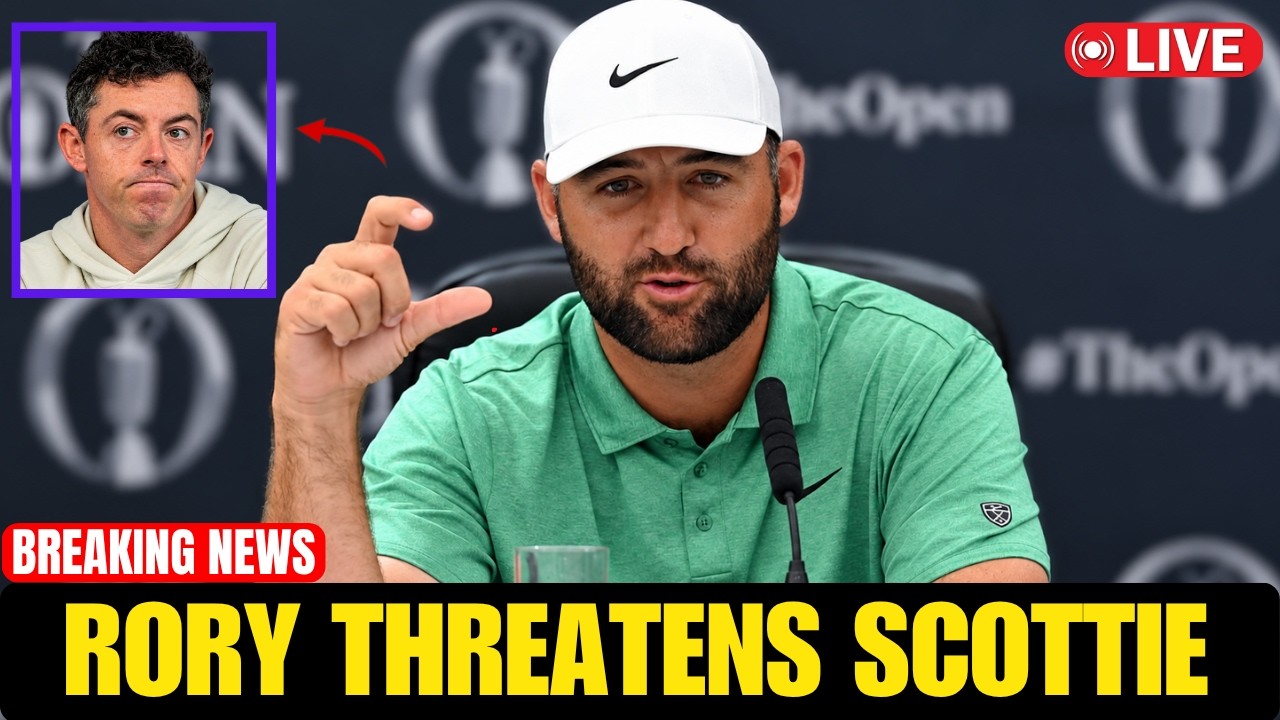 Rory McIlroy, a man who spent the second half of the season openly confessing he was lost in a desert of his own swing mechanics, has emerged as the biggest rival to Scheffler’s fifth consecutive Jack Nicklaus Award, not despite his struggles, but because of what he achieved before they began. McIlroy won the Masters. That singular fact, that green jacket weighing heavier than any strokes-gained metric, has fractured the locker room and thrown the outcome of the season’s final honor into genuine doubt.
Scheffler entered the 2026 season as the undisputed king of golf. He held the title of world number one, had won the Tour’s highest honor four years in a row, and was coming off a six-win season that made a fifth crown seem like a mere formality. The expectation was simple: dominate again.
But the narrative that followed him from January to August was one of subtle regression.
He won three times, not six. He did not win a major, finishing second at Augusta and tied for fourth at both the U. S.
Open and the Open Championship. For the first time in years, the critics whispered of an “off-year” that was really just a masterpiece of beautiful numbers in a world that measures men by Sunday hardware.
But the truth, buried under the narrative of missing major derbies, is that Scheffler’s 2026 season was statistically one of the most dominant ever recorded on the PGA Tour. He finished with three wins, five runner-up finishes, and 13 top-five finishes in just 20 official starts. He made 19 cuts.
Every single time he walked off a course with a weekend tee time, he left with a top-25 finish slot.
He led the Tour in scoring average at 68. 619. He was first in strokes gained total at 2.
249. He was first in strokes gained tee to green at 1. 674.
He topped the Tour with 13 top-10 finishes. He earned $30,937,525, obliterating the single-season earnings record previously held by a young man named Tiger Woods.
His victory at the Tour Championship was a masterclass in clutch play. He entered the final round three shots behind Viktor Hovland. He then executed the final round of his life, posting a four-under 66 to win by three shots.
He claimed his second FedEx Cup title in three years, and in the process, his post-victory thoughts turned not to the trophy, but to the man whose record he had just shattered. He surpassed Tiger Woods on the all-time PGA Tour money list, bringing his career total to $130,390,661.
Tiger, a man who rarely dips into the current conversation, sent a message of congratulations. “Three wins, five runner-ups, and finishing the season number one. Those are some numbers to be proud of.
Incredible consistency all season long. Congrats on a historic season, Scotty.”
That was the crux of it. Imperious consistency, a historic final win, and yet a deep-seated murmur began to grow. Because while Scheffler was stacking seasons, McIlroy was stacking moments that went into the lore of the game.
Rory McIlroy won the Masters in April. He then threw on a second green jacket, defending his title, becoming just the fourth player in the history to win back-to-back Masters, joining a list of clay-bearing demigods: Jack Nicklaus, Tiger Woods, Nick Faldo, and Rory McIlroy.
 It was his sixth major championship. It was his first successful defense of a major title. And for most of the rest of the season, that was the only thing of substance he could point to.
McIlroy’s 2026 campaign was instead defined by two diametrically distinct halves. In the first half, he was the champion of the season. In the second half, he was a lost collector of missed cuts.
After Augusta, he played a limited schedule, admitting he was so far away from where he needed to be. His performance at the FedEx St. Jude was the lowlight, an 8-over par finish that had him stepping out of the gates like a zombie with a golf club.
He confessed he felt lost with his gravity swing.
He barely played. He skipped events. He fell short of the 15-event minimum requirement that allows a player to vote for the trophy.
He was in danger of becoming an afterthought, a one-glory man being propped up by a day of rain shots in Georgia.
But then came the playoffs. McIlroy found a ghost, a soul, a driver—whatever you want to call it—and he began to roar. He finished third at the BMW Championship, charging from a five-shot deficit to tie for the lead before falling short in a playoff.
At the Tour Championship, he shot a final round 63, a scintillating display of clay slide iron play, to finish solo, sitting at 11-under tie for fourth place.
The statistics tell the tale of two entirely different geographic seasons. Scheffler won three times. McIlroy won once, a major.
And that is where the rubber begins to scorch the asphalt.
The PGA Tour Player of the Year is not handed to the player with the highest strokes gained. It is not a formula. It is a vote.
It is debated behind closed doors, cast by the men who daub themselves onto the grass every week. The eligibility requires that voter has played at least 15 events that count for the money list. These players, the rebels of the fairways, are the ones who decide who holds the Jack Nicklaus Award silhouette.
When Todd Lewis of the Golf Channel did the rare thing, he asked the players at the Tour Championship who should win. The answers were not so much illuminating as they were conflicted, a boxing match between two definitions of excellence.
“Consistency is really hard out here,” one player said. “To play consistently well all the time, being in contention all the time is very, very difficult. To put yourself in that position all the time, to me is most impressive.”
It is a statement for the sheer grind of greatness that does not fade, winless or leisure. It painted Scheffler’s 2026 as a Sunday marathon.
 But then came the counter-punch from a rival. “I think it’s got to go off the wins. I would say Rory’s year has been incredible, winning a major and then having that moment in Augusta.
And then Scotty’s obviously won a couple times, but just shown a lot of good golf over the season. It’s not going to be an easy decision.”
The message, loud and clear, was that if enough voters value the single, most glorious piece of silver in the game, McIlroy could steal this award from right under Scheffler’s feet.
Here is where the story becomes even more complicated. Rory McIlroy publicly believes he does not deserve the award. He said so, flat out.
“No, I’m not the Player of the Year. No chance. Scotty is,” McIlroy said before the BMW Championship.
He went on to joke about Scheffler’s putting, a function of his mooning at Scheffler’s advantage. “Well, there’s 2 weeks to go, but I first hand watched him for the first 2 days last week, and he, if he keeps playing like that, if he gains nine strokes on the greens every week, sometimes,” he said.
McIlroy’s humility, in a world filled with self-aggrandizers, is a breath of fresh, but it does not change the math. The voters, the players, might decide they value the magnitude of the Masters trophy over the volume of top-20 finishes. The field is not a two-horse race.
Wyndham Clark, the pole on which some of the game’s fractures rest, won his second U. S. Open title and is also in the conversation.
He has two wins on the year. Cameron Young won The Players Championship and the Cadillac.
Matt Fitzpatrick won three times. Chris Gotterup won three times. The draw is crowded with trophies, but only McIlroy can lay claim to the major and the history of the career Grand Slam.
Scheffler’s case is a broadcast of a construct. He is the best player in the world. He has not missed in the top 10 in over a year.
He doesn’t have a bad few weeks. He just shows up and he devours. His consistency is a lie of its own doing, the kind of boring actuality that wins awards, until it catches a bowling ball in the form of a major champion.
“Sustained statistical excellence does not win the Player of the Year award. Trophies win the Player of the Year award. These are players who know how good he is.
That’s not a debate that he is the best player in golf right now. That’s not in doubt. But the Player of the Year award is not for the best statistical performance.
It’s for the man who actually wins the trophies that the guys in the locker room want,” hammered Eamon Lynch on the Golf Channel, dripping with the premise of a tied voter.
 Scheffler was close in all the majors. He finished T-2 at the Masters—a green jacket denied—then tie at fourth, then tie at fourth again. The finals of the house of the majors.
In the history of a career, those are memories. To a voter, they are just losses.
The problem for Scottie is the final. Scheffler, for all his machine-like and mesmerizing focus, is a polarizer to be missed. He is universally respected and the vote will not be a referendum on his character.
Yet McIlroy is a beloved figure of the game, a three-time winner of of the tour’s award. The players understand the difficulty of Masters repeat, the sacrifice of the Champion Golfer. There is a reason Rory is considered a bridge between the old and the new generations, and there is a reason he is historically treated as the face of the tour.
The Playoffs erased any doubt about Scheffler’s ability to close. He won the St. Jude by eight strokes.
He fought through hand, foot, and mouth disease at the BMW Championship, blistering his hands and throat, to finish tenth. Then he controlled that Tour Championship. Athlon Sports gave him an A grade.
The margin he used to win the FedEx title didn’t come from a flash but from the method of his toil.
But the damage had been done. The only argument that could delay his fifth crown was the winner of the green jacket, the man who has graced the covers of golf magazines for two decades.
Scottie Scheffler is the best player in the world. He has been for years. He broke arguably the most unbreakable financial record in the history of the sport.
He won the Tour Championship for the second time in three years, he led the tour in any category that matters.
But the Player of the Year award is a vote of the people, and a voting is a chorus of passions. Some like the machine. Some like the artist.
Some will check the box of the man who Tennessee at Augusta National.
If McIlroy walks away with the 2026 PGA Tour Player of the Year award, it will not be because he had the best statistical campaign. He will have been hidden by the tour because he won the one tournament that told a story of green jackets and immortality. He will have a campaign built on a Saturday in April rather than the schedule of an entire five-month summer.
The grave is now in the eyes of the locker room. The ballots are being cast on servers at Tour headquarters. The golf world holds its breath, awaiting the verdict of which being granted the Jack trophy.
The one player who has nothing to prove is the one who will be watching the result with most fears. A win for Rory means a legacy of majors over consistency. An award for Scottie means the best player, not the flashes man, might finally win the argument.
Day the vote comes, the answer will be revealed, but no matter which side the coin flips on, the debate has already split the player into two. The official title will be announced, capturing the head of golf, but the true winner in the past several weeks has seen the line between greatness and infallibility, and it has been drawn.