Roughly 5,300 years ago in what is now southeastern Ecuador, someone cracked open a leathery pod growing from the trunk of a short, twisted rainforest tree. Inside were rows of pale, wet seeds wrapped in sweet white pulp. Bitten raw, those seeds are intensely bitter and astringent—nothing like the food they would eventually become. The species is Theobroma cacao, a name Carl Linnaeus gave in 1753.
Theobroma means “food of the gods,” and Linnaeus reportedly was extremely fond of chocolate. The tree itself is one of the most demanding crops on Earth, growing only within about 20 degrees of the equator, requiring constant warmth, high humidity, heavy rainfall, and protection from wind and direct sun. Its reproductive strategy is equally improbable. Cacao flowers grow directly from the trunk and main branches, a trait called cauliflory.
The flowers are roughly one centimeter across, with a specialized hood that blocks most pollinators. Only tiny midges of the genus Forcipomyia—measuring 1 to 3 millimeters long—can fit inside to pollinate them. A single tree can produce up to 10,000 flowers in a year, but only 1 to 5 percent get pollinated. The tree aborts more than half of the resulting tiny fruit through a process called cherelle wilt.
Typically, one tree yields just 30 to 50 mature pods annually. For decades, historians assumed chocolate was invented in Mesoamerica by the Olmec, Maya, or Aztec. A 2018 study published in Nature Ecology and Evolution by archaeobotanist Sonia Zarrillo and a team including Francisco Valdez rewrote that timeline. Analyzing artifacts from the Santa Ana La Florida site in southeastern Ecuador, part of the Mayo-Chinchipe culture, they found starch grains, theobromine residues, and ancient DNA fragments matching Theobroma cacao.
The evidence dated cacao use there to roughly 3300 BC, about 500 years earlier than the oldest Mesoamerican evidence. Genetics point the same direction. A 2008 study led by Juan Carlos Motamayor, published in PLoS One, analyzed over 1,200 cacao samples and identified 10 distinct genetic clusters. The greatest genetic diversity was not in Mesoamerica but in the upper Amazon region spanning Ecuador, Peru, and Colombia.
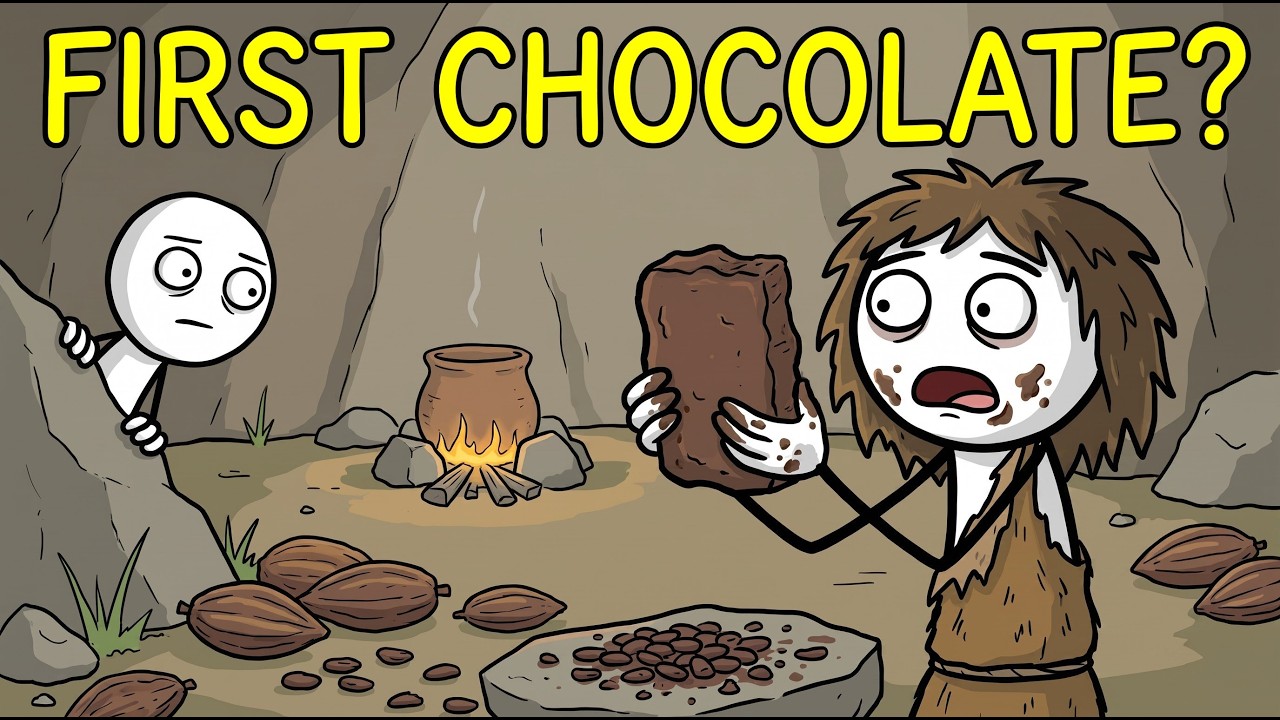
Cacao originated there, was used there first, and later traveled north. The central puzzle is how anyone figured out that bitter, unpleasant seeds could become chocolate. The likely answer begins with the pulp. The sweet white pulp around the seeds tastes something like a cross between lychee and mango, and it ferments almost immediately in tropical heat.
Wild yeasts convert the sugars into alcohol, producing a mildly alcoholic drink that people likely consumed for thousands of years before anyone cared about the seeds. The accidental discovery came when seeds were left in the fermenting pulp for several days. Yeasts produce alcohol first, then acetic acid bacteria convert it into vinegar. Temperatures inside a fermenting pile can reach 50 degrees Celsius.
That combination of heat and acid kills the embryo inside the seed, rupturing cell walls and allowing enzymes to mix for the first time. Proteins break down into free amino acids, polyphenols oxidize, bitterness decreases, and beans turn brown. Without fermentation, there is no chocolate flavor. Roasting then completes the transformation through the Maillard reaction, the same chemical process that creates bread crust and steak flavor.
The result is over 600 identified volatile flavor compounds—more than vanilla’s 200 or strawberry’s 300. None of these exist in the raw bean. Every one is built by fermentation and heat. By the time cacao reached Mesoamerica, it had already become significant.
At the Olmec site of San Lorenzo Tenochtitlan in modern-day Veracruz, Mexico, archaeologist Ann Cyphers and her team published a study in the Proceedings of the National Academy of Sciences in 2011. They found theobromine residues in pottery dating to roughly 1800 to 1000 BC. The Olmec were consuming cacao in liquid form nearly 3,800 years ago. Linguists Lyle Campbell and Terrence Kaufman argued in a 1976 paper that the word cacao traces back to the Proto-Mixe-Zoquean language spoken by the Olmec, with a reconstructed root word of kakawa.
Other language families, including Mayan and Nahuatl, borrowed this term. The Olmec did not just drink cacao—they named it. The Maya transformed cacao into something sacred. They consumed it as a frothy beverage, hot or cold, mixed with chili peppers, vanilla, achiote, ground maize, honey, and sometimes flowers.
Sugar did not exist in the Americas, so the drink was bitter and spicy. The foam was considered the spiritual essence of the drink, created by pouring from a tall vessel at head height into another on the ground. Maya artists depicted this process on pottery. The Princeton Vase, dating to roughly 670 to 750 AD and held at the Princeton University Art Museum, shows exactly this pouring scene.
Epigrapher David Stuart deciphered the Maya glyph for cacao—read as kakawa—and found it on hundreds of vessels. In 1984, archaeologist Richard Adams excavated a tomb at Rio Azul in Guatemala dated to roughly 460 to 480 AD, finding a vessel with the cacao glyph and a screw-top lid. W. Jeffrey Hurst at the Hershey Foods Technical Center used high-performance liquid chromatography to confirm theobromine and caffeine in the vessel’s residue.
The confirmation, published in American Antiquity in 1990, proved the Maya were drinking chocolate 1,500 years ago—matching the glyphs with chemistry. For the Maya, cacao was currency, ritual offering, and divine substance. It appears in the Popol Vuh, the K’iche’ Maya creation narrative. It was consumed at feasts, marriages, and funerals.
The Aztecs took it further. A surviving 1545 Tlaxcala price document records exact exchange rates: one turkey cost about 100 cacao beans, one large tomato cost one bean, a small rabbit cost 30 beans, and a cotton cloak cost 65 to 300 beans depending on quality. Counterfeiting was documented—sellers would fill empty cacao shells with amaranth dough or mud and seal them shut. Franciscan friar Bernardino de Sahagún described this fraud in the Florentine Codex.
Montezuma II reportedly consumed up to 50 goblets of cacao drink a day in gold cups, according to Bernal Díaz del Castillo. The number is likely exaggerated, but the point stands: cacao was for the powerful. The Codex Mendoza records that the province of Soconusco delivered 200 cargas of cacao beans as tribute to Tenochtitlan, each cargo roughly 24,000 beans—nearly 5 million beans from a single province. The first European to encounter cacao was not Cortez but Christopher Columbus.
On August 15, 1502, during his fourth voyage, his crew intercepted a Maya trading canoe off the island of Guanaja. His son Ferdinand wrote that the traders scrambled to pick up fallen cacao beans “as if an eye had fallen. ” Columbus thought they were strange almonds and sailed away without realizing their value. Cortez arrived in Tenochtitlan in November 1519, witnessed the cacao economy, and wrote to King Charles V describing a fruit resembling almonds that was used as money throughout the land.
The Spanish did not initially love the drink. Jesuit historian Jose de Acosta wrote in 1590 that the foam was “disgusting to those who are not acquainted with it” and that it was “more a drink for pigs than for humanity”—then admitted those accustomed to it became addicted. The Spanish added something Mesoamericans never had: sugar. Spanish monks are widely credited with mixing cane sugar and cinnamon into the bitter drink.
Historical tradition in Aragon records that in 1534, Cistercian monks at the Monasterio de Piedra boiled ground cacao with cane sugar and cinnamon, possibly creating the first European-style hot chocolate. Spain kept chocolate relatively close for about a century, spreading it through royal marriages and diplomatic gifts. When Anne of Austria married Louis XIII of France in 1615, chocolate came to the French court. By 1657, the first chocolate house opened in London.
In 1693, White’s Chocolate House opened on St. James’s Street, eventually becoming White’s Club, the oldest gentlemen’s club in London still operating. Jonathan Swift called White’s “the bane of half the English nobility” because young heirs lost entire estates at its gambling tables. For over a century, the Catholic Church debated whether chocolate broke the Lenten fast.
In 1662, Pope Alexander VII reportedly settled it with the phrase liquidum non frangit jejunum—liquids do not break the fast. Chocolate was approved. Until the early 1800s, chocolate was still a drink. In 1828, Dutch chemist Coenraad Johannes van Houten invented a hydraulic cocoa press that squeezed out most of the cocoa butter, leaving a dry cake that could be ground into cocoa powder.
He also treated his cocoa with alkaline salts, a technique now called Dutching, which mellowed bitterness and improved solubility. In 1847, J. S. Fry and Sons in Bristol, England, remixed cocoa powder with melted cocoa butter and sugar to create a paste that could be poured into a mold.
The first modern chocolate bar was born. For roughly 3,800 years, chocolate had been liquid. Fry made it solid. A detail worth noting: Fry, Cadbury, and Rowntree’s—the three companies that dominated British chocolate for a century—were all founded by Quakers.
Barred from universities and public office, they turned to business. As temperance supporters, they championed chocolate as a wholesome alternative to gin. In 1875, Swiss chocolatier Daniel Peter in Vevey solved the problem of adding milk without rancidity. His neighbor Henri Nestlé had developed condensed milk with most of the water removed.
Peter combined it with chocolate, and milk chocolate was born. In 1879, Rodolphe Lindt reportedly left a chocolate mixing machine running over a weekend. When he returned Monday, the chocolate had been stirred, heated, and aerated for days—and it was smooth. The process, which Lindt called conching, evaporates volatile acids, distributes cocoa butter evenly, and reduces particle size below 20 microns, the threshold where the tongue cannot detect graininess.
Before Lindt, chocolate was gritty. After Lindt, chocolate melted. Cocoa butter melts between 34 and 38 degrees Celsius. Human body temperature is 37 degrees.
Chocolate is one of the only foods solid at room temperature that melts precisely at mouth temperature. Getting that melt right requires tempering, carefully heating and cooling chocolate to encourage one specific crystal form out of six possible structures. Only form V produces the glossy sheen, snap, and melt that defines quality chocolate. Get it wrong and the chocolate develops a white film called bloom.
The chemistry runs deeper. Among chocolate’s 600-plus flavor compounds is theobromine, a mild stimulant weaker than caffeine but with a longer half-life. There is anandamide, an endocannabinoid that binds to the same brain receptors as THC—though in very small amounts. There is phenylethylamine, sometimes called the love chemical, and flavanols like epicatechin and catechin, studied for their cardiovascular effects.
Theobromine is also why chocolate is dangerous to dogs. Dogs metabolize it roughly 10 times more slowly than humans, taking about 17. 5 hours to process it. The compound accumulates to toxic levels in their systems.
So how did humans invent chocolate? They did not set out to. The most probable sequence: roughly 5,300 years ago in the upper Amazon, people cracked open pods for the sweet pulp. The pulp fermented naturally.
Someone left seeds in the fermenting pulp long enough for the chemistry inside the beans to change. They dried them, ground them, heated them, and tasted something that had not existed before. Was it a single invention? Almost certainly not.
The evidence points to cacao being used independently in South America and Mesoamerica, with distinct cultural developments in each region. The probability of a single invention in one place is low—perhaps 15 to 20 percent. The more likely scenario, at roughly 80 to 85 percent probability, is that people in the upper Amazon figured out the basics first around 3300 BC, and that knowledge or the plant itself traveled north over centuries. The entire story hinges on fermentation.
Without it, there is no chocolate flavor, no Maillard reaction, no transformation. The invention of chocolate is, at its core, the invention of patience—leaving seeds alone in the heat and letting microbes run the chemistry. The word itself still remembers the origins. Linguists Karen Dakin and Søren Wichmann argued in a 2000 paper in Ancient Mesoamerica that the English word chocolate likely traces to an Eastern Nahuatl term, chikolatl, derived from chikoli, the hooked wooden stick used to froth the drink.
At its etymological root, chocolate means “beaten beverage. ” The name is not about flavor. It is about the foam.


