The Great Pyramid of Giza remained the tallest human-made structure on Earth for over 3,700 years. Built with copper chisels, hemp rope, and human muscle, it contains roughly 2. 3 million stone blocks, some weighing up to 80 tons. It aligns to true north within 1/15 of a degree, achieved without GPS.
But this monument was not a sudden stroke of genius. It was the result of a century of engineering failures that came before it. Around 2,670 BC, Pharaoh Djoser commissioned his vizier, Imhotep, to build something never seen before. Instead of the traditional mud-brick mastaba tomb, Imhotep stacked six decreasing stone tiers on top of each other.
This created the Step Pyramid at Saqqara, the first pyramid ever built and the first massive structure constructed entirely from stone. Beneath it, Imhotep engineered a network of tunnels and chambers extending over 3. 5 miles into the bedrock. His success was so complete that Egyptians later deified him, turning the architect into a god.
Roughly 150 years later, Pharaoh Sneferu, father of Khufu, took the throne and sought perfection: a true pyramid with smooth, unbroken sides. His first attempt, the Meidum pyramid, began as a step pyramid but was modified to fill in the steps. The outer casing did not bond with the inner core, leading to a catastrophic collapse that left thousands of tons of carved stone sliding off the structure. Today it stands as a ruined tower surrounded by rubble.
Sneferu tried again at Dahshur. His builders set an initial steep angle of 54 degrees, but the immense weight compressed the inner chambers and cracked the walls. Mid-construction, architects desperately reduced the angle to 43 degrees to save the structure. The result is the Bent Pyramid, a permanent monument to a terrifying miscalculation, with a sudden kink halfway up its face.
Sneferu ordered a third attempt. This time, his architects started the Red Pyramid at a safe 43-degree angle from the first block. It became the first successful true pyramid in human history, with a stable geometry and unbroken surface. When the Great Pyramid was built, Khufu did not have to guess.
He inherited a century of trial and error, and his monument is the perfection of that accumulated failure. The logistics of the Great Pyramid were staggering. The majority of its core limestone was quarried on the Giza Plateau itself, with workers using dolerite hammers and wooden wedges soaked in water to split stone. The outer casing, however, came from Tura, across the Nile River.
Every casing stone had to be quarried, loaded onto boats, and ferried across the water. The hardest material, granite for the King’s Chamber, came from Aswan, over 900 kilometers south of Giza. Workers cut it using copper saws and abrasive quartz sand, a process of agonizing friction. The 80-ton blocks were then dragged onto massive wooden barges and floated down the Nile, using the annual flood as a temporary highway.
For decades, historians questioned why the pyramids were built far from the Nile in inhospitable desert. In 2024, a team of researchers led by Dr. Emen Goneim at the University of North Carolina Wilmington published a study in Communications Earth and Environment that answered this question. Using advanced radar satellite imagery, soil coring, and geophysical surveys, they found a massive extinct branch of the Nile buried under the sand.
They named it the Ahramat branch, and it flowed roughly 64 kilometers long, up to 700 meters wide, and 8 meters deep, directly past the pyramids. The researchers mapped 31 pyramids built over a thousand years, all constructed in a chain along the banks of this vanished waterway. The long causeways extending from the pyramids into the desert, which had long puzzled archaeologists, ended precisely at the ancient riverbanks. They were not just roads; they were docks.
They were ancient harbors where barges carrying 80-ton granite blocks could pull directly up to the construction site. Around 4,200 years ago, a massive drought caused the Ahramat branch to silt up and disappear beneath the Sahara. The builders were not dragging stones across endless sand. They were unloading them on a bustling waterfront property.
Even with a river delivering stone, workers still had to drag blocks from the dock to the pyramid base. This posed a problem of friction on dry sand. In 2014, physicists from the University of Amsterdam published a study in Physical Review Letters that revealed the solution. The Egyptians poured water onto the sand.
The water created capillary bridges between sand grains, doubling the sand’s stiffness and allowing sledges to glide over a firm track. Wetting the sand cut the required pulling force exactly in half. This was not just a lab discovery. A wall painting from the tomb of Djehutihotep, dating to roughly 1880 BC, shows 172 men hauling a colossal statue on a wooden sledge, with a single man pouring liquid from a jar directly onto the sand in front of the runners.
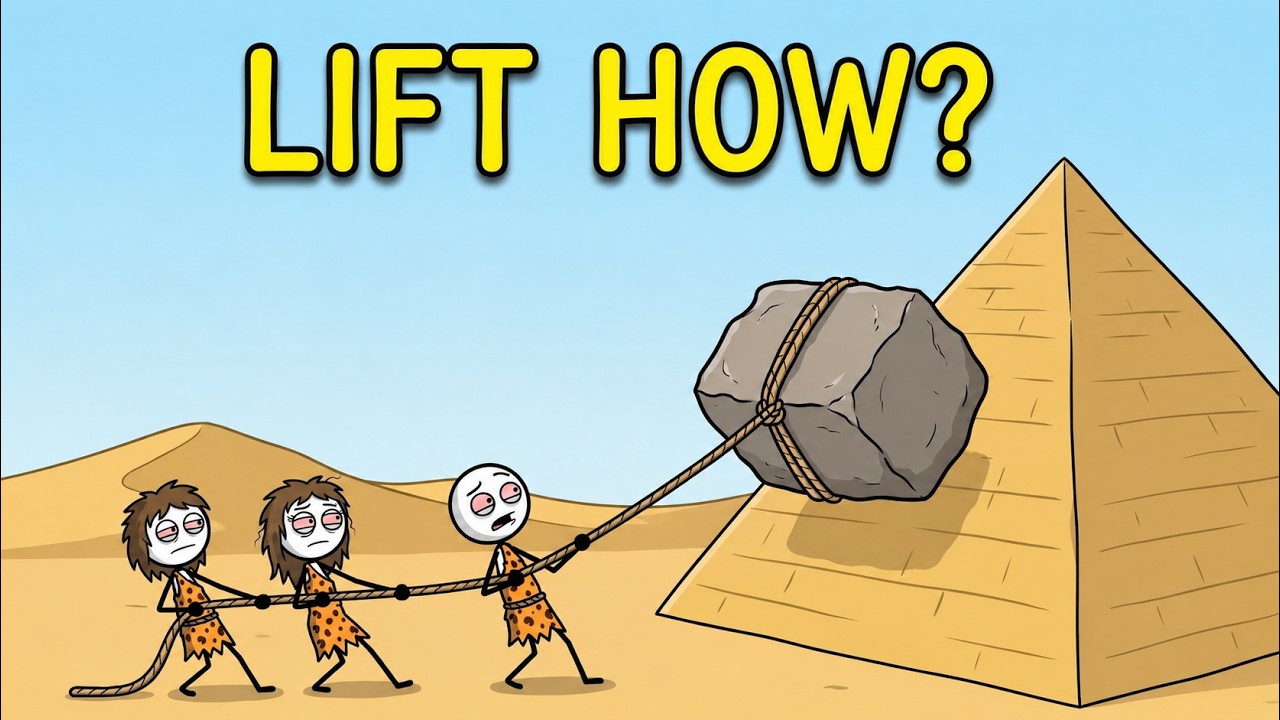
For decades, this was interpreted as a religious ritual. It was physics. How the heaviest stones were lifted to the top of the 146-meter structure remains the most heavily debated question in Egyptology. The traditional theory of a straight external ramp would require more raw material than the pyramid itself.
In 2008, architect Jean-Pierre Houdin proposed an internal ramp spiraling up inside the outer walls. In 2026, researchers published models in NPJ Heritage Science supporting an integrated edge ramp system using the stepped tiers of the inner core with counterweights and levers. Physical proof of advanced ramp mechanics was found in 2018 at the Hatnub Alabaster Quarry. Archaeologists discovered an intact ramp system dating back to the time of Khufu.
It featured a steep central ramp flanked by staircases, with massive post holes carved into rock. Workers wrapped ropes around wooden posts and pulled down while walking down the stairs, using mechanical advantage to drag stones up slopes as steep as 20 percent. The idea that the pyramids were built by slaves is a myth, first popularized by the Greek historian Herodotus around 450 BC. In the 1990s, archaeologists discovered the workers’ cemetery at Giza, right next to the pyramids.
Proximity to the pharaoh’s tomb was the ultimate status symbol in ancient Egypt, and these workers were buried with honor, provisioned with jars of beer and bread for the afterlife. Excavators also found the lost city of Heit el-Ghurab, a massive organized urban center with administrative buildings, bakeries, breweries, and barracks, designed to feed and house thousands of laborers. In 2013, archaeologists found the diary of Merer at Wadi el-Jarf on the Red Sea. This 4,500-year-old papyrus logbook, the oldest known papyrus with text in the world, records his crew’s daily activities transporting Tura limestone by boat to the Horizon of Khufu, which is the Great Pyramid.
It is the only first-hand contemporaneous account of the pyramid’s construction ever found. Most of the workforce consisted of Egyptian farmers recruited through the corvée system. During the Nile flood, when their fields were underwater, they owed a labor tax to the state. They came to Giza, worked their shifts, and went home.
In hidden relieving chambers above the King’s Chamber, workers painted graffiti naming their work gangs. One gang called themselves the Friends of Khufu gang. The work was still brutally destructive to the human body. Bioarchaeologists examining skeletons from the workers’ cemetery found severe degenerative joint disease, osteoarthritis, and lumbar compression fractures.
Workers suffered fractures of the ulna, radius, and fibula, classic injuries from limbs crushed by slipping stones or snapping ropes. However, the vast majority of these broken bones show signs of proper healing and careful realignment. Archaeologists even found evidence of surgical amputations where the patient lived for years afterward. Slaves were not given complex surgery.
The state invested in keeping these valuable workers alive. To fuel this machine, workers ate a diet rich in high-quality animal protein. Excavations uncovered over 175,000 animal bones, with the state slaughtering thousands of cattle and sheep every week. Researchers believe the laborers ate better than the average peasant.
Despite modern technology like ground-penetrating radar and thermal scans, no surviving blueprints have been found. The builders took their final secrets into the sand. The idea that aliens built the pyramids is a form of modern arrogance, implying that ancient humans were too stupid to stack stones into the sky. The evidence shows they did it with raw human muscle, copper chisels, wet sand, and an organizational capacity rivaling modern nation-states.
They failed repeatedly for a century, collapsed their own monuments, and cracked the walls of their tombs. Then they learned from the rubble and built a mountain that would outlast time itself.