The “puppy license” is a temporary form of social immunity granted to young animals that allows them to break rules that would normally trigger serious discipline within their social groups—and it operates across an enormous range of species. In wolf packs and domestic dog groups, pups can bite the ears of dominant adults, steal food, and interrupt social interactions without facing meaningful punishment. The worst reaction they typically receive is a firm nudge or a theatrical grumble, rather than the violent correction an adult would face for the same behavior. This license generally expires around four to five months of age.
At that point, a young wolf suddenly discovers that the rules it has been ignoring throughout its early life actually apply—usually through a much harsher correction than anything it experienced before. The leading explanation for this leniency relates to brain development and learning. Young animals are still mastering social cues, coordination, and communication signals. If every clumsy mistake triggered adult-level punishment, the result would be a population of anxious, poorly socialized adults who never properly learned how their own species’ social systems function.
The leniency extends beyond rule-breaking into physical aggression. Adult male chimpanzees, which can be brutally violent toward rival males, show dramatically different behavior around infants—including infants that are not biologically their own. Documented cases show adult males tolerating infants climbing on them, pulling their fur, and even slapping at their faces during play. Researchers call this “infant handling tolerance,” and it appears specifically and consistently around juveniles.
This raises the question of how animals recognize a baby in the first place. The answer is a concept called “baby schema” or kinderschema. This describes a cluster of physical features—large head relative to body size, big eyes, round face, short limbs—that triggers automatic caretaking responses across a huge range of species, including humans. Researchers describe it as a deeply wired visual trigger that essentially short-circuits aggressive or dismissive responses and replaces them with gentleness and protectiveness.
The trigger does not always stay contained within a single species. Big eyes and a round face on an unrelated animal can partially activate the same response. Lion social structure provides one of the most dramatic examples of differentiated treatment toward young. When a new male takes over a pride, he will often kill cubs from the previous male’s bloodline.
At first glance this appears to contradict the pattern of animals being gentle toward young, but it actually reinforces the underlying point. The treatment young lions receive is based on relatedness and investment, not on a universal species-wide gentleness rule. Cubs that share the new male’s genetics receive intense protection and tolerance, while cubs that do not receive the exact opposite treatment. This reveals that differentiated treatment is not a blanket softness toward anything small and helpless.
It is a highly specific calculation tied to genetic investment. Animal gentleness toward young is deeply connected to investment, relatedness, and survival calculus. Where that calculus favors protection, animals display extraordinary gentleness. Where it does not, behavior can look shockingly brutal by human standards—and both extremes come from the same underlying evolutionary logic.
Alloparenting, where animals other than the biological parents take on caretaking responsibilities, offers another window into this behavior. In elephant herds, calves are looked after by an entire network of related females. These “auntie” elephants show measurably different behavior toward calves compared to how they interact with adults. They tolerate clumsy bumping, allow calves to use their bodies for shade and protection, and actively position themselves to shield calves from threats during travel.
Adult elephants do not extend this same protective behavior toward other adults nearly as readily. Meerkat colonies operate with a strict social hierarchy enforced through aggressive posturing, yet the moment pups are involved, that hierarchy seems to take a backseat. Subordinate meerkats that might otherwise face aggression from dominant members receive notable patience while performing babysitting duties—standing guard over pups while the rest of the group forages, sometimes going without food themselves to maintain the watch. Colony survival depends heavily on pups reaching adulthood, and that priority appears to reshape social dynamics around anything categorized as vulnerable juvenile.
Play behavior shows a similar pattern. Adult dogs playing with other adults engage in fairly even reciprocal play. The same adult dog playing with a puppy will deliberately handicap itself—exaggerating its movements, slowing down its chase speed, and allowing the puppy to win contests it would never win against a similarly sized adult. Researchers refer to this as self-handicapping, and it shows up across an impressively wide range of species, including primates, big cats in captivity, and some birds.
Many species also use different vocalizations when communicating with juveniles: softer tones, simplified call structures, and repeated patterns. This mirrors how human parents instinctively shift into a higher-pitched, slower, more exaggerated speech pattern when talking to infants—something researchers call “parentese. ” Studies on certain primate and bird species have identified comparable vocal adjustments directed at young individuals, suggesting this instinct may be a widespread evolutionary pattern rather than a uniquely human quirk. The behavior of predators toward prey young provides one of the most counterintuitive examples.
There are documented cases, admittedly inconsistent and species-dependent, of certain predators showing reduced predatory drive toward very young prey animals compared to adults—sometimes ignoring an extremely young animal entirely in favor of pursuing an adult that requires significantly more effort to catch. Some researchers suggest this may relate to underdeveloped scent or movement cues in very young prey failing to fully trigger a predator’s hunting response. Others suggest it might be inconsistent individual variation rather than any kind of deliberate sparing. Either way, it serves as a reminder that not every piece fits into one tidy explanation.
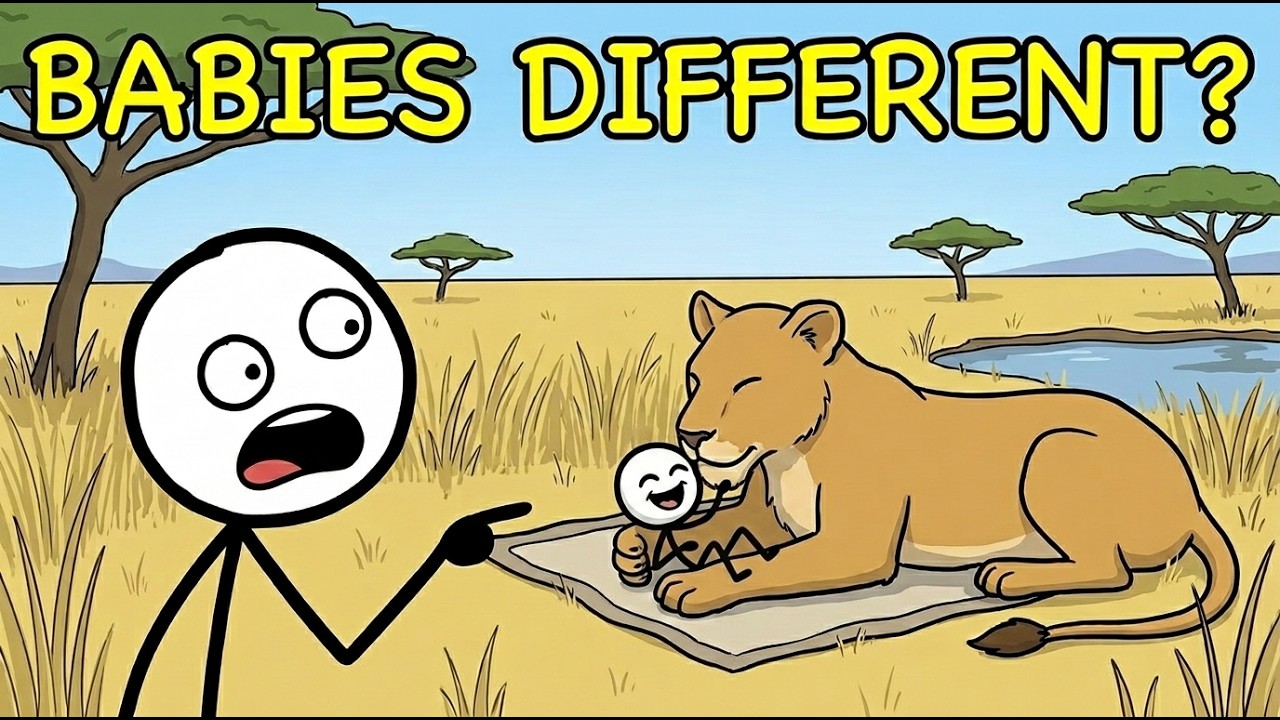
Cross-species baby tolerance returns to the baby schema concept. Documented cases include dogs nursing orphaned kittens, cats caring for orphaned squirrels, and even a lioness observed adopting and protecting an oryx calf for several days despite oryx normally being within a lion’s typical prey range. These cases are rare and do not always end well, but their existence tells us the vulnerable-young trigger is powerful enough to occasionally override an animal’s own predatory instincts—even temporarily—because the visual and behavioral cues of helplessness are strong enough to flip a switch built to prioritize protection over almost everything else. The biology behind this behavior involves measurable hormonal changes.
Prolactin and oxytocin levels rise significantly in many mammal species specifically around the presence of vulnerable young, even in individuals that are not the biological parent. These shifts have been documented in mothers, fathers, siblings, and unrelated group members in certain cooperatively breeding species. The hormonal changes correlate directly with increased patience, caretaking behavior, and reduced aggression toward the young triggering the response. A large portion of differentiated treatment is not a conscious behavioral choice but an automatic internal chemical shift in response to specific triggers.
Birds offer a particularly intense variation. Many bird species show extreme self-sacrificing behavior triggered by the presence of chicks. Parents repeatedly risk their own safety by performing distraction displays to lure predators away from the nest, sometimes feigning injury to draw attention away from vulnerable young. This behavior essentially never appears in the context of protecting another adult bird.
The presence of dependent young does not just adjust behavior slightly for many bird species—it fundamentally reorganizes an individual’s entire risk tolerance and priority structure for as long as the young remain dependent. Larger animals demonstrate physical gentleness calibration. Adult gorillas, capable of exerting forces that could seriously injure or kill, have been repeatedly documented handling infants with remarkable precision and restraint. This level of fine motor control calibrated around fragility suggests a level of body awareness and intentional restraint that is genuinely impressive, especially considering how effortlessly destructive these same animals can be in other contexts.
The differentiated treatment rarely switches off all at once. Most species show a gradual tapering process where tolerance for mistakes, physical roughness, and rule-breaking decreases as the young animal demonstrates increasing competence. This tapering appears to be at least partially responsive to the individual’s actual development rather than a fixed rigid timeline. Slower-developing individuals sometimes receive an extended grace period compared to their faster-developing peers, indicating a surprisingly sophisticated level of social tracking within these groups.
Older siblings experience a shifting of tolerance as younger siblings arrive. In wolves, primates, and certain birds, older juveniles are gradually expected to take on more responsibility and tolerate less indulgence. Researchers studying primate troops have noted that juvenile chimpanzees who once received extensive tolerance from adults often see that tolerance shift dramatically once a younger sibling is born. Caretaking attention and behavioral leniency are redirected toward the newest and most vulnerable member of the family unit.
Environmental pressure also plays a role. In times of severe resource scarcity, some species show a measurable reduction in caretaking intensity—sometimes abandoning the youngest or weakest offspring in a litter to concentrate limited resources on the offspring most likely to survive. This reinforces that differentiated treatment toward babies is a flexible, responsive system constantly weighing investment against probability of survival. Even domestic cats, a species famous for general indifference, show measurable tolerance thresholds toward kittens.
Adult cats will often allow kittens to pounce unexpectedly, steal food directly from a bowl mid-meal, or climb over a sleeping adult without warning—behavior that would immediately trigger a hiss or a swat if attempted by another adult cat. Researchers studying domestic cat social behavior have documented this as a measurable, repeatable pattern rather than anecdotal cuteness. Zoos and wildlife sanctuaries have used this phenomenon as a practical conservation tool. By understanding exactly which physical and behavioral cues trigger increased tolerance and caretaking instinct in a given species, conservationists have successfully facilitated surrogate parenting arrangements where orphaned animals need immediate care and no biological parent is available.
So do animals treat babies differently? Resoundingly, yes. The mechanisms behind it are a mix of hardwired visual triggers, measurable hormonal shifts, deliberate behavioral calibration, and evolutionary logic tied directly to genetic investment and species survival. It is a layered system that adjusts tolerance, gentleness, communication style, physical restraint, and even risk tolerance specifically around the presence of vulnerable young—sometimes overriding instincts as powerful as predatory drive itself.
The most familiar part of all this is how recognizable it feels: the exaggerated gentle play, the simplified communication, the temporary suspension of rules, the willingness to take on serious risk to protect something small and helpless. These are ancient, deeply conserved evolutionary strategies that appear across unrelated species because they work—populations that protect, indulge, and patiently nurture their young consistently outcompete populations that do not.