Ricky Gervais walked onto the Golden Globes stage in January 2020, took a sip of beer, and within minutes referenced Jeffrey Epstein’s private jet in front of a room full of Hollywood’s most powerful people. The line about guests making their own way to the ceremony on their own planes was a direct nod to the Lolita Express, and he delivered it live on television without flinching. That was not even the most intense moment of the night. Gervais turned to the assembled studio executives and told them they were all terrified of journalist Ronan Farrow, the man who broke the Harvey Weinstein story for The New Yorker in 2017.
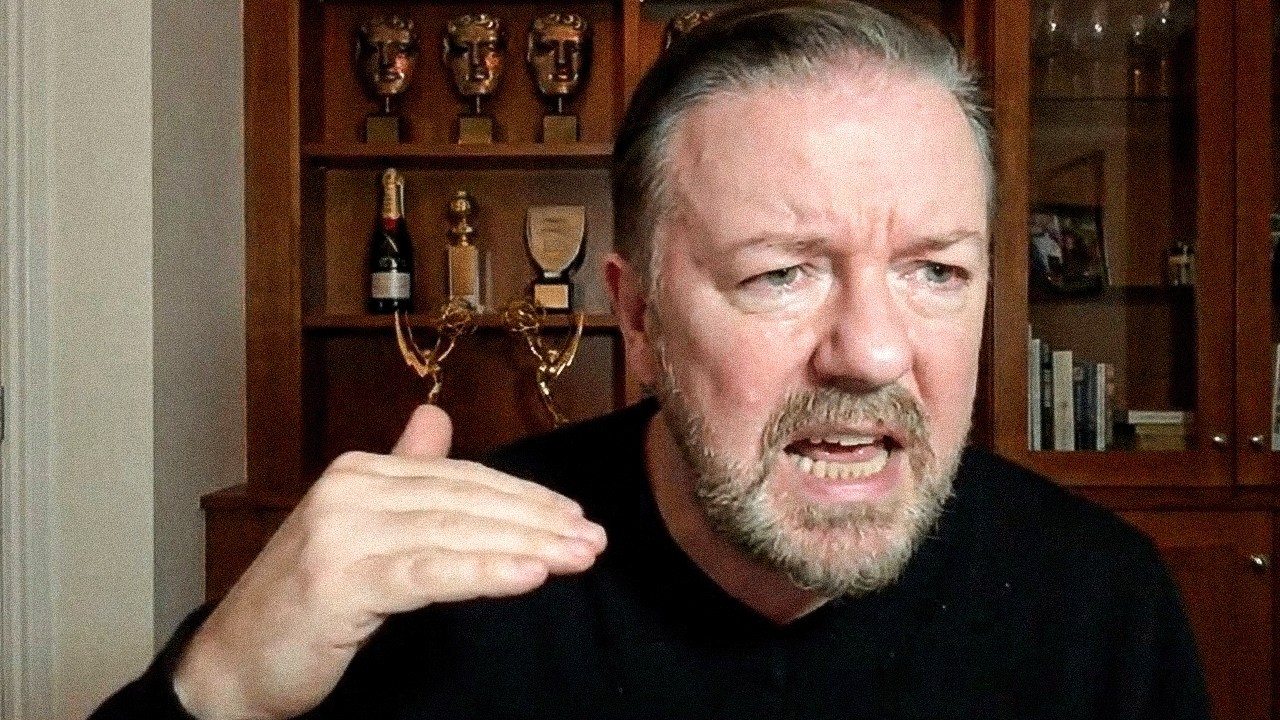
“He’s coming for you,” Gervais said. Later, introducing Sandra Bullock, he compared the premise of her film Bird Box—where characters survive by refusing to look at what surrounds them—to working for Harvey Weinstein. The timing was striking. Weinstein’s criminal trial was scheduled to begin the very next morning.
Gervais had hosted the Golden Globes five times over fifteen years, and each time he used the platform to name names and expose the industry’s worst-kept secrets. His approach was deliberate. He explained that he chose to write his own jokes and decided early on who he was performing for: not the roughly 200 wealthy people in the room, but the global audience of millions watching at home. Before his final hosting gig in 2020, Gervais articulated this philosophy directly.
He said he had to choose between pandering to the privileged egos in the room or entertaining the global audience who were not winning awards and were not millionaires. He said it was a “no-brainer” and that he was doing it for the people watching at home. His 2020 monologue also targeted the industry’s habit of using awards speeches for political statements. He told winners not to use the platform to lecture viewers, pointing out the hypocrisy of multimillionaires telling people to recycle while flying around in private jets.
The morning after that monologue, Gervais did not apologize. Instead, he posted on Twitter, thanking people for their reactions and writing, “Make jokes, not war. ” Months later, he told Yahoo Entertainment that the monologue resonated because people were tired of being lectured by the wealthy and tired of the hypocrisy. This was not a new pattern.
Gervais had been doing this since his first hosting gig in 2010. That year and in 2011, he went after Mel Gibson, Charlie Sheen, Robert Downey Jr. , Bruce Willis, Hugh Hefner, and made thinly veiled references to Scientology and closeted celebrities. He described Sheen’s hotel meltdown in graphic detail on stage.
In 2012, he targeted Jodie Foster, the Hollywood Foreign Press Association’s voting process, and Helen Mirren. In 2016, he returned to Mel Gibson and brought up Bill Cosby, saying he would rather have a drink with Gibson than with Cosby—a bold statement at the time. He also took shots at Matt Damon, Ben Affleck, and Jennifer Lawrence. The 2020 show was his most pointed yet.
Beyond Epstein and Weinstein, he referenced R. Kelly, Michael Jackson through the Leaving Neverland documentary, Felicity Huffman and the college admissions scandal, Leonardo DiCaprio’s dating patterns, and major tech companies including Apple, Amazon, and Disney. Looking back, the jokes read less like roast material and more like a witness statement. Yet the Hollywood Foreign Press Association invited him back five times.
Gervais understood the dynamic. He told The Hollywood Reporter that he went after broad targets like cinema, television, actors, pretension, and hypocrisy, but in practice, he often singled out specific people. The spectacle of watching powerful people squirm was good for ratings, and the industry kept inviting the one man willing to say what others would not. When the 2021 Golden Globes were canceled due to a separate diversity scandal within the HFPA, a fan asked Gervais on Twitter if he would host a one-hour special roasting Hollywood instead.
His two-word response: “The Golden Balls. ”
In January 2024, a federal court unsealed hundreds of pages from Virginia Giuffre’s lawsuit against Ghislaine Maxwell. Names began circulating online, including Leonardo DiCaprio, Cate Blanchett, Cameron Diaz, Bruce Willis, Kevin Spacey, and George Lucas. None were accused of wrongdoing; many appeared only because Epstein had dropped their names in conversation.
But the internet did not wait for clarification. Within hours, clips of Gervais’s 2020 monologue resurfaced across social media. In March 2025, Attorney General Pamela Bondi released the first phase of Epstein’s contact files and flight logs, which included names like Michael Jackson, Mick Jagger, Alec Baldwin, and Naomi Campbell. Once again, comment sections pointed back to Gervais, suggesting he should be the one to read the list aloud.
The 2025 Golden Globes went to Nikki Glaser, not Gervais. He responded by writing his own opening monologue anyway and posting it from a selfie video in his bathtub the night before the show. He opened with the Vatican, mentioning Hollywood’s rush to meet Pope Francis, then moved to Justin Timberlake’s 2024 drunk driving arrest and Sean “Diddy” Combs’ federal sex trafficking and racketeering charges. He brought Epstein back into it as well.
He was not invited, and he showed up anyway. Gervais’s willingness to speak openly stands in contrast to others who faced consequences for far less. In 2005, Courtney Love warned a young woman on camera not to go to Harvey Weinstein’s private hotel party. That clip effectively got her blacklisted from mainstream Hollywood.
Ronan Farrow spent years trying to get major outlets to run his Weinstein story; NBC News passed before The New Yorker published it in 2017. Gervais said similar things on live television to millions of viewers with cameras pointed directly at the people he was talking about. In a 2025 Los Angeles Times interview, Gervais explained that his Epstein line was not just a joke. He said he wanted to take the audience somewhere they had not been before and make them reflect on it.
He said it was a statement made in front of the people it was about. He also defended his broader approach to comedy, arguing that free speech is essential and that it is impossible to avoid offending someone, so there is no point in trying. For fifteen years, he refused to soften his material for the most powerful room in the world.
In retrospect, his jokes often described reality more accurately than the industry was willing to admit.