Waking at 3:00 a. m. is a common experience that causes many people to believe something is wrong with them, but sleep researchers say it is often a normal part of human sleep biology rather than a sign of clinical insomnia. Sleep is not a single, uninterrupted state.
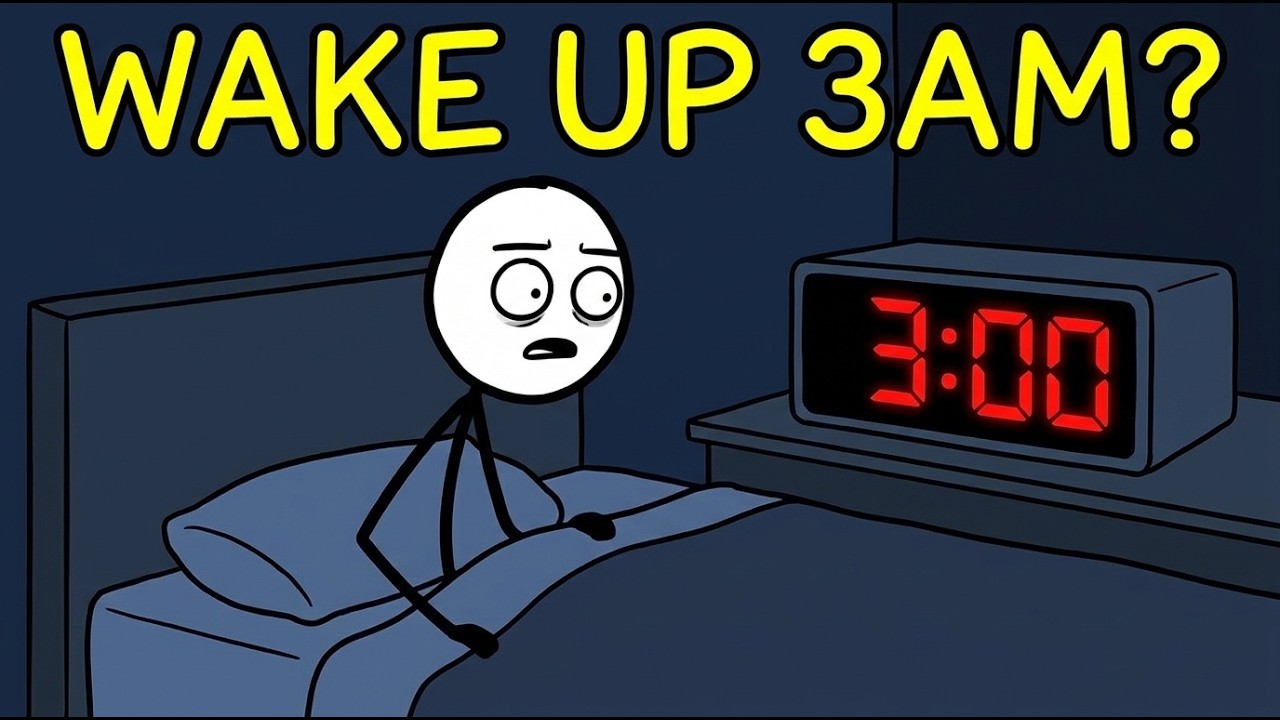
It runs in roughly 90-minute cycles that repeat throughout the night, with the first half dominated by deep, restorative slow-wave sleep and the second half dominated by lighter REM sleep that is easier to disrupt. For most people on a conventional schedule, the transition between these two halves falls between midnight and 3:00 a. m. , and it is not always seamless.
The body often surfaces briefly at this transition point before entering the REM-heavy second half of the night. Most people return to sleep quickly and never remember the moment. Those who notice it and experience it as a problem are typically the people who fail to fall back asleep, and that failure has distinct causes. Cortisol plays a central role.
The hormone follows a circadian rhythm, dropping during early sleep and rising in the pre-dawn hours as a wake-preparation signal. For people with elevated baseline cortisol, which can result from chronic stress, metabolic conditions, or irregular sleep schedules, this rise can come earlier and steeper, producing awakening at 2:00 or 3:00 a. m. instead of closer to the morning alarm.
The mind that races at 3:00 a. m. is not just psychologically anxious. It is operating on a hormonal profile that is physiologically promoting wakefulness.
Blood sugar is connected to this process as well. If glucose falls too low during the overnight fast, the body releases cortisol and adrenaline to mobilize stored energy, and that surge is associated with waking. People with less stable blood glucose regulation, insulin resistance, or those who ate a high-carbohydrate dinner may be more prone to this effect. Alcohol complicates the picture further.
It accelerates sleep onset and suppresses REM sleep in the first half of the night, but as it is metabolized hours later, REM rebounds and produces lighter, more easily disrupted sleep. The 3:00 a. m. waking that follows an evening of drinking often tracks exactly with this metabolism timetable.
The historical dimension reframes the entire issue. For most of human history, consolidated eight-hour sleep was not the norm. According to historian Roger Ekirch’s landmark 2001 research, pre-industrial Europeans typically slept in two segments: a first sleep after dark until around midnight, a wakeful period of one to two hours used for prayer, conversation, sex, reading, or light work, and then a second sleep until dawn. This segmented pattern was treated as completely unremarkable across cultures.
The shift to single-block sleep happened rapidly in the 18th and 19th centuries with the spread of artificial lighting, which extended evening social activity and pushed bedtimes later. Within a few generations, the two-sleep pattern was forgotten, and the middle-of-the-night waking that had been normal for most of human history was reclassified as insomnia. From this perspective, the 3:00 a. m.
waking is not a malfunction but ancestral sleep architecture expressing itself in a modern context that has no space for it. The problem is not the waking itself but what happens afterward. People in the pre-industrial world expected the gap between sleeps and had activities for it. They did not calculate how many hours remained until an alarm.
Individual variation also matters. Early chronotypes have earlier cortisol rhythms and earlier REM windows, making early-morning waking more characteristic of their sleep pattern. Late chronotypes are less likely to experience it because their biological pre-dawn processes are shifted later. Environmental factors play a role.
A room warmer than about 19°C can interfere with the pre-dawn drop in core body temperature, promoting lighter sleep. Bright screen exposure in the hours before bed suppresses melatonin and delays the circadian clock, contributing to more fragmented sleep later in the night. Magnesium deficiency is a regularly overlooked factor. Magnesium regulates GABA receptors that promote sleep and helps manage the cortisol response.
Low levels are associated with more frequent nighttime awakening and difficulty returning to sleep. The modern diet, low in magnesium-rich foods like leafy greens and nuts, has produced widespread low-grade deficiency. Research on the gut-brain axis also points to a documented connection between digestive health and sleep fragmentation. The content of 3:00 a.
m. thoughts is not random. The brain in this half-awake state has amplified threat detection and reduced function in the prefrontal cortex, the region responsible for rational evaluation and perspective. Emotional centers fire at full intensity while the system that normally applies context is running at reduced capacity.
This is why a mildly concerning work email can feel like a career-ending disaster at 3:00 a. m. The evaluation performed in this state is reliably inaccurate in the direction of overestimation. What to do about it is where practical guidance matters most.
The worst step is checking the time. Knowing it is 3:00 a. m. and calculating hours until the alarm triggers a cascade of cognitive and physiological responses that make returning to sleep harder.
If the anxiety machine has already started, the evidence-supported approach is to get out of bed and do something calm and low-stimulation in dim light, such as reading a physical book or light stretching, until sleepiness returns. Lying in bed becoming increasingly anxious associates the bed with wakefulness. Diaphragmatic breathing directly activates the parasympathetic nervous system and measurably slows heart rate within a few breath cycles. Writing thoughts down on paper offloads them from working memory, signaling to the brain that they are captured and can be addressed tomorrow, which reduces the cycle of repetition.
The cognitive reframe matters most in the long term. Accepting that waking at 3:00 a. m. is not a crisis, that lying quietly in the dark provides some rest even without sleep, and that the body has been managing this moment for most of human history is harder to achieve in the moment but has the largest effect on whether the waking becomes chronic.
The explanation is straightforward: waking at 3:00 a. m. occurs at the transition between deep sleep and REM-dominant sleep, at the moment cortisol begins its pre-dawn rise, at a time when human sleep architecture has always been most prone to brief arousal. It happened to your great-grandparents and to medieval monks who called it the canonical hour between first and second sleep.
The body knows how to return to sleep on its own. The only thing that stops it is the mind deciding that what the body is doing is wrong.