Playback experiments in African savannas have shown that many wild mammals are more likely to flee from the sound of a calmly speaking human voice than from the roar of a lion. Elephants, giraffes, leopards, hyenas, and antelope have all been recorded reacting to ordinary human conversation as if it signaled immediate danger, a response researchers attribute to a long and brutal ecological history. This widespread fear is not an innate instinct. Urban pigeons ignore pedestrians, protected wildlife can become tolerant of people, and island species with no evolutionary experience of terrestrial predators have sometimes greeted human newcomers with fatal curiosity.
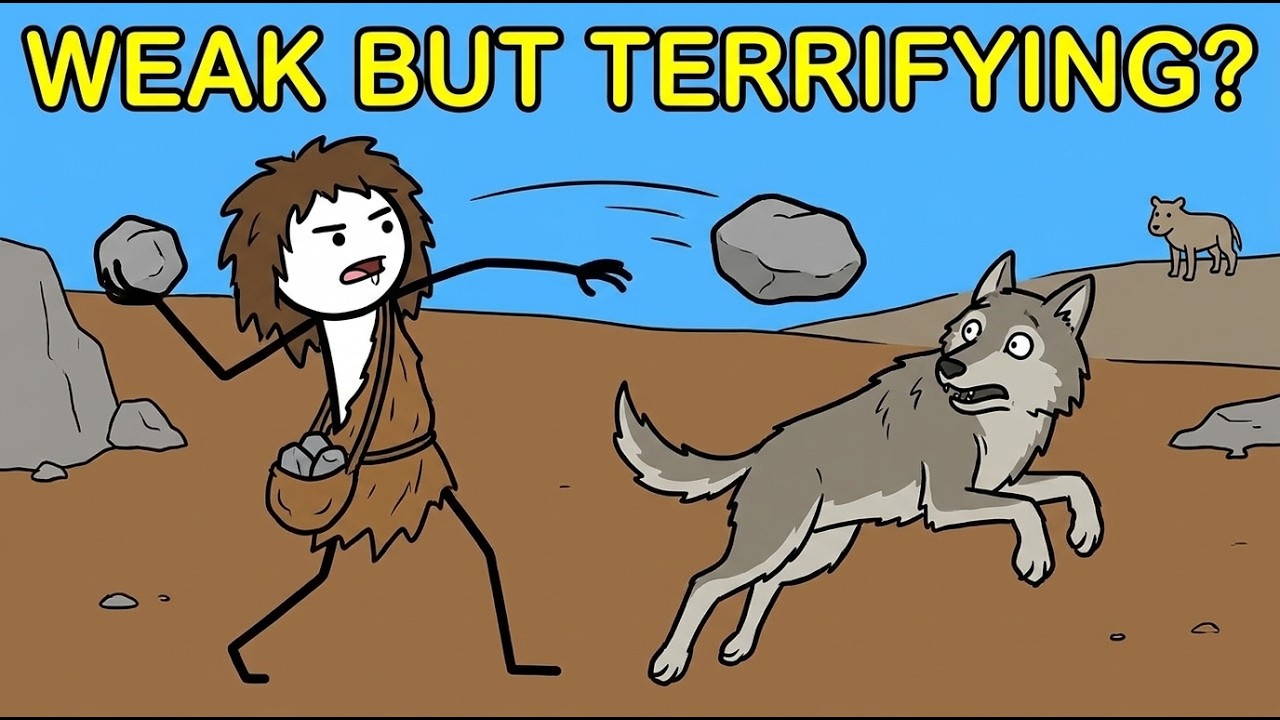
Animals learned to fear us, and what they learned was more unsettling than simple physical strength. A lion is dangerous because of what its body can do in the moment; a human is dangerous because of what its mind, hands, group, and memory can arrange next. The first human advantage was not speed but refusal. Upright walking is efficient over distance, and a nearly hairless body covered in sweat glands allows humans to cool themselves while moving.
Many mammals rely on panting, which competes with the mechanics of running and forces them to stop and rest in the heat. Under the right conditions, a trained hunter could track and pursue an animal until the faster body overheated and the slower one arrived. This persistence hunting is documented in ethnographic records, though experts caution that it was only one of many hunting strategies and not the single heroic explanation for human evolution. Danger soon moved outside the human body.
A sharpened stick is a tooth that detaches, and human hands could combine wood, stone, fiber, and resin to create weapons that no gene had to grow. Wood preserves poorly, making early hunting tools difficult to date, but ancient wooden spears and throwing sticks show that human relatives were manufacturing carefully designed equipment hundreds of thousands of years ago. The key transformation was that the safe distance changed. Claws and teeth require contact, but a thrown spear bleeds an animal before strength ever becomes relevant.
Later spear throwers and bows extended that range even further. Human cooperation added another layer of unpredictability. While many carnivores hunt in groups, human coordination was unusually flexible, allowing individuals to assign different roles before the animal appeared. Some drove prey, others waited in ambush, some blocked escape routes, and others guarded dangerous approaches.
The landscape itself became suspicious, as a narrow pass could contain waiting spears and a cliff could become a tool if a herd was driven toward it. This was disadvantage hunting, arranging situations where an animal’s speed, mass, or aggression stopped helping. The most disturbing development for prey was that the human predator could leave while the risk remained. A snare is human intention left alone in the forest, and a pit is a hunter that does not breathe.
Fire extended the problem, turning an environmental force into portable behavior. A group with flame and smoke could defend a campsite in ways teeth never could, and large carnivores had to decide whether approaching the hairless apes was worth receiving burning branches from every direction. Animal fear is a calculation, and it develops in several ways. An individual may survive an encounter and learn.
Young animals copy their mothers. Social species transmit alarm calls. Over generations, cautious genes can spread if bold animals die more often. The variability explains why reactions differ so widely by location.
Where humans walk without harming wildlife, animals habituate; where humans hunt, tolerance becomes expensive. Some animals even distinguish between local groups, voices, clothing, and whether a person is looking directly at them. The evidence that fear is learned rather than automatic comes from islands. Flightless birds nested on the ground and giant tortoises could be approached and collected because neither had evolved a category for a primate arriving by boat with containers and free time.
When humans colonized new environments, the reputation often arrived too late. Hunting contributed to extinctions and population collapses, interacting with climate change, habitat alteration, and other pressures, though the exact causes for many prehistoric extinctions remain debated. Humans also broke the normal ecological contract between predators and prey. Ordinary predators are constrained by prey abundance, and they typically capture the young, old, injured, or slow because those are cheapest to catch.
Humans often target large, healthy adults for meat, hides, bone, or status. Technology reduces the cost of choosing difficult prey, and food storage, sharing, and trade separate the place of killing from the place of consumption. Targeting reproductively valuable adults affects populations in ways another predator of similar abundance might not. Still, ancient humans were not industrial hunters.
Populations were small, technology was variable, and failure was common. Hunting dangerous game produced injuries visible in the skeletal record, people starved, and predators stole kills. Early hominins were sometimes prey, scavengers, competitors, and hunters within the same landscape. Living among powerful carnivores rewarded vigilance, group defense, weapon use, and the ability to read tracks and intentions, which may have helped make us more dangerous.
The decisive human advantage was cultural accumulation. A genetic adaptation spreads through reproduction over many generations, but a useful hunting method can spread after one demonstration. A new point design, trapping technique, or animal call can be copied, modified, and taught within a single animal’s lifetime. Biological evolution faced cultural evolution, and culture moved with uncomfortable speed.
Language magnified this, allowing detailed planning and teaching about things not currently visible. When a human failed, the human could return with notes, while a lion’s failed ambush could not be explained to lions beyond the mountain. This does not mean humans were perfectly designed predators. We were predators whose weapons arrived separately.
A tiger is born carrying most of its equipment, while a human child spends years downloading the local operating system. That dependence looks pathetic until the download finishes, and the adult inherits thousands of years of experiments without personally repeating the fatal versions. Human technology functions as an extended phenotype, as natural to us as webs are to spiders. Judging a human without tools is therefore like judging a spider after removing the web and congratulating the fly.
Modern playback studies show the accumulated result. In one South African experiment, many savanna mammals responded more strongly to recordings of humans speaking calmly than to lion vocalizations. Yet even this result requires caution. It does not prove a mammoth feared human conversation 40,000 years ago, and responses vary with hunting pressure, habitat, previous exposure, protection, hunger, season, and context.
A starving predator may approach, a habituated animal may ignore us, and a mother defending young may attack. Crocodiles, big cats, elephants, and bears continue to kill people, and our reputation never made our skin thicker. Fear made encounters happen less often. Killing is dangerous, so a predator benefits when prey begins fleeing before combat.
Once wildlife treats humans as high risk, people gain access to space, carcasses, water, and roots without fighting every competitor directly. Fear changes behavior even when nobody dies, as animals feed less, move at different times, abandon productive areas, and avoid paths associated with people. Ecologists call this a landscape of fear, and humans can reshape it through voices, roads, hunting, recreation, and settlement. The weakest-looking predator influences where stronger bodies are willing to stand.
When a herd flees from an ordinary human voice, it is not confusing us with lions. It is recognizing something lions never became: a predator that can arrive looking weak, fail without forgetting, kill without touching, and return as a different problem.