The 4-kilogram cat on your chest has created a situation in which a creature many times its size has voluntarily immobilized itself. This is not unusual—it happens in hundreds of millions of households daily. When the full picture is considered—the billions spent annually on cat food, toys, medicine, and cat-shaped merchandise; the elaborate indoor environments built for animals that contribute nothing economically; the emotional labor humans perform to accommodate a species that barely acknowledges them—the question of who domesticated whom becomes considerably less settled than the biology textbooks suggest. The standard account holds that humans domesticated cats approximately 10,000 years ago, when agriculture created grain stores that attracted rodents, which in turn attracted wild cats.
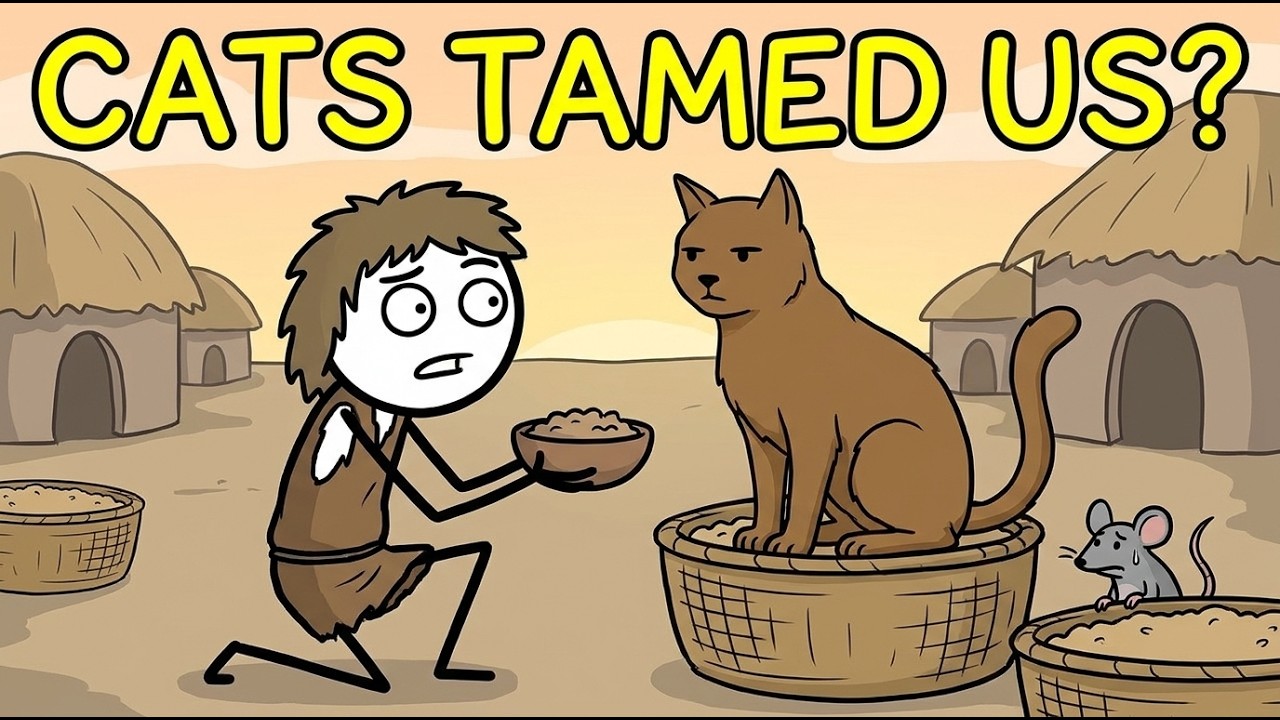
Humans tolerated and eventually welcomed the cats because they killed the pests. In this version, humans are the agents and cats the subjects. But a different reading of the same facts examines what each party actually ended up with—and asks whether the party that got the better deal is the one traditionally credited with being in charge. Domestication in the biological sense means a wild species is modified through human-controlled selective breeding to become genetically distinct from its wild ancestor.
Dogs fit this definition. They have been reshaped over tens of thousands of years until they differ from wolves in hundreds of measurable ways. Cats barely fit it. The genetic distance between a domestic cat and its wild ancestor, Felis libyca, is remarkably small.
Domestic cats show differences in regions associated with reduced fear response, modified reward pathways, and some coat coloration changes. But the fundamental biology is essentially unchanged. What happened was not humans reshaping cats. It was cats moving into human environments, with the individuals best suited to those environments doing better than others.
The genetic changes are the signature of cats adapting to humans, not of humans shaping cats. Called by another name, that kind of domestication might be called colonization: the cat found a resource-rich environment occupied by a species disinclined to harm it, moved in, and made itself at home. The standard justification for the arrangement is rodent control. Cats killed the mice and rats that threatened grain stores, and this was genuinely valuable in early agricultural settlements.
But rodent control required no training, no management, and no modification of cat behavior. Cats hunted small mammals before humans arrived and continued afterward. Humans got the benefit of existing cat behavior without doing anything to create or maintain it. The cat was not killing rodents as a service; it was killing rodents because that is what cats do.
The grain store created a concentration of prey that made the hunting easier than anything available in the wild. Humans, meanwhile, provide food, shelter, veterinary care that extends healthy lifespan by years, and protection from predators, traffic, and other hazards. In most contemporary arrangements, the rodent control that justified the original deal is no longer needed. What remains is humans providing everything while the cat provides companionship on terms determined entirely by the cat.
The answer to how a 4-kilogram predator got this deal involves manipulation—not conscious strategy, but functional manipulation shaped over thousands of years. The meow is the most documented example. Adult wild cats do not meow at each other. Domestic cats meow almost exclusively at humans.
Research has found that cat meows and solicitation purrs contain acoustic components in the frequency range associated with infant distress vocalizations—the specific sounds human auditory systems are tuned to respond to with attention and concern. The solicitation purr embeds a higher-frequency cry within the low-frequency purr, producing a sound less obvious than a demand but more difficult to ignore than silence. The slow blink is another such behavior. Research by Karen McComb and colleagues at the University of Sussex found cats use a slow blink as a social bonding signal toward humans and that humans respond to it positively.
It functions as a trust marker and a communication of comfort. Humans who receive a slow blink feel a meaningful social exchange has occurred. The cat has learned to communicate in a way that activates human social bonding machinery—the same neural systems involved in human-to-human affiliative communication. The purr deserves particular attention for its physical properties.
It produces vibrations primarily between 25 and 150 hertz, with most energy concentrated between 25 and 50 hertz. Research on therapeutic vibration has found this frequency range promotes bone density, accelerates healing of soft tissue injuries, and reduces swelling and pain. The purr is produced close to the human body during physical contact, vibrating through the contact surface, continuous and rhythmic. Humans receiving it are getting a sustained low-frequency vibration input that is physiologically calming.
The cat is conducting a biological massage on the human nervous system. Research increasingly supports measurable effects of cat ownership on human health. Multiple studies have found reductions in blood pressure, heart rate, and cortisol levels in humans who interact with cats—effects that appear in physiological measurements, not just self-reported well-being. Cat ownership has also been associated with reduced cardiovascular disease risk and improved survival after cardiac events.
This changes the accounting: the cat receiving food and shelter is simultaneously providing measurable stress reduction and cardiovascular benefit. The exchange is more reciprocal than it first appears, though the cat’s side operates through mechanisms less visible and less credited. Humans in cat-owning households modify their behavior substantially. They choose furniture partly based on whether cats will use it or destroy it, manage sleep schedules around cat activity, talk to cats in ways they would not talk to inanimate objects, interpret cat behavior as expressive of emotional states, apologize when disturbing a sleeping cat, and modify daily routines to accommodate cat preferences.
The global pet care industry is valued in the hundreds of billions of dollars annually, with cats representing a substantial share. The evolutionary biology explanation is that humans have parental instinct systems that respond to specific stimuli—large eyes, rounded faces, small bodies, vocalizations in infant frequency ranges—and that domestic cats have converged on a suite of characteristics that trigger these systems reliably. The cat’s face is a juvenile face. The meow is an infant vocalization.
The dependent behavior maps onto infant behavior patterns that human caregiving systems are designed to respond to. The domestic cat has effectively infiltrated the human parental care system and extracts resources by presenting the key stimuli that activate it. The comparison with dogs illuminates what is unusual about the cat case. Dogs were shaped to be pro-social with humans, to seek human company, to read human social signals, to be distressed by separation.
The cat’s attachment—while real, as documented in Oregon State University attachment research—appears more resource-based and less purely social. Crucially, the cat’s attachment is on the cat’s terms in a way the dog’s is not. A dog accommodates the human’s schedule and social style. A cat approaches on its own schedule, in its preferred manner, for its preferred duration, and withdraws when satisfied.
The human is not setting the terms. The species that sets the terms of a relationship is, by any reasonable definition, the species with more power in it. The cultural record reveals the depth of cat influence. Cats have been subjects of art, literature, mythology, and religious veneration across virtually every major civilization: the Egyptian goddess Bastet, the Norse goddess Freya whose chariot was pulled by giant cats, the Islamic tradition of respect for cats traceable to the Prophet Muhammad’s affection for his cat Muezza, Japanese maneki-neko figurines, and the overwhelming dominance of cat content in early internet culture.
Given a blank canvas of global communication technology and unlimited content choices, humans chose in substantial part to share images and videos of cats. That revealed preference is not explained by advertising; it is explained by something in human psychology that finds cats specifically compelling. In the strict biological sense, cats did not selectively breed humans to produce a genetically modified population. But in the functional sense—did cats, through behaviors shaped by thousands of years of cohabitation, modify human behavior in ways that systematically benefit cats at significant cost to humans?
The evidence says yes. Every great domestication produces an animal better adapted to the human environment. The cat is better adapted to that environment than any wild cat. Every great domestication also produces humans organized around providing resources to the domesticated animal.
The humans who live with cats are organized around providing resources to the cat. The only question is which side of the arrangement is running it. The cat is sitting on your chest and you cannot move. You could move it.
You’re not going to.