Belgium then topped Group H with a 5-1 win over New Zealand, while Egypt and Iran played out a thrilling 1-1 draw to finish second and third, respectively.
ESPN’s By The Numbers brings you best stats from the World Cup action on June 26:
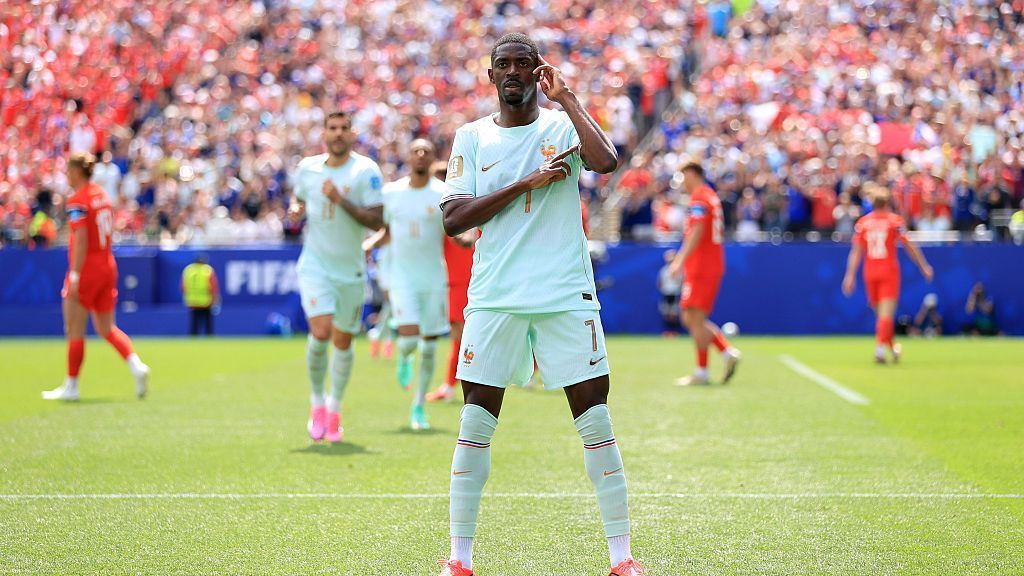
Norway 1 – 4 France
0.19
Ousmane Dembélé completed his hat trick despite just accumulating an xG total of 0.19. Since 1966, the only men’s World Cup hat trick completed with a lower xG was Hungary‘s Laszlo Kiss in 1982 (0.17).
1/182
Of the 182 goals scored (until then) at this FIFA World Cup, Dembélé’s hat trick goal was the first to see all 11 players involved in the move.
Dembélé ‘s hat trick (7′, 20′, 32’) is the second earliest hat trick in men’s World Cup history after Austria‘s Erich Probst vs Czechoslovakia in 1954 (24th minute). He is, in fact, just the 6th man with a first-half hat trick in a World Cup match and the first since Oleg Salenko for Russia in 1994 (Salenko hit 5 goals in that match).
2
With two assists today, Kylian Mbappé has joined Lionel Messi (26) and Miroslav Klose (20) as the only men with 20+ World Cup goal contributions (16 goals, 4 assists), since assist records started in 1966. What’s curious is that he had two assists in his previous 16 World Cup games!
3
Dembélé is only the third Frenchman to score a World Cup hat trick, after Just Fontaine (2x) and Kylian Mbappé.
3
Stunningly, Dembélé is the first Reigning Ballon D’Or winner to score a World Cup hat trick since Cristiano Ronaldo vs Spain in 2018. He’s only the fourth overall to do so (also Karl-Heinz Rummenigge in 1982 and Eusébio in 1966)
3
Mike Maignan is the third French goalkeeper to save a men’s World Cup penalty after Alex Thepot in 1930 vs Chile and Joel Bats in 1986 vs Brazil (excluding shootouts). Maignan dived to his left to keep out Jorgen Strand Larsen’s 50th minute penalty.
3 (or more)
France have scored 3 (or more) goals in each of their last four FIFA World Cup matches, the longest run by a team at a men’s World Cup since Spain between 1998 and 2002 (4).
6
Norway, who made 10 changes to the starting XI from the previous match, are now winless in their last 6 competitive games without Erling Haaland in the starting XI (0-3-3).
20
This is the 20th instance of a Frenchmen having a multi-goal game at the World Cup. France join Brazil (39), Germany (35), and Argentina (27) as the only countries to have players who’ve had multi-goal games at least 20 times at the World Cup.
23
With Jens Petter Hauge substitution in, all 23 of Norway’s outfield players have had minutes this tournament.
The tension surrounding Quinn Hughes and the Minnesota Wild has reached a critical boiling point, with the hockey world bracing for what promises to be a bombshell revelation from the star defenseman. Tomorrow, Hughes is scheduled to address the media during the NHL’s annual media tour, and the anticipation is palpable as conflicting reports have muddied the waters regarding his long-term future with the franchise. The stakes could not be higher, as the Wild face a ticking clock to secure their cornerstone player before the start of the season. The buildup to this pivotal moment has been anything but quiet, with prominent insiders offering divergent narratives that have left fans on edge. Michael Russo, a highly respected voice covering the Wild, has dropped a new report that sheds light on the internal dynamics of the negotiations. According to Russo, those closest to Hughes maintain that his intention remains to sign an extension, yet the language used suggests a level of uncertainty that cannot be ignored. The revelation that Hughes will speak publicly has transformed this from a behind-the-scenes saga into a very public spectacle. Russo’s insights paint a picture of a player who is weighing a multitude of factors, far beyond just the dollar figure on the contract. The reporter noted that conversations with Hughes’s camp still point toward a deal getting done, but he refused to speculate on a salary number given the unpredictability of what Hughes might say. The upcoming media availability is being framed as a potential turning point, where Hughes could either put the speculation to bed with a firm commitment or leave the door open to a myriad of possibilities that would send shockwaves through the league. The intrigue deepened on Tuesday when another credible reporter, Chris Johnson, released a report suggesting that Hughes is not ready to sign an extension with the Wild at this moment. This starkly contrasts with the optimism emanating from other sources, creating a confusing landscape where no one seems to have a definitive answer. Johnson’s credibility lends weight to his claims, but the conflicting nature of these reports underscores the reality that only Hughes himself knows the true state of his intentions, making tomorrow’s press conference an absolute must-watch event. Adding another layer to the chaos, Elliotte Friedman recently offered his own take on the situation, only to be publicly countered by Russo, who cited a source with closer ties to Hughes. This public clash between two of the most respected insiders in the sport highlights just how fluid and opaque this situation has become. It serves as a stark reminder that every report, no matter how well-sourced, should be taken with a grain of salt until the man at the center of it all speaks his truth. At the heart of this drama lies the specter of family and the dream of playing alongside his brothers. The thought of Quinn Hughes joining forces with his siblings, potentially in New Jersey or Detroit, is a narrative that will not dissipate regardless of what he says tomorrow. This emotional pull is believed to be a significant factor in his hesitation, as he contemplates a future that could see him align his career with his brothers in a way that few athletes ever get to experience. The financial landscape of the potential deal is another massive hurdle that must be cleared. Russo has indicated that the Wild are eager to lock Hughes down for the long term, with an eight-year offer reportedly on the table at a staggering $20 million per season. However, the player’s camp may be more inclined toward a shorter-term agreement, possibly a three-year deal, which would allow him to hit free agency at a time when his brothers are also available. This fundamental disagreement over term is shaping up to be the central battleground of the negotiations. The Wild’s front office is operating with a sense of urgency, knowing that they have a limited window to secure Hughes on an eight-year deal before he becomes an unrestricted free agent next summer. The team has expressed confidence in their ability to retain him, but that confidence is being tested by the swirling rumors and the player’s own silence. The next seven days are critical, as a face-to-face meeting between Hughes and the team is scheduled for next week, providing a platform for substantive progress. There is a strategic element to the timing of these talks, as history has shown that significant movement often occurs once a player returns to the team’s home base. The case of Kirill Kaprizov serves as a precedent, where negotiations ramped up considerably once he was back in Minnesota. The Wild are hoping for a similar dynamic with Hughes, as face-to-face conversations tend to be more productive than phone calls, allowing both sides to gauge each other’s intentions with greater clarity. The worst-case scenario, as outlined by Russo, involves a trade request if a deal cannot be reached. The Wild could theoretically offer Hughes a path to his preferred destination, but that would be a devastating outcome for a team that has invested so much in him as their number-one left defenseman. Losing him for nothing would be an organizational catastrophe, and the front office is acutely aware that they must either sign him or recoup significant assets in a trade. The pressure on the Wild’s management is immense, as they navigate the delicate balance between meeting Hughes’s demands and protecting the team’s long-term competitive viability. The projected value of an extension, according to analytics, sits at around $15 million per year over eight years, but the reported offer of $20 million suggests the team is willing to go above and beyond to get a deal done. Whether they are prepared to exceed that figure remains an open question that could define the franchise’s trajectory for years to come. For the fans, this is a nerve-wracking period filled with anxiety and hope in equal measure. The prospect of losing a generational talent is a nightmare scenario, but the belief that the Wild will ultimately do whatever it takes to keep him provides a glimmer of optimism. The team’s roster, which is already thin on the left side of the blue line, would be decimated without Hughes, making this negotiation existential for their playoff aspirations. As the hours tick down to Hughes’s media availability, the hockey community is holding its breath. Will he deliver a definitive statement that ends the speculation, or will he offer cryptic comments that fuel further uncertainty? The answer will have ripple effects across the entire league, influencing trade markets, free agency plans, and the competitive balance of the Western Conference. Tomorrow’s press conference is not just a formality; it is a pivotal moment in the saga of a franchise and its superstar. The Wild have made their position clear, expressing confidence that a resolution will be reached, but actions will speak louder than words. The reported offer of an eight-year, $20 million per season contract is a massive commitment, but it may not be enough to sway a player who has his sights set on a different path. The coming days will reveal whether the bond between Hughes and the organization is strong enough to withstand the allure of playing with his brothers. In the broader context, this situation is a reminder of the fragility of roster construction in the modern NHL. A single player’s decision can alter the fate of a franchise, and the Wild are learning this lesson in real-time. The front office’s ability to navigate this crisis will be a defining test of their leadership, and the outcome will shape the narrative of the team for the next decade. The speculation has reached a fever pitch, with fans and analysts alike dissecting every word from every insider. The lack of clarity is maddening, but it also underscores the complexity of the situation. Hughes is not just a hockey player; he is a brother, a leader, and a cornerstone of a franchise. His decision will be influenced by a myriad of personal and professional factors, and no one outside his inner circle truly knows what he is thinking. As we await the moment of truth, the Wild’s fanbase is bracing for any outcome. The hope is that Hughes will look into the cameras and declare his commitment to Minnesota, but the fear is that he will leave the door open for a departure. The team’s future hangs in the balance, and the next 24 hours will be among the most consequential in recent franchise history. The clock is ticking, and the pressure is mounting. The Wild have seven days to make their case for an eight-year commitment, but the player’s mindset remains an enigma. The reports from Russo and Johnson offer two very different realities, and only Hughes can provide the clarity that everyone craves.…
In a stunning turn of events, LIV Golf's financial troubles have sent shockwaves through the professional golf community, particularly affecting two of…