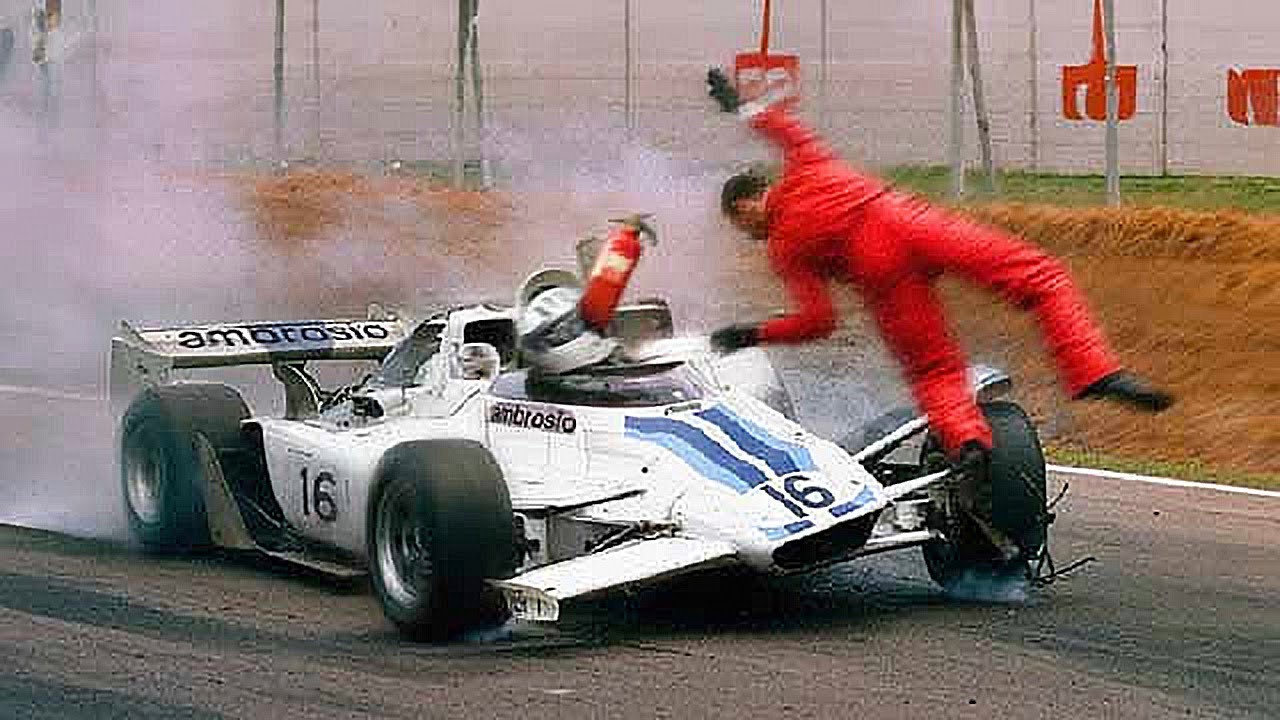
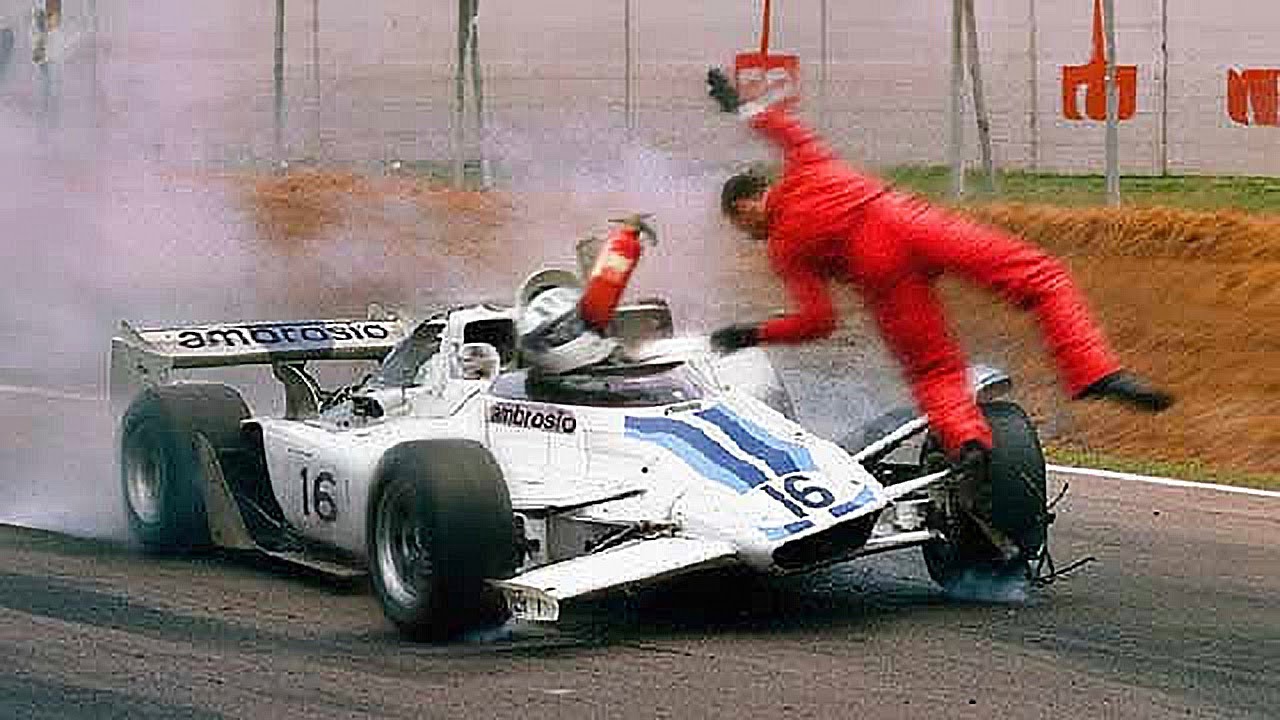
The sun blazed down on the Kyalami circuit on March 5, 1977, promising a routine afternoon of Grand Prix racing. Within forty minutes, the track would become a charnel house, a scene of such graphic, instantaneous violence that it would force a global reckoning with the sport’s callous disregard for human life. The tragedy that unfolded on that warm South African afternoon was not a single accident, but a catastrophic chain reaction of negligence, poor visibility, and a fuel system design that turned racing machines into mobile infernos.
It claimed the life of a rising star and a nineteen-year-old volunteer, leaving a stain on Formula 1 that the sport has spent decades trying to wash away.
 The victim of fate was Tom Pryce, a 27-year-old Welshman whose name was whispered with the same reverence reserved for the sport’s greatest talents. Born in Rutland in 1949, Pryce was not a product of wealth or privilege; his obsession began humbly, driving a baker’s van at the age of ten. His idol was Jim Clark, the stoic Scotsman who redefined speed, and Pryce chased that ghost with a ferocious determination that saw him climb the motorsport ladder with alarming speed.
By the mid-1970s, he was the spearhead of the Shadow team, a plucky midfield outfit that occasionally punched above its weight, and he was widely tipped to become a world champion. He possessed a supernatural ability in wet conditions, a calm demeanor under pressure, and a raw pace that made seasoned observers sit up and take notice.
But the 1970s were a different world, a brutal, unforgiving arena where the machinery was lethal and the safety measures were, at best, an afterthought. The cars were effectively bombs on wheels, their fuel cells prone to rupture and ignite on impact. The tracks were lined with flimsy barriers, and the marshals, often volunteers with minimal training, stood perilously close to the action, protected by nothing more than a fireproof suit and a prayer.
Drivers accepted a grim calculus: every race weekend carried a tangible risk of death or disfigurement. They raced with a fatalistic philosophy, believing that tragedy was something that happened to the other guy, while knowing deep down that the line between survival and disaster was thinner than a tire’s contact patch.
The race at Kyalami began with the usual chaos and jockeying for position. James Hunt led the early laps, with Niki Lauda and Jody Scheckter in hot pursuit. Pryce, after a poor start that dropped him to 22nd, was carving his way through the field with characteristic aggression, a man on a mission to salvage points from a difficult weekend.
By lap 21, he had fought his way back to 15th place, his Shadow running smoothly, his mind focused on the next corner, the next overtake. He had no way of knowing that the race’s true horror was about to be staged directly in his path, a tragedy waiting to happen on the crest of a hill.
The trouble began with the unfortunate retirement of Luigi Mazzotti, whose car had ground to a halt on the main straight. The problem was not the breakdown itself, but where it occurred. The straight at Kyalami was on a hill, creating a blind crest that completely obscured the stranded vehicle from approaching drivers until they were nearly on top of it.
 Two marshals, 19-year-old Jansen Van Vuuren and a colleague named William, sprinted across the track, carrying a fire extinguisher, to attend to the smoking car. They were amateurs, doing a volunteer’s job in a professional’s danger zone, with no regard for the 170 mph projectiles hurtling toward them.
The first car to crest the hill was that of Hans-Joachim Stuck. He saw the marshals at the last possible instant, swerving violently to avoid them, the car lurching as he fought for control. The near-miss was a warning, a split-second of chaos that should have been a signal to everyone.
But there was no time to process it. Directly behind Stuck, Tom Pryce crested the blind rise at full speed, his vision blocked by the car ahead. He had no chance to react, no time to brake, no room to swerve.
The inevitable, horrifying impact occurred at a combined speed that left no margin for survival.
The collision was instantaneous and brutally efficient. Pryce’s Shadow struck Van Vuuren at full velocity. The young marshal was killed instantly, his body torn apart by the impact.
The force of the strike also ripped the fire extinguisher from his hands, sending it flying through the air like a missile. It struck Pryce directly in the face, smashing through his helmet with a sickening crunch. The Welshman was killed instantly, his skull fractured by the blunt-force trauma.
 His car, now with a dead man at the wheel, continued on its trajectory, veering off the track and slamming into a barrier at the first corner, the wreckage coming to rest in a twisted heap.
The images from that day are seared into the memory of anyone who has seen them. The television footage shows Pryce’s car careening out of control, his helmet visibly detached, his body motionless in the cockpit. The blood was visible even through the grainy broadcast quality, a stark, crimson testament to the violence of the impact.
The race was not immediately stopped. In the chaotic, unregulated spirit of the 1970s, the red flag was not shown until lap 22, a full lap after the tragedy, as officials struggled to comprehend the scale of the disaster. The identity of the dead marshal was not even confirmed until after the race, when officials had to gather the remaining volunteers to account for their missing colleague.
The aftermath was a study in the sport’s callousness. The race continued, with Niki Lauda taking the victory, spraying champagne on the podium while the bodies of a driver and a teenager were being removed from the circuit. Pryce, a man who had been on the cusp of greatness, was gone at 27.
Van Vuuren, a boy who had come to watch a motor race and volunteered to help, was gone at 19. The tragedy was not just a double fatality; it was a grotesque failure of every safety protocol that should have been in place. The marshals were untrained, the track layout was dangerous, and the cars were designed with a reckless disregard for crash survivability.
The public outcry was immediate and deafening. The footage was broadcast around the world, a stark illustration of the sport’s bloodlust. The FIA, the sport’s governing body, was forced to act, but its response was a token gesture, a band-aid on a gaping wound.
 They mandated that all track marshals wear helmets and fireproof clothing, and that they receive basic training. It was a necessary step, but it did nothing to address the fundamental dangers of the cars or the tracks. The sport had learned a lesson, but it was a shallow one, a reaction to public pressure rather than a genuine commitment to change.
The tragedy at Kyalami was not an isolated incident; it was a symptom of a systemic disease. In the years that followed, more drivers would die, more marshals would be injured, and more families would be shattered. The sport’s leadership seemed content to accept a certain level of carnage as the price of glory.
It took the near-fatal accident of Niki Lauda at the Nürburgring in 1976, and the deaths of Ronnie Peterson in 1978 and Gilles Villeneuve in 1982, to finally force a comprehensive overhaul of safety standards. The halo device, the survival cell, the advanced barriers, and the modern medical facilities are all direct descendants of the horrors of that era.
Today, Formula 1 is a multi-billion dollar industry obsessed with safety, a far cry from the death-defying circus of the 1970s. But the sport’s history is written in blood, and the tragedy of Tom Pryce and Jansen Van Vuuren remains one of its darkest chapters. It is a story that the sport would rather forget, a reminder of a time when the pursuit of speed was a dance with death, and the cost of a mistake was measured in human lives.
The image of Pryce’s helmetless head, the sight of the young marshal’s body, these are the ghosts that haunt the paddock, a silent rebuke to the glory and the glamour. The sport has moved on, but it has never truly escaped the shadow of that terrible day at Kyalami.
The legacy of the 1977 South African Grand Prix is not the victory of Niki Lauda, but the brutal, avoidable deaths of two people. It stands as a monument to the arrogance of an era that valued spectacle over safety, and a grim reminder that the price of progress is often paid in the currency of human tragedy. The cars are safer now, the tracks are lined with run-off areas, and the marshals are trained professionals.
But for those who remember, or for those who have seen the footage, the memory of that sunny afternoon in March remains a chilling testament to how far the sport has come, and how much it cost to get there.