Prince Harry inherited his mother’s engagement ring, but he later gave it to his brother, Prince William, without any public announcement, a quiet decision that redefined how Diana’s memory would be carried forward. The exchange was deeply personal: Harry surrendered the legendary sapphire ring, while William gave Harry their mother’s gold Cartier watch in return. It was a private agreement between brothers, made years before their public rift, and it ensured Diana’s most iconic piece of jewelry would remain a symbol of family connection rather than legal ownership. When Prince Charles proposed to Lady Diana Spencer at Windsor Castle on February 6, 1981, he did not present a ring on the spot.
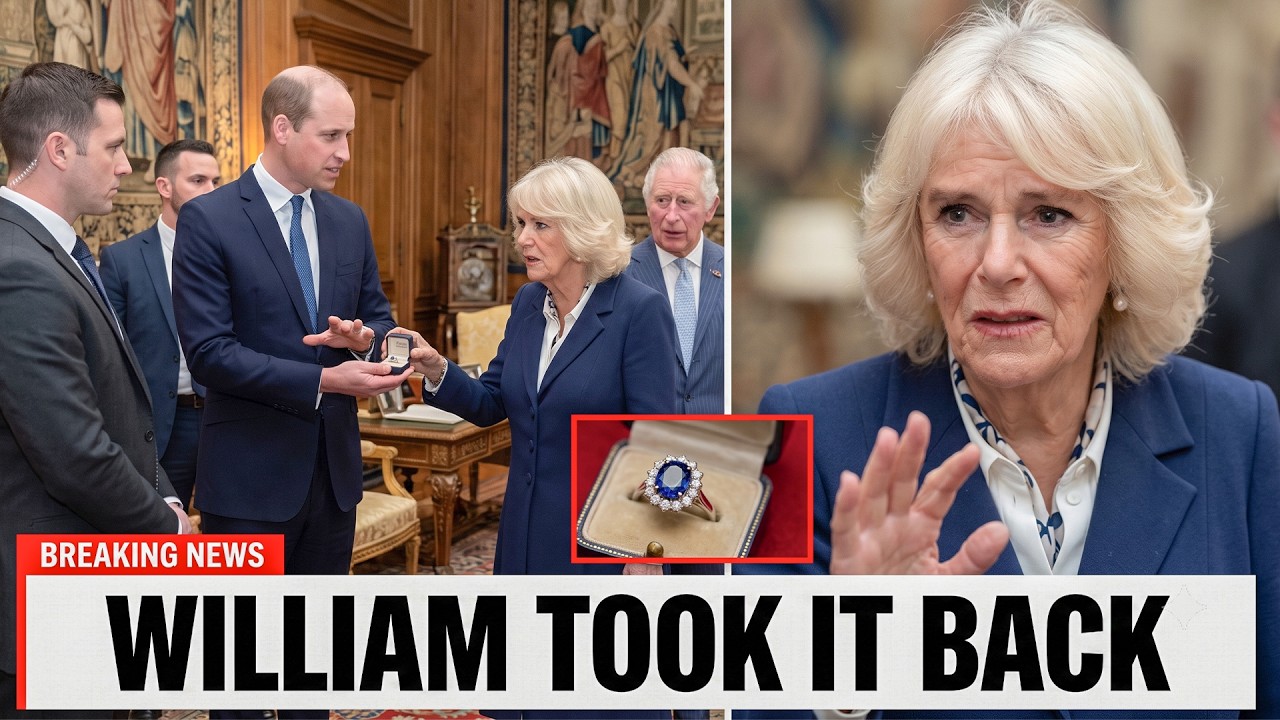
Diana was instead allowed to choose one she liked, and she made her selection without hesitation from a tray of options sent by London jewelers Garrard. That choice broke long-standing royal protocol. Royal brides traditionally wore custom-made pieces, designed exclusively for them, not items selected from a public catalog. Diana’s decision to pick from the Garrard range was considered highly unconventional, but it became one of her earliest and boldest statements.
The ring she chose featured a 12-carat oval Ceylon sapphire surrounded by 14 round brilliant diamonds, all set in 18-carat white gold. The design was inspired by a sapphire and diamond brooch that Prince Albert gave Queen Victoria the night before their wedding in 1840. Diana was drawn to that historical connection. At the time, the Garrard catalog was technically available to any member of the public, which scandalized certain corners of the palace.
A future Princess of Wales choosing an off-the-shelf ring was seen as almost radical. The ring accompanied Diana for the next 16 years. It was on her hand during state dinners, hospital visits, school runs, and countless photographs that defined her public life. After her tragic death in August 1997, the ring disappeared from public view.
It would not resurface for more than a decade. Diana’s sons inherited the piece, although the exact arrangements were not made public for years. Even though Harry legally received the ring, he chose to hand it over to William so that his brother could use it when proposing to Kate Middleton. Diana had anticipated such an outcome.
In a letter of wishes written the day after signing her will, she asked that all her jewelry be held by her sons so their future wives could wear it. She wrote the letter without knowing who those wives would be, trusting her sons to interpret her intentions. That letter, however, was not legally binding. Her estate executors challenged parts of her wishes, and the jewelry remained in official custody for years.
Many items were finally handed to the princes when they turned 30, far later than Diana had intended. William kept the ring for several years before using it. In October 2010, he took it to Kenya, carrying it nervously for three weeks while on safari with Kate Middleton before proposing. He later admitted he was worried about losing it.
In November 2010, the engagement was announced, and Kate appeared publicly wearing the sapphire ring. At St. James’s Palace, William explained his decision: “It’s my mother’s engagement ring and it’s very special to me, just as Kate is special to me. It was important to bring them together.
I wanted to ensure my mother was part of this day and our future together. ”
William’s choice carried symbolic weight beyond romance. Much of Diana’s jewelry did not remain with her sons after her death. Items she personally owned went to William and Harry, but jewelry from the royal collection belonged to the crown and returned to the vault.
The distinction between what was truly Diana’s and what was only loaned to her was often unclear. Gifts given under crown rules were expected to return to the institution once she was no longer part of the royal family. Other pieces had been loaned for specific occasions and were never really hers. One such item was the Queen Mother’s wedding gift to Diana in 1981: a striking necklace of diamonds and emeralds featuring three white ostrich feathers in diamonds, representing the Prince of Wales.
The piece dated back to 1863, originally given to Princess Alexandra of Denmark upon her marriage into the British royal family. Diana wore it at state dinners and formal galas until April 1996, just months before her death. After she died, the necklace was returned to the royal collection, as it was loaned through her marriage rather than owned outright. In 2006, Queen Camilla wore that same necklace, but in a changed form.
It had been refashioned into a brooch valued at roughly $137,000. Critics called the alteration tacky and disrespectful, arguing that the piece should have been passed on to Diana’s sons. Others defended Camilla, noting that the necklace belonged to the crown estate, not to Diana personally, and that Camilla had every right to wear it. Buckingham Palace issued a statement explaining that the Duchess of Cornwall wore the brooch to Cheltenham while presenting the Queen Mother Cup, a fitting choice since the piece once belonged to the Queen Mother.
The public, however, remembered Diana wearing the necklace at memorable events, including a gala in Vienna in 1986 and in Toronto in 1991. The palace’s explanation was factually accurate, but the emotional weight of the image could not be easily dismissed. The moment became another chapter in the complex relationship between Camilla and Diana’s legacy, one that Prince Charles reportedly took note of from a distance. William’s decision to place Diana’s ring on Kate’s hand was widely seen as a direct response to that complicated history.
In his mother’s letter of wishes, Diana wrote: “I would like you to allocate all my jewelry to the share to be held by my sons, so that their wives may, in due course, have it or use it. ” William understood that instruction. Kate has worn the ring every day since her engagement, and she has also worn Diana’s pearl earrings, matching sapphire earrings, the Lovers’ Knot Tiara, and the emerald choker Diana wore as a teenager. The ring, once a symbol of Diana’s defiance of palace tradition, became a symbol of her son’s devotion to her memory.
It sat in the vault for 13 years before William recovered it and placed it on Kate’s finger under the African sky in Kenya. Diana spent 16 years building a legacy the palace could not fully control. In the years that followed, William worked to carry that legacy forward in ways that went beyond protocol.