Around 60,000 years ago, people in southern Africa were carrying water in ostrich eggshells. A small opening cut near one end, the contents emptied, the shell cleaned, and a grass stopper plugged the hole. Placed in a sling or net, an object meant to protect an unborn bird became a roughly one-liter canteen. The eggshell is only the part of the story that survived.
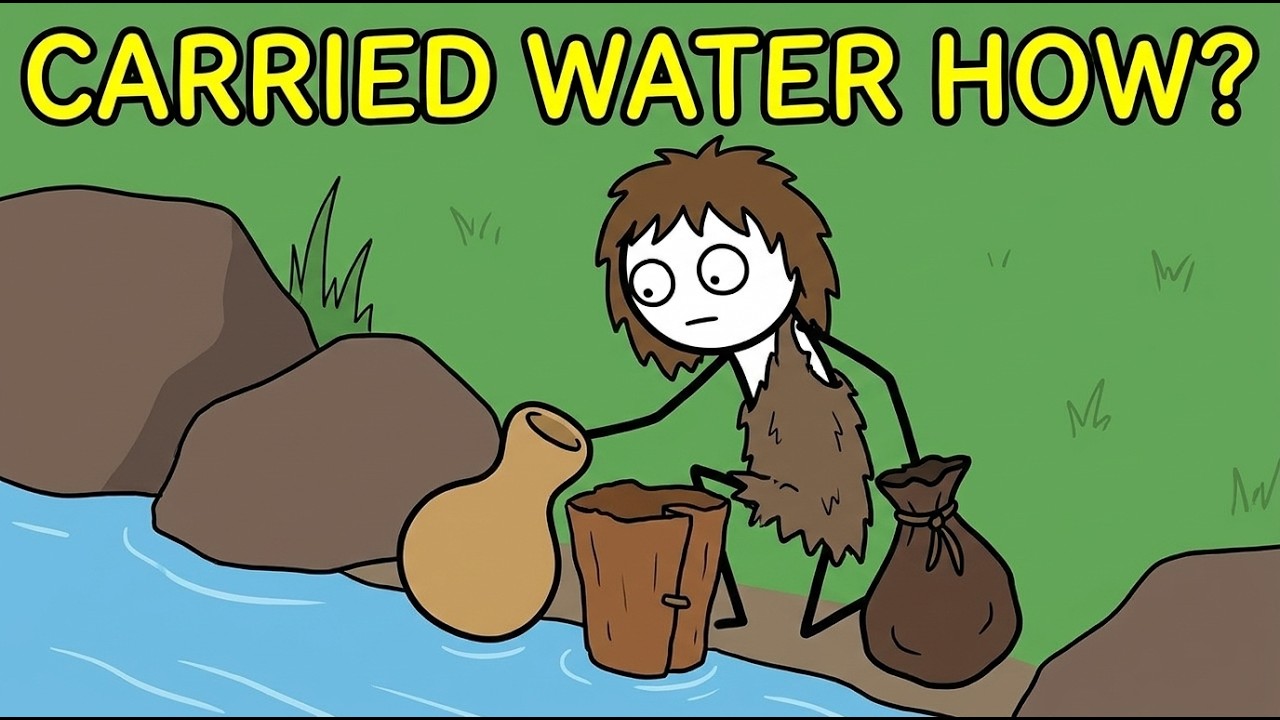
Ancient humans also transported water in animal skins, stomachs, bladders, gourds, bark vessels, wooden containers, woven baskets, and pottery — plus materials that have long since decayed. Some groups used an even lighter method: they carried knowledge of where water would be, and placed supplies along a route before they needed them. The real invention was not the bottle. It was the ability to separate water from the place where nature had left it.
Before that separation, water controlled movement. A group could hunt only so far from a spring, and could cross only so much dry ground. If the return journey exceeded the water available inside the body, the landscape had effectively built an invisible but persuasive wall. The physical problem was simple: water is heavy.
One liter weighs almost exactly one kilogram. Ten liters means ten kilograms before the container is counted. Thirty liters turns a person into an accidental weightlifter. Water also refuses to cooperate with bad engineering.
It escapes through tiny holes, soaks fiber, weakens some materials, and makes poorly shaped containers swing against the body. Wide openings spill; narrow ones are hard to clean. Rigid vessels protect their contents but take up space when empty. Soft bags collapse for easy carrying, but every seam becomes a possible leak.
Heat made the calculation worse. Water lost through sweat must be replaced, yet hotter journeys make every kilogram feel heavier. A dark container left in the sun becomes warm. A fragile vessel needs padding, adding bulk.
One large container puts the entire supply in a single object, so one fall becomes a group emergency. Several small containers require several stoppers, several carriers, and several chances for something to crack. The best design depended on the journey. A short trip from stream to camp favored a different vessel than a two-day move across dry country.
There was no perfect prehistoric canteen because there was no standard prehistoric day. Contamination added another problem. A container preserves water, but it also preserves everything living in it. Ancient people could recognize bad smells, strange colors, and stagnant pools, but they could not inspect bacteria and parasites.
A portable container solved distance; it did not automatically solve safety. Carrying water was never one invention made once. It was a long series of local answers. The easiest answer was to use a container that already existed.
Large shells held liquid. Tortoise shells became bowls. Hollow wood or bamboo became tubes. Certain fruits dried into hard, light vessels.
An animal organ was already designed to hold fluid without leaking. The ostrich egg was unusually good. An intact shell is strong for its weight, its curved surface spreads pressure, and the small opening used to empty it can later be plugged. It holds roughly a liter — enough to matter, but not so much that one break destroys the whole supply.
Several shells distribute risk. If one fails, the day becomes worse; it does not necessarily become final. At Diepkloof Rock Shelter in South Africa, archaeologists found hundreds of deliberately engraved ostrich eggshell fragments dating to roughly 60,000 years ago. The geometric patterns were not scratched onto useless debris.
They belonged to functional containers used in daily life. The designs show a tradition: people selected the material, prepared it, marked it, and passed knowledge about its manufacture through generations. Some patterns may have identified individuals, groups, contents, or ownership, though archaeology cannot recover the exact meaning. The line survives; the explanation does not.
More recent observations among San communities in the Kalahari illustrate how such flasks worked. A hole was drilled, the egg emptied and cleaned, and the opening closed with grass, clay, wax, or another stopper. The shell was often carried in a net or sling to spread pressure across its surface. Some flasks were placed in caches, letting water wait at a location until people returned.
Ethnography cannot prove that every recent practice existed unchanged 60,000 years ago, but it demonstrates what the material can do. Eggshells were regional technology — they worked where ostriches lived. Humans eventually occupied forests, mountains, northern plains, islands, deserts, and river systems without such a convenient bird. Elsewhere, soft containers mattered more.
An animal bladder is light, flexible, and naturally resistant to leakage. A stomach can be cleaned and repurposed. A hide can be cut, folded, and stitched with sinew or plant cord. Grease, wax, resin, or repeated wetting could improve the seal.
A skin bag collapses when empty, a major advantage when carrying a full container outward and an empty one home. The disadvantage is that skin disappears. Bone survives. Stone survives almost offensively well.
Fired pottery breaks but leaves fragments that last thousands of years. Leather, gut, sinew, bark, and fiber are eaten by microbes, damaged by insects, soaked, or crushed until nothing that looks like a container remains. This creates a distorted prehistoric world: museums fill with hand axes and spear points, so ancient humans appear to have spent most of their time producing sharp rocks. In reality, a cutting tool is useful partly because it can manufacture everything less likely to survive — wooden shafts, hide bags, baskets, cordage, clothing, shelters, and handles.
Stone gets the credit because stone stays available for archaeologists. Direct evidence for very early skin water bags is therefore scarce. It is reasonable to infer their use from later ethnographic examples, from ancient hide-working tools, and from the obvious availability of animal membranes. But reasonable is not the same as proven.
Archaeology can show that people processed skins deep in prehistory; it cannot always tell whether a particular hide became clothing, bedding, shelter, a carrying bag, or a container lost before reaching camp. That uncertainty is not a weakness in the story. It is the story. Plant materials created another range of possibilities.
Bark could be removed in sheets, folded, stitched, or shaped into a vessel. Wood could be hollowed, carved, burned, and scraped. Bamboo and other naturally hollow stems provided ready-made chambers. A hard-shelled gourd could be dried, opened, and cleaned with little additional weight.
Bottle gourds are particularly revealing: when mature and dried, the outer wall becomes rigid while the soft interior can be removed, leaving a light, reusable container suitable for liquids or dry goods. Gourds later became important across Africa, Asia, the Pacific, and the Americas, but their deep history is complicated. Plants spread; people moved them. Ocean currents may have carried some gourds between continents.
A gourd found in a later archaeological setting does not prove every earlier population had one. What it proves more broadly is that ancient container technology was ecological: people did not wait for one universal design; they learned the useful properties of whatever grew nearby. Fibers expanded the options again. Twist plant material and it becomes cord.
Combine cord and it becomes a net. Interlace flexible stems and they become a basket. Line that basket with leaves, hide, clay, wax, or resin, and a vessel originally meant for roots can hold liquid for at least part of a journey. Evidence for complex fiber work reaches far into the Upper Paleolithic.
Impressions in clay from sites in what is now the Czech Republic show that people around 25,000 years ago understood cordage, textiles, and basket-like structures. The skill was probably older than the evidence. A basket requires planning that begins before weaving: identifying suitable plants, gathering them at the right stage, splitting or softening them, maintaining tension, and shaping repeated flexible elements into a strong form. A carrying net needs a pattern that distributes weight without letting the container slip through.
Carrying water also meant solving the problem of carrying the container. A vessel held in one hand costs a hand that could grip a climbing surface, balance a load, carry a spear, hold a child, or process food. Slings, straps, nets, and frames moved the weight onto the shoulder, back, forehead, or hips while freeing the arms. There was no single prehistoric backpack launch event.
Different communities developed carrying systems suited to their bodies, terrain, and daily work. A rigid pot behaves differently from a flexible skin. An eggshell must be protected from impact. A round-bottomed container may refuse to stand on a flat surface.
A narrow neck limits spilling. Handles create stress points. A wide body holds more but shifts the center of mass away from the carrier. Ancient people did not need equations to understand these forces; they had experience.
A strap that snapped ten kilometers from water was redesigned if the carrier returned. A seam that leaked was stitched differently. A shell that broke under a particular load taught everyone who saw it. Each successful container held more than water; it held accumulated failure.
Not all water needed to travel with the person. Sometimes the better strategy was to make the journey in advance. Water could be carried to a hunting route, seasonal camp, dry crossing, or resource area and left in a cache. A sealed vessel might be hidden in shade, placed inside a crevice, covered, or buried to protect it from animals, sunlight, and damage.
Later travelers would arrive not at a natural spring, but at water deposited by an earlier version of the group. This turned memory into infrastructure. A cache was useful only if people remembered its location, trusted that it remained intact, and communicated that knowledge. Archaeological and recent caches of ostrich eggshell flasks in southern Africa demonstrate the principle: some shells were set aside underground, occasionally in groups.
A traveler could distribute water across a landscape instead of carrying the entire mass in one exhausting movement. The technique carried risks — the cache might break, leak, be found, become contaminated, or simply not be where memory insisted it was. Landscapes change; landmarks burn; sand moves. Still, caching changed the calculation.
A dry route could be provisioned in stages. There was another solution: carry less because you know more. Expert landscape knowledge reduces the amount of water that must be transported. People followed animal movements, bird behavior, vegetation, geology, drainage, and seasonal rain.
They timed travel for cooler hours, rested during dangerous heat, chose shaded routes, and moved between reliable sources. Survival knowledge was local: which hollow still held water late in the dry season, which spring became salty, which route offered shade, which source could support a group rather than one thirsty hunter. The container and the mental map worked together. Natural water sources could also be modified.
People cleared blocked seepages, deepened shallow hollows, covered small supplies against animals and debris, and used stones, bark, or branches to improve access. In some landscapes, a damp patch could be opened until water slowly collected; in others, rock cavities held rain long after the surrounding surface dried. These were not portable containers, but they turned parts of the landscape into vessels. Ancient water logistics included water carried by people, water stored at camp, water hidden along routes, and water protected where it naturally gathered.
The smartest solution was usually a combination: carry enough to reach the next source, maintain that source when possible, cache an emergency supply beyond it, and teach someone else the sequence. A route was safe only when every link worked. People could also begin a journey already hydrated, travel after drinking at a source, select water-rich foods, and coordinate movement around predictable access. These strategies did not replace carrying devices; they reduced the burden placed on them.
Eventually, pottery transformed storage. Some of the earliest known pottery comes from Xianrendong Cave in China, dating to roughly 20,000 years ago, long before farming. Those vessels were probably strongly connected to cooking, but pottery opened a new category of liquid control. Clay could be shaped into a large container, fired until durable, cleaned, set beside a hearth, and reused.
It was also heavy and breakable. For a highly mobile person crossing rough ground, a pottery jar can feel like carrying a future archaeological fragment. Pottery becomes more attractive when water must be stored at a camp, when people remain longer in one place, or when loads move by boat, sledge, pack animal, or organized labor. As communities became more settled, water containers grew larger and more specialized.
Jars stored household supplies; smaller vessels poured and drank; ceramic surfaces could be modified, repaired, or coated. Later societies developed wells, cisterns, canals, aqueducts, and fleets carrying amphorae. But those systems did not replace the ancient question; they enlarged it. How do you move enough water from where it exists to where people intend to live?
For mobile hunter-gatherers, the answer might be one eggshell in a sling. For a farming village, repeated trips with jars. For a city, thousands of workers, pipes, reservoirs, and laws deciding whose field receives the flow. The scale changed.
The physics remained. Transporting water affected more than thirst. It changed hunting range. A group could remain near a carcass longer, travel farther for high-quality stone, visit another community, explore dry terrain, or occupy places where water appeared only seasonally.
Containers supported children, injured people, older adults, and anyone unable to make the full trip to a source. Water could be brought to a fire, a hide-processing area, or a temporary shelter. It also created work: someone made the vessel, filled it, carried the weight, repaired the net, remembered the cache, cleaned the interior, or decided that a particular smell meant the experiment had ended. The ability to move water did not free humans from dependence on it; it reorganized that dependence across tools, labor, knowledge, and cooperation.
That cooperation is easy to miss when looking at a broken shell. One person may have drilled the opening. Another knew which grass made a reliable stopper. Someone understood how to weave the carrier.
Someone else knew the route. A child learned where the cache was located. An older person remembered that a distant spring failed during a particular kind of dry year. The technology existed between them.
A container is more than an object with an empty space inside; it represents foresight. The maker prepares for a need that has not arrived. Water is collected here because thirst will happen there. The vessel physically carries a prediction into the future.
Humans had already shown this ability in tools made before a hunt and food saved for later. Containers multiplied it: a person could carry resources beyond the immediate reach of two hands. That may be why the container’s importance is underestimated. Spears are visually dramatic; hand axes look ancient in exactly the way people expect.
A bag resembles something left beside a supermarket checkout. Yet the quiet container may have changed human movement as profoundly as many weapons. A spear allows a hunter to reach an animal; water allows the hunter to reach the place where the animal lives. The first person who carried water will probably never be identified.
The behavior may be far older than the earliest surviving vessel. A folded leaf can hold liquid briefly; a piece of hide leaves almost no durable signature. There was no single bottle age. There were shells beside coasts, eggs across African grasslands, gourds in warmer regions, skins wherever animals were processed, bark and wood in forests, fiber vessels in places rich with workable plants, and clay where people could shape earth and control fire.
Ancient humans transported water without bottles because a bottle is only one version of an older idea: make an empty space, stop it from leaking, and carry it into a future where water will not be waiting. Sometimes that space was inside an eggshell. Sometimes it was sewn from an animal. Sometimes it was woven, carved, grown, fired, hidden underground, or stored inside the memory of a route.
The materials changed; the problem did not. Human beings could move beyond the edge of dependable water only when they learned to bring part of the water with them, or arrange for it to arrive first.


