The back room of the bar was hotter than it should have been for a June evening in coastal North Carolina, but a back room full of Marines is always its own weather. Dominic had thrown the door wide and let the smell of cheap pilsner and frying oil follow him in, and a couple dozen men in collared shirts had trailed in after him, and somewhere in that crowd I had carried two cardboard boxes from my rental car and set them on the long table by the wall. Inside were the kinds of things an older sister thinks of on the way to a younger brother’s promotion party: a sheet cake from a grocery store, a cheap aluminum frame with his new sergeant chevrons in it, and a card I had picked up at the airport because the one I had bought a week ahead had been too sentimental to give him in front of his platoon. I had not seen Dominic in fourteen months.
He had eight years on me and forty pounds. He had hugged me when I came through the door, lifted me a little off the floor in front of his men, and made a joke about how the wing nut had finally turned up. I had let him. The Marines knew me only by face.
I had told them my name when they asked. Told them I worked for the Air Force. Told them I was based out of Georgia. None of them pressed.
None of them had any reason to. I wore a green blouse, dark jeans, and a thin gold chain my grandmother had given me at my commissioning. I looked like what I was on paper that night: a forty-year-old woman who had flown into Jacksonville to watch her kid brother get pinned. Sergeant Dominic Marchetti, United States Marine Corps, twenty-eight years old, Bravo Company, Second Battalion, Eighth Marines.
He had wanted his sister there. I had come. The Gunny was the one I noticed first. Marines always tell you who the Gunny is without anyone having to point.
He was a wide-shouldered man with a clean fade and a tan line where his patrol cap had cut a band across his forehead. He stood at the back of the room with a foam cup of coffee in one hand and a beer set down on the high top behind him, because Marine gunnery sergeants drink coffee at their Marines’ parties for a reason. He nodded at me when I came in, polite, with the eyes of a man who was at work in his own way. I nodded back.
I did not introduce myself. Dominic pulled me toward his table when the second round of beers came. His arm went around my shoulders. He was beaming the way a man beams when he has spent his whole life being the loud one and the room has finally given him a stage.
“Marines, this is my sister Vivian. She’s the reason I’m here tonight, mostly. ” He grinned at his own line, and the table grinned back. “She bullied me into staying through my senior year of high school when I was about to drop out and enlist.
”
A chuckle from his squad. One of them, a corporal whose face I would later learn went with the name Pace, lifted his glass to me. I lifted mine back. “Now,” Dominic said, swinging his beer to his right, “she works for the United States Air Force, which we will forgive.
” A bigger laugh. The Gunny smiled into his coffee. He did not laugh. “Come on, sis.
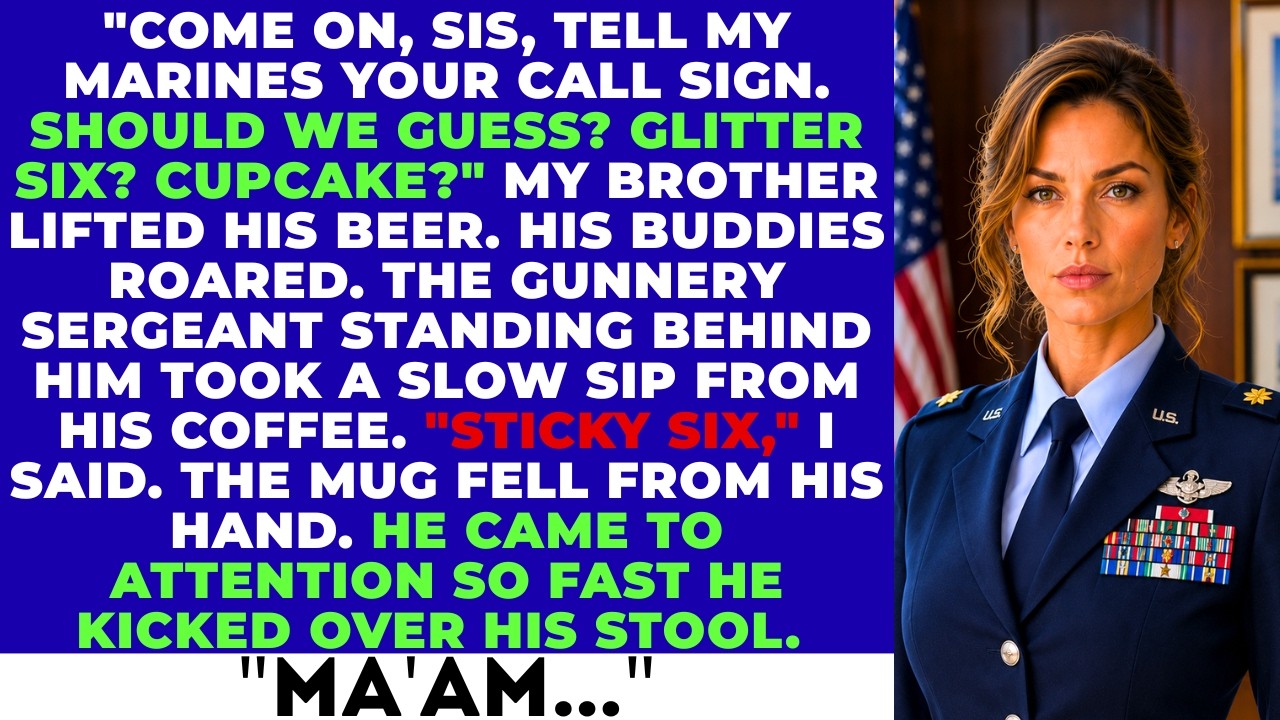
Tell my Marines your call sign. Should we guess? ”
“Glitter 6 cupcake. ”
The table howled.
Dominic was looking at me with the expression he had used as a boy when he wanted me to play along. The one that said, Please be the good sport. Please let me have this. I had let him have things for twenty-eight years.
I would have let him have this. But I was looking at the Gunny. The Gunny had stopped smiling. The smile on his face had not yet caught up to whatever his shoulders were doing.
He had heard the words call sign in a room of Marines, and his face had become a little quieter than it had been a second before. He was a man who had been on a radio in his life. I do not know why I said it the way I said it. I do not know why I did not laugh along.
I do not know why I did not give him Stapler 6 or Coffee 6 or one of the other answers I had used in the years I had not wanted to be asked. Something in the Gunny’s still face was something I recognized, and something in me had been quiet for too long. I said, “Sticky six. ”
His coffee cup went first.
He did not throw it. He simply stopped holding it. The foam cup hit the toe of the deck mat and bounced, the lid came off, and coffee splashed up over his shoe and the back of his hand on its way down. He did not look at it.
His stool was the second thing. He came to his feet without a noise, the way only men who have stood up under a poncho liner in the cold a thousand times come to their feet, and the stool tipped over behind him with a clatter no one moved to catch. He brought his hand up and saluted. He held it.
The Marines at his side of the table turned because the stool had fallen. They saw the Gunny’s hand. They saw his face. The laughter at the table went out the way a candle goes out all at once, with a small thin sound in the place where the noise had been.
I returned his salute the way you return one when the man giving it is older than his rank suggests. Slowly. The way I had returned the salute of a Master Chief Petty Officer at Joint Base Andrews three years before. He had been a SEAL.
He had known the same kind of thing the Gunny knew. “Ma’am,” the Gunny said. He had to clear his throat. “Oh, ma’am.
”
Dominic’s arm was still around my shoulders. It went heavy on me. It had stopped being a thing he was doing on purpose. Pace was the one who stood up next.
He stood up slowly. He set his beer down on the table without looking at it, and the beer foamed up over the lip of the glass and ran down the side, and he did not seem to notice. He was looking at the Gunny, then at me, then at the Gunny again. He drew a breath as if he were about to say something specific, and then he said it.
“Major. ”
He had not been told. He had read it off the Gunny’s face. “Major,” he said again.
“My sister’s husband was in Third Platoon, Bravo Company, March of 2013. You are the reason he came home. ”
A boy at the far end of the table, whom I would learn was named Tate Connelly, whispered the word sang under his breath. I heard it.
I did not look at him. I did not look at any of them. Dominic’s hand was still on the back of my chair. It had stopped moving.
There is a sound an A-10 makes when its cannon fires that is not the sound the movies give you. The movies give you the long buzzing roar, which is correct as a phonetic but wrong as a feeling. What you hear from the cockpit when you press the trigger is a low hum that is more felt than heard, because the plane is built around the gun the way a violin is built around the sound. The thirty-millimeter cannon is the structural reason for the aircraft.
The wings, the engines, the pilot, the cockpit, the titanium tub I sat in—all of it is a delivery system for seven barrels arranged around a single bore. When you press the trigger, the gun adds mass to your nose. The plane settles. The plane gets serious.
The men on the ground who hear it, who have been told it is coming, do not cheer. They do not move. They put their cheek against the dirt and listen to the long low hum and they pray. I had pressed that trigger many times in my career.
I had pressed it for the first time over a tank-killing range in southern Arizona in 2011. I had pressed it for the last time over an Afghan riverbed in 2013, and the gun had clicked dry after the third pass. My flight lead, a man with the call sign Hammer 26, who had been my flight lead since the schoolhouse, had said over the interflight frequency that he was Winchester also. We had been Winchester together.
The plane is built to keep firing after it has run out of ammunition, in a sense. The plane is built to stay. I had been built to stay, too. That was the discipline.
That was the thing I had taken into the Air Force at twenty-two years of age. You learn to be the loudest thing in a fight without ever raising your voice. You learn to put the rounds inside the line the troops in contact have given you. And you learn to put them inside that line under fuel pressure and weather and your own fear, because the men on the ground do not get to leave the way you get to leave.
You go. I had filed the citation away in a sock drawer in the apartment I rented near my squadron at Moody Air Force Base in Georgia. I had not framed it. I had not shown it.
I had pinned the ribbon on once at the ceremony at Davis-Monthan in the fall of 2013, where a one-star general I had never met read three paragraphs of careful language about an action in Helmand Province, and where my squadron commander had clapped me on the shoulder afterward and said quietly, “Sticky, you do not have to put it in a drawer. ” I put it in a drawer anyway. I had been twenty-seven years old. I had a brother who was fifteen and a mother who had stopped picking up on the second ring after my father’s funeral.
I had not believed the ribbon would belong in the conversations we were having. In the bar that night, with the Gunny’s salute still warm in my returned hand, I felt the drawer in Georgia six hundred forty miles away and the metal in it. I felt my own breath against the lining of my throat. The composure I had spent eighteen years building was holding.
The hand I had set flat on the table was steady. The Marines were waiting for me to say something. Not pressing. Waiting in the way of men trained to wait at attention while a senior officer worked something out.
I said, “Gentlemen, sit down, please. ”
They sat. The Gunny sat last. He did not sit until I had taken my hand off the table.
My father had been a Gunnery Sergeant. Daniel Augustine Marchetti, United States Marine Corps Infantry, retired with twenty-eight years in 2001 and dead of a heart attack two years after that at the age of fifty-one. He had grown roses in a small bed against the back of the garage. He had read the obituaries first in the morning paper.
He had taught me to fold a flag at the age of nine on a Sunday afternoon with a triangle of practice cotton, his big hands over my small ones. He had not lived to see me commission. He had not lived to see Dominic become a Marine. My mother had buried him in the same kind of clothes she would wear for the next twenty years.
Marchetti, sixty-seven years old now, a woman who had once been a hostess at a Holiday Inn in the Lehigh Valley and had spent forty-one years pressing the same kinds of uniforms over and over again. She had folded the flag at the cemetery and held it on her lap during the drive home. She had said almost nothing to me at the wake. She had said a great deal to Dominic, who had been five years old and had not understood most of it.
Although he had understood the part where she pressed his small face to the brass of his father’s belt buckle one last time and told him he was the man of the house now. I had been seventeen. I had stood at the cemetery in a black dress I had borrowed from a girl at school whose grandmother had died the year before. I had not cried.
My father had told me the spring before he died that I would not cry at his funeral because I was made the way he was made. He had been correct. I have not, in eighteen years, found a way to disagree with him on that point. I had decided to fly when I was twelve.
I had decided to fly the A-10 specifically when I was fourteen, after a magazine article in a doctor’s waiting room and a documentary on a Saturday afternoon. I had not told my mother. I had told my father in the garage the year before he died. He wiped engine oil off his hands with a rag and looked at me for a long minute, and then he nodded.
And then he said the only thing he ever said to me on the subject. “If you fly the airplane shaped like a bathtub, you fly it for the men on the ground. You do not fly it for yourself. ”
I said, “Yes, sir.
” He let it go at that. After he died, my mother organized the family’s pride around the man she had buried. The dress blues went into a glass case in the living room. The Korea ribbon his uncle had earned went into a frame on the hall wall.
The folded flag went into a triangular wooden case on the mantel. The conversation became slowly a conversation about Marines, and about the brother who was being raised to follow his father, and about the daughter who had elected to do an easier thing. My commissioning ceremony at Penn State in May of 2008 was on a hot Saturday morning in a gymnasium that smelled of varnish. I stood in dress blues that were not Marine dress blues—the Air Force kind—and raised my right hand and swore to support and defend the Constitution of the United States of America against all enemies, foreign and domestic.
My mother came. She brought a pound cake. She hugged me afterward and said she was proud of me. She said it the way she would have said it if I had graduated from cosmetology school.
I had not believed it was malice. I had believed it was geometry. My father had been a Marine. Dominic was going to be a Marine.
The space between them was where she had decided to keep her pride, and there had not been room in that space for an Air Force daughter. I had not corrected her. I had not corrected anyone. I had taken my training in Oklahoma and my fast-mover ride in Mississippi and my A-10 training in Arizona, and I had gone to Afghanistan twice, and I had pressed the trigger of a thirty-millimeter cannon and stayed on station, and I had come home, and I had said almost nothing about any of it at the kitchen table in Allentown or in the bar in North Carolina with the Gunny’s coffee bleeding into the boot mat.
The Marines were sitting again. The room had begun to remember it was a room. I picked up my glass, took a small sip of beer, set it back down where my hand had been. “Dominic,” I said, “I am still happy for you tonight.
”
He could not look at me. He looked at the rim of his glass. I let him. The Gunny sat down with both hands flat on the table.
His knuckles had whitened. He turned the foam cup right side up on the deck mat with the toe of his boot, in the kind of gesture that buys a man two seconds. He brought his hands together. He looked at me.
“Ma’am, I am Gunnery Sergeant Reed Hulkcom. In March of 2013, I was a corporal in Bravo Company, First Battalion, Third Marines, Third Platoon, Second Squad. My platoon sergeant was Staff Sergeant Iverson Reyes. My platoon commander was First Lieutenant Hugh Tarlton.
Our radio call sign that night was Bravo 22. ”
He said it the way Marines say things when they want a record to be straight. The way a man says it when he has been carrying the names for thirteen years and has not had a place to put them. “Hulkcom,” I said.
“Bravo 22, the tree line on the south bank of the wadi. ”
His eyes filled. He did not let them spill. “Yes, ma’am.
”
I do not know what I would have said next. There is no Air Force standard operating procedure for a moment like that. No doctrine. Only what is in the room and what is in your hand and what you have already chosen to be.
Pace had been on his phone outside the bar’s back door for three minutes. He came back in with the kind of pale a man’s face becomes when he has heard his wife’s voice say something he cannot yet say out loud. He held his phone in front of him in both hands like a thing he was carrying. He stopped behind the Gunny’s left shoulder.
“Ma’am, my name is Corporal Devon Pace. My sister is Rosalind Pace Wexler. Her husband is Staff Sergeant Aaron Wexler. He is stationed at Quantico.
He was a sergeant in March of 2013. He was in the wadi that night under the lip of the ditch with a sucking chest wound. He was the third man you were given as a casualty on the radio. ”
“He was the second,” I said.
The number had come out of me without my asking. I had not known I still had the number. It had been sitting in my head for thirteen years, waiting. “He was carried out at 0114 local.
”
Pace’s face did not change. The corner of his mouth moved a little. “Ma’am, my sister kept the call sign. She kept it because we did not have your name.
She named her son after the call sign, because she had been twenty-three years old and pregnant and had not known what else to do. ”
The room had gone still in a different way. The Marines who had not been in Bravo Company had begun to understand, the way Marines understand, that something the senior NCOs were not going to explain was being said in front of them, and they had taken on the posture they take on when they are not going to ask. “What is his name?
” I said. “Aaron Pace Wexler. He goes by Aaron. Your nephew, Sticky.
”
The word landed in the middle of the table the way a coin lands. It did not ring. It sat. “Ma’am,” the Gunny said, his voice gone quiet.
“He plays second base. He is eleven. He has the call sign on the back of his Little League jersey. He does not know why.
”
“He knows why,” Pace said. The Marines at Dominic’s table had begun, in the slow way Marines do this, to stand. Not all at once. Not coordinated.
The way a long bench rises when the men on it cannot sit anymore. Connelly, the lance corporal who had whispered sang, came up out of his chair first. Then the corporal at the end of the table. Then two more.
Then the Gunny’s senior squad leader, a sergeant whose name I did not learn that night. The Gunny did not stand. He had stood once. He stayed seated to keep the room from going into a ceremony I had not yet given anyone permission to give.
Dominic did not stand. His chair did not move. He sat the way a man sits when his arms have become heavy and his face has become a face he does not know how to wear in front of the men he leads. He kept his eyes on the rim of his glass.
I looked at him. I had not looked at him in two minutes. He had been the only person in the room for twenty-eight years, and I had not looked at him in two minutes. I did not know yet whether I was angry.
I did not know yet whether I was disappointed. I knew, in the part of me that had survived three years of training and two combat tours, that I was going to need to look at him for a long time before I knew what I was, and I was going to need to do it on my own. I touched the Gunny’s wrist with two fingers. He looked up.
“Gunny, I am going to go outside for a minute. Please tell your Marines to sit down. ”
“Ma’am. ” He turned in his chair.
He did not raise his voice. He did not need to. “Marines, your seats. ”
They sat.
I picked up my coat off the back of the chair. I did not look at Dominic on my way past him. I went out through the back door into the parking lot, into the smell of summer asphalt and pine, and closed the door behind me. I stood for a moment with my hand on the cold metal and breathed.
He came out after me ninety seconds later. I had known he would. I had been counting in my head the way pilots count when they’re waiting for a thing to arrive. I had reached eighty-three when the door behind me opened, the noise of the bar came out for a second, and went back in when the door closed.
Dominic stood three feet away with his hands in the back pockets of his jeans. He had not put on a jacket. The night was warm. The lot was half full of pickup trucks, one new sedan, and a single motorcycle.
A man sat on the curb at the far end of the building on his phone, his back to us. The streetlight above the dumpster had a moth in it. Dominic did not look at me. He looked at the line where the asphalt met the curb.
“You could have just told me,” he said. “You could have told me one time. ”
“I tried to. ” I had said it before I had decided to say it.
“When I told you in 2013, I told you in 2014. I told you at Christmas of 2015. I told you in the garage at the lake house in the summer of 2016. I told you in the hospital when Mom had her hip replaced in 2019.
Each time, you stopped listening when I got to the part where I was the lead pilot, and you went and asked Mom what she thought of the pickup truck I was looking at. ”
He had not known any of this. He had also known all of it. I watched the knowledge land on him.
“You made me look stupid in front of my platoon, Vivian. ”
He had used my full name. He had not used it in years. “I did not make you look stupid.
Hulkcom made you look slow. He did not mean to. He had no way of knowing you did not know. ”
“You should have told me before tonight.
Before I walked in there with my Marines and let them say cupcake. ”
“Dominic, what? I am forty years old. You are twenty-eight.
I have known about Sang for thirteen years, and you have known about Sang for thirteen minutes. I am sorry that the order of those two numbers is uncomfortable for you. I am not sorry the numbers are what they are. ”
He looked at me then.
He had his father’s face. He had had his father’s face since he was a boy. He had not had his father’s eyes until the year before he enlisted. He had them now.
He was a Marine looking at a sister he did not know how to look at, and he had no rank in his pocket that would help him. “Mom is going to call you. ”
“I know. ”
“She’s going to ask you why you did not tell me.
”
“I know. ”
“What are you going to tell her? ”
“The same thing I am telling you. ”
He breathed out.
He took his hands out of his back pockets. He did not put them anywhere. They hung at his sides. “You have a cross.
”
“I have a Distinguished Flying Cross. ”
“There is no Air Force Cross for stayed on station. The Air Force Cross is one level above. There are men in the Air Force who deserve one and do not have one.
I am not one of them. ”
“You have a DFC with a V. ”
“Yes. ”
“You have never said it out loud to me before.
”
“You have never asked. ”
He looked at the asphalt again. The moth in the streetlight had stopped beating against the glass. “I do not know what to do with this,” he said.
“I do not need you to do anything with it tonight. ”
“You’re going to leave tomorrow. ”
“I am going to leave Monday. ”
“What do you want me to do?
”
I had not known until he had asked. I thought about it for the length of a slow breath. “I want you to go back inside and sit down at your own promotion party and let your platoon gunny tell you the truth. And I do not want you to interrupt him.
And after that, I want you to think about it for a week. And then I want you to come and find me on your own. No Mom. No platoon.
No beer. I do not want a public apology. I want a private one. ”
He nodded.
The way a Marine nods. “And Mom? ”
“Mom is going to be Mom. I am not going to fix that for her.
And I am not going to fix it for you. She gets to find her own way to whatever this is. ”
The door behind me opened. The Gunny was framed in it.
He did not say anything. He looked at me, held the door open, looked at Dominic, and did not say anything. I went back in. Dominic followed me.
The Gunny pulled out my chair without making a show of it. The Marines were sitting. The cake was on the table. The Gunny had cut it.
He had given me the corner piece. I ate it. So did Dominic. The sheet cake had blue frosting in the shape of chevrons.
The frosting was sweet enough to hurt your teeth. The phone call from my mother came the next morning at 7:30, before I had finished my coffee at the hotel. She had heard a version of the story from Dominic. She started as she had always started, with the version of me she had been telling herself.
She told me she was glad I had come. She told me she was sorry she had not come. She told me that Dominic had been very upset on the phone. She used the word upset.
She used it twice. “Why didn’t you just tell him, baby? You could have made it easy. ”
“I am not easy, Mom.
I have never been easy. I am not going to be easy now. ”
“Don’t take that tone with me. ”
“I am not taking a tone, Mom.
I am telling you a fact. ”
She was quiet for the length of a breath. I could hear her in the kitchen in Allentown. The percolator was on.
She had always made coffee in the percolator. The sound of it had been the soundtrack to my entire childhood. “He is your brother. ”
“He is.
”
“He is the only brother you have. ”
“He is, Mom. ”
“You have humiliated him. ”
“He humiliated himself.
I did not put the call sign in his mouth. He asked for it as a joke. I gave him an answer. ”
“He was being silly.
He didn’t know. ”
“He was being twenty-eight. Mom, I am forty. I have stopped this year being responsible for the things he does not know.
”
She drew in a long breath. She let it out as a sigh. “You always have to be the difficult one, Vivian. ”
“I have never been the difficult one, Mom.
I have been the quiet one. They are not the same. ”
She did not have anything to say to that. I had not known I had it in me to say it.
I had said it. I would not take it back. “I love you, Vivian. ”
“I love you too, Mom.
”
I hung up. I drank my coffee, which had gone cold. I went down to the lobby and bought a fresh cup from the urn, and I did not look at the phone again for an hour. The text thread lit up at eleven that morning.
Dominic. Two of our cousins. Two aunts. A version of the joke from the bar, retold with the call sign as a punchline, an attempt to laugh the moment small enough to fit back in the family’s drawer.
My mother weighed in late in the afternoon to say that she remembered Sticky 6 from a movie in the nineties. I do not know what movie she was thinking of. I do not know if there is one. I did not check.
I put the phone face down on the bedside table. I flew back to Georgia on Monday morning. I drove from Atlanta to Valdosta in a rental sedan with the windows down and the radio off, the way I had driven the same stretch a hundred times before. I got to my apartment on base by 4:00.
I unpacked. I made dinner. I sat at the kitchen table with a glass of water. The envelope was already in my mind.
A manila clasp envelope, the kind I had used for travel vouchers since 2008. I addressed it on Tuesday morning at my desk at the squadron. Inside I put a printed copy of the unclassified portion of my DFC citation, a copy of the official photograph from the pin-on ceremony at Davis-Monthan in November of 2013, and the after-action summary that had been declassified three years later and which I had kept in a folder in a filing cabinet ever since. I did not write a note.
I sealed it. I addressed it to Sergeant Dominic Marchetti at the unit address at Camp Lejeune. I dropped it at the post office on base on my way to the flight line. I flew that afternoon, a two-ship formation up to the range, the kind of flight that is half checklist and half meditation.
My wingman was a captain six years my junior, a man named Calhoun, who had been in the squadron a year and my wingman for six months. He did good work. He did not ask why I was quiet on the way home. He had been around me long enough to know which kind of quiet I was that day.
The call from the Gunny came on Wednesday at 7:00. He had gotten my number through the operations office at Moody, through proper channels. He had not gone around them. He called from a number with a North Carolina area code.
“Ma’am, this is Reed Hulkcom. ”
“Gunny. ”
“Ma’am, I am calling to ask you a thing on my own. I have cleared it with my company commander, and he has signed off, but I am asking it as me and not as the company.
”
“Go ahead. ”
“We are having a mess night in two weeks. The platoon, on a Tuesday. The company commander has asked the battalion commander, and the battalion commander has cleared it.
I would like to invite you to be our guest of honor. ”
I let that sit for a second. “Who is coming? ”
“Aaron Wexler.
He is on leave from Quantico for it. Two Marines who were squadmates of mine in 2013. Both still in. The company commander now is a major named Sheber, who was a lieutenant in the company in 2013.
The battalion commander is a lieutenant colonel who was an A-10 liaison officer at the joint air operations center in 2012. He says he never met you. He says he wishes he had. ”
“Gunny.
”
“Ma’am, that is a lot of work to put on a Tuesday night for a woman in a different uniform. Ma’am, I have wanted to ask you a question for thirteen years. I would like to ask it in front of my Marines. I would like to ask it in dress blues.
I am not asking the Corps to do this. I am asking myself to do it. Will you come? ”
“I will come.
”
“Thank you, ma’am. ”
“Gunny, it is a question. ”
“It is. ”
“It is going to take me thirteen years to answer it too, but I will.
”
“Yes, ma’am. ”
I called Lieutenant Colonel Yates in the morning. He was my squadron commander. He had been a captain in 2013, an A-10 instructor pilot who had taught me my last set of upgrade rides.
He had pinned my captain’s bars on at a small ceremony at Davis-Monthan in December of 2012. He had been a major when I was awarded the DFC. He had not been at the ceremony, but he had written the recommendation. He had been my squadron commander for two years.
He was forty-six. He had been waiting to have a conversation with me of this exact shape for nine of them. I told him about the mess night. He did not speak for a beat.
Then he said, “Sticky, are you going? ”
“I am. In service dress. With the ribbon row?
”
“Yes, sir. ”
“With the V on the DFC? ”
“Yes, sir. ”
“I am coming with you, sir.
”
“You do not need to. ”
“Sticky, you’re about to let a Marine give you the speech you should have had in 2013. Wear the ribbon. Let your wing be there to hear it.
I am coming. ”
I did not argue with him. I had argued with him once in 2018 about a check ride, and I had been wrong, and I had not argued with him since. I took the DFC out of the drawer that night.
The ribbon bar was still in the small plastic case it had come in. The metal itself was in its jeweler’s box, the white satin lining gone yellow at the edges. I took both out and put them in the top drawer of the bureau where I would see them every morning. I closed the drawer.
I did not look at the envelope I had mailed Dominic. I slept that night the way I had not slept in two weeks. The officers’ club at Camp Lejeune is a low brick building with white columns and a lawn mowed in such a way that you can read it from above. We pulled up at 6:45 on a Tuesday evening in June of 2026.
The air warm but not yet heavy. The live oaks on the long avenue hanging the way live oaks hang when they have not yet decided what to do with their afternoon. I was in service dress. Dark blue jacket, dark blue trousers, white shirt, dark tie, my flight cap under my arm.
The DFC ribbon was on my chest in the second row, the first ribbon in its row because of where it sits in the order of precedence. Lieutenant Colonel Yates was beside me in his own service dress, with his own ribbon row, including the Bronze Star with V he had earned in 2010, the one he had never put on a press release. The Gunny was at the front door. He was in dress blues.
He had his master-at-arms baldric on. The dress blues looked the way Marine dress blues look in person, which is the way they cannot look in photographs. The white belt, the high collar, the eagle, globe, and anchor on the cover. He saluted us both.
We returned it. “Ma’am, sir, welcome to 2/8. ”
“Gunny. ”
He walked us in.
Pace was at his elbow inside the foyer in his own dress blues, the corporal chevrons crisp on his collar. Behind Pace was a Marine I did not know, a staff sergeant whose face I knew the way I had known the Gunny’s voice. He had a face I had built in my mind out of a radio call sign and a casualty number, thirteen years of imagining the man under the lip of the ditch. He looked the way that man would look at thirty-eight years of age, which was a thing I had not been able to picture until that moment.
He came to attention. He saluted slowly. He held it the way the Gunny had held it. “Ma’am.
Staff Sergeant Aaron Wexler. ”
“Sergeant Wexler. ”
His eyes filled. He did not try to hide it.
“Ma’am, I was not sure I could come. I’m glad you did. ”
“I owe your wife a name to put with the call sign. ”
He nodded twice.
He stepped back. Behind him was his wife, Rosalind, in a navy blue dress, holding a small clutch with both hands. Beside her was a boy of eleven in a clip-on tie and dark trousers, his hair combed flat with water, holding in his hands the back of a Little League jersey folded over itself. The word stitched on the back of it was the word I had used as my call sign on a March night in 2013.
“Major,” Rosalind said. Her voice was steadier than I had expected. “Thank you for coming, Mrs. Wexler.
”
“Rosalind, please. ”
“Rosalind. ”
The dining room beyond the foyer was set for fifty. Long tables in a U, candles down the centers, white linen, sterling silver, the colors at the head of the room.
The Marines in dress blues had been at their seats for ten minutes already. They stood when I came in. They did not stand for me. They stood because their company commander had given the order.
They stayed standing until I was at my seat at the head table, where the Gunny pulled the chair out for me and then crossed behind me and stood at parade rest behind the chair next to mine until I had sat. Lieutenant Colonel Yates was on my right. Major Theresa Sheber, the company commander, was on my left. Sergeant Wexler and Rosalind were across from us.
The boy, who I would later learn answered to Sticky on his Little League team and to Aaron everywhere else, was beside his mother. He looked at me once and then at his plate. He had been raised to know not to stare at adults. The mess night opened the way a mess night opens.
The president of the mess, Major Sheber, called the room to order, read the rules of the mess, and led the opening toasts: to the Commander-in-Chief, to the Marine Corps, to absent companions, to the Air Force. She read the toast to the Air Force in a voice that did not stumble. The dinner was beef. It was good.
I ate slowly. I drank water. Yates ate the way he always ate, the way a man eats who has been on too many trips. He talked to Major Sheber about the run her battalion had done at Twentynine Palms in March.
She asked about my squadron’s operational tempo. They were warming up. After the meal, after the port had been brought, Major Sheber rose. She gave the president’s remarks.
They were short. Precise. Formal. Mostly ceremonial.
She thanked her platoon for their conduct over the last twelve months. She named two Marines who had earned commendations. She paused. “Marines, I would like to invite Lieutenant Colonel Sebastian Yates of the United States Air Force to address the mess.
”
He rose. He nodded to her. He nodded to me. He took a folded piece of paper out of his jacket pocket and opened it slowly.
He waited until the room was quiet. The candles were doing the small wavering thing candles do in a room with a vent in the ceiling. He read the unclassified portion of the citation aloud. He read it in the voice of a man who had been waiting nine years to be allowed to say it out loud in a uniformed room.
He read it slowly. The place: Helmand Province. The date: the seventh of March, 2013. The act.
The decoration. The name. He did not look up until he was done. He folded the paper.
He put it back in his jacket. He looked at me. “Brothers,” he said, “the call sign you carried home is wearing Air Force blue tonight. ”
The room did the thing rooms do.
I felt the silence land on my own shoulders. Yates looked at me again. He did not need to say the next part. I knew the next part.
I stood. I had not practiced more than the first sentence. I had thought about what to say all week and had thought myself in a circle. On Sunday night, I had decided to give the speech the same way I had given the briefings before the guns: plain, factual, without decoration.
“On the seventh of March in the year 2013,” I said, “my wingman Hammer 26 and I were the troops-in-contact response for a Marine infantry platoon in Helmand Province whose call sign was Bravo 22. We were diverted at 2347 local. We arrived on station at 0011. We were Winchester at 0119.
We did not depart station until extract was complete at 0128. I want to tell you what I saw. ”
I told them. I told them about the heat signature spilling out of the tree line on the south bank of the wadi.
I told them about the radio voice that had said, in the calm Marine way, that the platoon was taking effective fire from a wood line two hundred meters south and that they had four wounded, two priority, one urgent surgical. I told them I had asked the Marine on the radio whether he could pop colored smoke, and he had said no, because the wind was bad and the smoke would mark his own position. I told them the Marine had counted me onto the target using a ground burn mark from his own Marines’ tracer fire. I told them I had run the first pass at three hundred feet, the second at two hundred, the third at one hundred fifty, low, because the geometry of the wadi made low the only choice.
I told them I had kept the cannon below the line of the platoon’s infrared strobe for every pass. I told them about my wingman, who had stayed in the high block doing the work of suppression with two-hundred-fifty-pound bombs while I worked the gun. I told them what the second bingo call had sounded like in my ear, and what the third would have sounded like if my flight lead had let me make it. I did not tell them I had cried in my cockpit on the way back to Bastion.
I had cried for three minutes and then I had stopped. I had not told anyone since. I did not tell them. I told them the name of the Marine on the radio that night had been a corporal named Hulkcom.
I told them I had not known the name then. I told them I knew it now. I told them I had been twenty-seven years old. I told them I had filed the citation in a drawer.
I sat down. The room stood. The way rooms stand at the end of an act, all at once, without any one Marine deciding to start it. The Gunny was at parade rest behind the chair next to mine, and he was the only one not facing me, because his face had become a face he did not want me to see.
I let him stay where he was. Yates was the last to sit. He looked at me. He did not say anything.
I let them stand. I had not seen Dominic come in. I had been speaking with the candles in my eyeline, and I had been speaking to a room I had been trained for years to read but had not yet read that night, because I had been busy giving it the only debrief I had ever given that mattered. I saw him when I sat down.
I saw him over Aaron Wexler’s left shoulder. He was in civilian clothes. He was not on the duty roster. He had not been invited.
He was at the back of the room behind a coat tree, half hidden by it. His shoulders against the wall, his hands at his sides, his face the face of a man who had decided he had to be there and had not decided what he was going to do once he had arrived. The Gunny saw me see him. He turned his head a quarter of an inch.
He had known Dominic was there. He had decided not to make a thing of it. I have since understood that the moment the Gunny chose not to make a thing of it was the moment I knew what kind of Marine he was, and the kind he was was the kind I had been trained to stay on station for. Major Sheber closed the mess in the formal way the Marines close a mess.
She made the final toast. She closed the bar. She invited the mess to the lounge for the rest of the evening. She made sure she shook my hand on her way out, and she made it a long handshake, and she did not let go until she had said, in a voice low enough only I could hear, that her father had been an Air Force navigator on a B-52 in 1968 and that he had been waiting for me her whole life.
The receiving line was the kind of line you make space for. The Gunny’s wife, a small blonde woman named Laney, came first with a small white card. She handed it to me with both hands. Inside was a thank-you written in a child’s handwriting, signed by the Gunny’s two sons, ages nine and seven.
I put it in my jacket pocket. I told her I would write the boys back when I got home. She told me she would tell them. Rosalind was already there.
She did not need to go through the line. She had been at the head table. She slid out of her seat, came around to mine, and knelt beside the chair, the way a woman kneels when she is not interested in looking taller than the person she is talking to. Her hand on my wrist was warm.
Her perfume smelled of citrus. She did not let me see her face. “Major, we did not have a name. We had a call sign.
I am sorry we kept it. ”
“I am not sorry we kept it. Don’t be sorry. ”
“He will be twelve in October.
I have rehearsed how to tell him for eleven years. ”
“You have already told him what mattered. ”
She nodded. She stayed kneeling for a beat longer.
Then she rose and went back to her seat. The boy who had been named Aaron after his father and called Sticky in a Little League dugout in Northern Virginia was the one who handed me the jersey. He had been holding it in his lap the entire dinner, folded twice in a careful square. He stood up beside his mother, walked around to my side of the table, and stopped a polite arm’s length away, the way an eleven-year-old has been taught to stop.
He held the jersey out to me. “Ma’am, my mom said I should let you see this. ”
I took it. I unfolded it once.
I held it up by the shoulders. The number on the back was six. The word above the number, in white block letters on the navy blue field, was the word I had used as my call sign in March of 2013. “Sticky,” I said.
“Yes, ma’am. ”
“You play second base. ”
“Yes, ma’am. ”
“Your dad was a sergeant when I knew him.
”
“He says you didn’t know him, ma’am. He says he knew you. ”
“He’s right. ”
The boy nodded once.
He took the jersey back when I handed it to him. He went around to his seat. He did not look back at me. He was a polite eleven-year-old boy who had been told what to do and had done it.
Now he was going to eat his cake. The Marines came next. Connelly. Pace.
Hulkcom. A sergeant whose name I would learn was Reyes, the son of the Iverson Reyes who had been the Gunny’s platoon sergeant. The major who was the company commander now and had been a lieutenant in 2013. The battalion commander, who had been a captain at the joint air operations center that year and had been on the radio in the operations cell when Hammer 26 and Sticky 6 were diverted.
He held my hand the way a man holds it who has stayed up nights with a memory. A master gunnery sergeant came up last. He was a man in his late forties, retired. He had driven down from Fort Benning.
He had been the platoon’s company first sergeant in 2013. He had taken his cover off when he came into the dining room. He stood in front of me with his hands behind his back. “Ma’am.
First sergeant. ”
“Yes. ”
“Ma’am, I am not going to say anything pretty. I am going to say one thing.
”
“Yes. ”
“I had a son in that platoon. He was the third casualty. He came home.
He died eight years ago in a motorcycle accident in Tennessee. He had two daughters. They are sixteen and fourteen. They are alive because their father was alive long enough to have them.
I have wanted to thank you in person for nine years. I am thanking you now. ”
“First Sergeant, what is your name? ”
“Master Gunnery Sergeant Lemuel Boyd.
Retired. ”
“Master Gunnery Sergeant Boyd. I am sorry about your son. ”
He nodded once.
He turned. He left the dining room. He did not stop in the lounge. He drove back to Georgia that night.
The line ended. The dining room emptied. The Marines moved into the lounge. Yates went with them.
He gave me his shoulder squeeze on his way out, the one he gave me when he wanted me to know he was leaving the room to me on purpose. I sat at my place at the head table for a minute and a half. I looked at the candles. I looked at my empty plate.
When I looked up, Dominic was no longer at the back of the room. I did not know yet whether that had been a leaving or a deciding. I drove away from the officers’ club at ten. The windows were down in the rental.
The live oaks on the avenue were heavy with the kind of June humidity that makes Carolina nights smell of pine pitch and warm tarmac. I did not turn the radio on. I thought about my father. He had been a Gunnery Sergeant.
I had been a captain that night over Sangin. The bars on his uniform had meant the same thing to him as the ribbon on my chest had meant to the men in the dining room I had just left. He would have understood the geometry. He would have understood the radio voice.
He would have understood, I think, why I had filed the citation in a drawer. He had told me once, when I was eleven, that the men who told the best war stories were always the men who had not done the most. I thought about my brother. I thought about the manila envelope I had mailed him three weeks before.
I did not know whether he had opened it. I did not know whether he had read it. I did not know which had landed harder, the citation or the after-action summary. I thought about the boy at the head table holding up the jersey.
I had filed the medal in a drawer. The boy had worn it on his back. The drive from the officers’ club to the hotel in Jacksonville is a long, low drive past the perimeter fence, the on-base housing, the empty Tuesday-night chapel, the gas station at the front gate. I made it without thinking about it.
The gate guard saluted me when I went through. I returned the salute. He was a Marine in his early twenties. He did not know who I was.
He saluted the silver oak leaf collar device and did the math. He saluted because he had been taught to. He did not have a story about me. I did not have a story about him.
He had done his job. I would not see him again. I would think about him for the rest of my life. The text from my mother came in at eleven.
The phone buzzed twice on the passenger seat. I read it at a red light a mile from the hotel. I did not know it was that one, baby. I will call tomorrow.
I read it twice. I did not write back. I parked at the hotel. I went up to my room.
I took off my jacket and hung it on the back of the desk chair. I sat on the edge of the bed in my white shirt, my tie still half loosened, and I looked at the curtains. I did not cry. I had not cried for a story since the cockpit on the way home from Sangin, and I had not cried for myself in years.
I sat with what I had paid. The price had not been the bar joke. The joke had been a noise. The price had been eighteen years of being unseen by the people whose name I shared while the men in the wadi had carried my call sign in their pockets.
The price had been a mother who had organized her pride around the man she had buried and the son who had agreed to look like him. The price had been a brother who had not known the difference between teasing his sister and ignoring her because no one had taught him there was a difference. I had paid the price quietly. The way a pilot pays bingo fuel by deciding that the cost of leaving station is higher than the cost of staying.
I had decided in March of 2013 that the men in the wadi were going to come home, and I had stayed. I had decided in May of 2003, when my father died and the geometry began to set, that I was going to stay too. I had stayed for my brother the long way. I had stayed for my mother the harder way.
I had stayed for myself. I did not feel sorry for myself about it. I did not feel proud either. I felt what a pilot feels when she has come home from a long flight: the residual weight of the air on her, the residual hum of the engines in her bones, the residual taste of metal in her mouth.
The fact that the flight was over had not removed the flight from her body. It would settle out in a day or two. It always did. I drew the curtains.
I went to bed. I did not sleep until two. The knock at the door came at eight Wednesday morning. I had been up since six-thirty, on a run along the canal road behind the hotel and back, the kind of run you take to remind your legs they are still the legs you were issued at twenty-two.
I had showered. I had ordered coffee. I had been reading a paperback about the Battle of Antietam that my squadron’s intelligence officer had loaned me three months before. The knock was not loud.
The way a Marine knocks at an officer’s door—briskly but not aggressively. I knew it was him before I opened the door. He was in jeans and a clean gray shirt. He had shaved.
He had not brought flowers or coffee or any of the props a man brings when he wants the props to do the work he has not done. He had brought the manila envelope. He held it loose in his right hand at his side. “Hey, Viv.
”
“Hey. ”
“Can I come in? ”
“Yes. ”
He came in.
He stopped four feet inside the door. He looked at the hotel room the way a man looks at a hotel room when he has been put off by the impersonality of the carpet and the lamp. “You want to sit? ” I said.
“Yeah. ” He sat at the foot of the bed. I sat at the desk chair. I did not turn it to face him head-on.
I left it at the angle it had been at and turned my head to him over my shoulder. It was the angle I had used in the bar that night. I had not done it on purpose either time. “I read it,” he said.
“I read it Saturday, the Saturday after you mailed it. I read it Saturday and again Sunday. I read it once more last night. ”
“Good.
”
“I did not call you because I did not know what to say. ”
“I know. ”
“I do not know what to say now either. I just came.
”
“That counts. ”
He looked at his hands. “What is the part with the asterisk? ”
“That is the part that is still classified.
”
“What does it say? ”
“It does not say. That is what classified means. ”
“I know that, Viv.
I just—”
“It is about the egress. It is about how we got out of the country. ”
“Okay. ”
He had not opened the envelope.
He held it in both hands. The clasp was folded under to keep it closed. “The picture. ”
“Yes.
November of 2013. Davis-Monthan. Eight months after. ”
“You look young.
”
“I was twenty-seven. ”
“You did not tell us. ”
“Mom asked what time the roast should go in. I was about to tell her on the phone the night I was notified in October.
She got up to put the roast in. I was going to tell her again at Christmas. By Christmas, I had decided not to. ”
“Why?
”
“Because she had not asked and Dad was dead and I was twenty-seven and I was tired and I had decided that the ribbon was for the men in the wadi and not for the kitchen table in Allentown. ”
“That is the kind of thing I would not have thought of in a thousand years. ”
“I know. That is why I did not need you to think of it.
I needed you to be told. ”
“You told me last night. ”
“Hulkcom told you. I told you.
The first sergeant told you. The whole room told you. ”
“Yeah. ”
“How did it feel?
”
“It felt the way—” He did not finish the sentence. He started again. “It felt the way it would have felt to find out my father was somebody if I had not already known. ”
“Okay.
”
“I am sorry, Viv. ”
“I know. ”
“I am sorry for twenty years. ”
“That is too long to be sorry for at once.
I do not want twenty years of sorry. I want you to ask me questions for twenty years. ”
“Okay. Ask me one.
”
He thought about it. He looked at his hands. “What does the A-10 sound like up close? ”
I told him.
I told him the buzzing roar was wrong but right. I told him the cannon shifts the airframe and you feel it before you hear it. I told him what the engines sounded like at idle on the line at Bagram and what they sounded like on a missed approach to Bastion in crosswind. I told him what the gun smelled like after a long sortie when you opened the canopy.
I told him a thing about the way the A-10 lands that you could not get from books: you set it down hard, because the plane is built to be set down hard, and the gear tells you when you have set it down right. He listened. He asked another question. I answered it.
He asked another. I answered that one too. We had breakfast at the hotel diner downstairs. We ordered the same thing: two eggs, bacon, dry rye toast.
He paid. The waitress did not call us sir or ma’am. She called us hon and sweetheart in equal measure. He smiled at her when she did.
He had his father’s smile when he smiled. I drove him back to base on my way to the airport. He had me drop him at the gate so he could walk back to his barracks. He had brought the envelope.
He had it tucked under his arm. He hugged me at the curb. He held the hug a beat longer than he had ever held a hug since he was eight years old. He stepped back.
He looked at me. “I will call you next week, Viv. ”
“Okay. ”
“I will call you next week and the week after that.
”
“Okay. ”
“Mom—you let me handle Mom. ”
“Okay. ”
He saluted me.
He saluted me wrong, because he was a sergeant and I was a major, and the salute order is that the junior salutes first, and he was not in uniform, and there is no salute exchanged in civilian clothes. But he saluted me anyway. He saluted me as a brother and as a Marine and as both at once. I returned it the same way.
I drove to the airport. I flew home. The call from my mother came on Friday afternoon at three. She had spent four days deciding what to say to me.
I could hear it in her voice. She was rehearsed and brittle and trying, and she was a sixty-seven-year-old woman who had organized her life around things she could not now keep organized in the same shape. She did not say the words I had stopped expecting. She said smaller words around them.
She said she had not known. She said she was sorry. She said she did not know how to talk to me about it. She said she would like to learn.
I let her say it. I did not punish her for being slow. I did not pretend the slowness was nothing. “Mom, I will be home for Thanksgiving.
We can start there. ”
“Okay, baby. ”
“Bring out the glass case for Dad. I will tell you a few stories he would have liked.
”
She breathed out. I could hear her in the kitchen. The percolator was on. “Okay, Vivian.
”
I hung up. I sat at the kitchen table in my apartment in Georgia. The sun was coming in low through the blinds. The metal sits on top of my bureau in the room I sleep in now.
I do not look at it every morning. I do not need to. I know where it is. My brother and I talk on Sunday nights.
He asks me questions, and I answer them, and sometimes I ask him a question back, and he answers it. My mother and I are still working. We will work for a long time. She is sixty-seven.
I am forty. We have time.