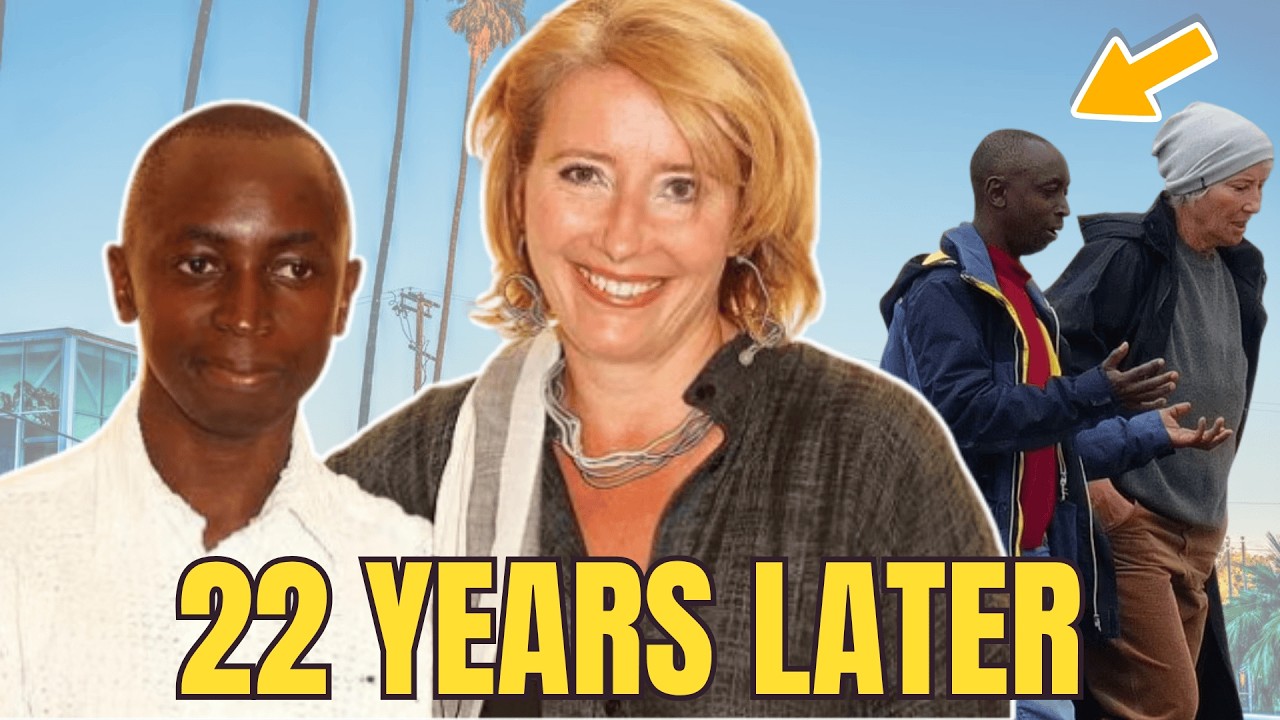
Emma Thompson, one of Britain’s most celebrated actresses, has spoken openly about the moment her family expanded in an unexpected way. In 2003, at the height of her fame, she met Tindyebwa Agaba, a 16-year-old refugee from Rwanda who had survived the aftermath of genocide and life as a child soldier. What began as a conversation at a Refugee Council event became a lasting bond, and Tindy eventually became a son to Thompson and her partner, Greg Wise. Thompson was born on April 15th, 1959, in Hammersmith, London.
Raised in a home filled with art and literature, she was the daughter of actor Eric Thompson and actress Phyllida Law. She studied English literature at Newnham College, Cambridge, where she joined the famous Footlights comedy troupe alongside Stephen Fry and Hugh Laurie. In 1981, she became vice president of the group and helped it win the Perrier Award at the Edinburgh Festival Fringe. Her father’s death during that period deeply affected her.
She later described it as the event that tore her family apart. In a reflection on that grief, she once admitted that if her father had lived longer, she was not sure she would have had the courage to push as hard as she did. That loss became part of the emotional depth she brought to her work. After graduating in 1982, Thompson built her career steadily through radio, television, and stage work.
In 1987, she delivered two breakthrough performances in the BBC productions Fortunes of War and Tutti Frutti. Her work earned her a BAFTA Award and signaled the arrival of a major new talent. That same year, she began a relationship with actor Kenneth Branagh. By 1989, the couple had married, and their professional and personal lives became closely intertwined.
The public viewed them as a golden creative pair, though Thompson was determined to establish her own identity beyond his shadow. The early 1990s brought international stardom. In 1992, her performance as Margaret Schlegel in Howards End earned her the Academy Award for Best Actress. One year later, she achieved the rare feat of two Oscar nominations in the same year: Best Actress for The Remains of the Day and Best Supporting Actress for In the Name of the Father.
These roles showcased her trademark style of portraying women who carry deep inner pain beneath a composed surface. In 1995, Thompson wrote the screenplay for and starred in Sense and Sensibility, an adaptation of Jane Austen’s novel. The film was both a critical and commercial success. She became the first person to win Oscars for both acting and screenwriting on the same project.
Despite that professional peak, her personal life was falling apart. Her marriage to Branagh had been crumbling under the pressures of working together and public scrutiny. At the time, the public did not know that Branagh had begun an affair with actress Helena Bonham Carter. When Thompson learned the truth, she was devastated.
She fell into a deep depression and later admitted the pain was so overwhelming that she could barely function. She later revealed that the famous crying scene in Love Actually (2003), in which her character discovers her husband’s infidelity and quietly composes herself, was drawn directly from her own experience. During the filming of Sense and Sensibility, Thompson had met actor Greg Wise, who played John Willoughby in the film. After her separation from Branagh, Wise became a steady source of support.
Their friendship grew gradually into a romantic relationship. Notably, Wise had originally asked Thompson to introduce him to Kate Winslet, who starred in the film. Winslet turned him down, but Thompson and Wise grew closer instead. In 1999, Thompson gave birth to their daughter, Gaia.
The arrival of her first child marked a major shift in her priorities. At the height of her career, she chose to step back from major roles and reduce her workload significantly. Being present for her daughter became her primary focus. Thompson and Wise later tried to have more children through IVF.
The process involved multiple failed cycles and devastating miscarriages. They eventually made the painful decision to stop. Thompson carried the sorrow of those losses for a long time. In 2003, that grief met an unexpected turn.
At a Refugee Council event, she met Tindyebwa Agaba, a 16-year-old boy from Rwanda. Tindy was not simply an orphan; he was a former child soldier who had lived through the aftermath of the Rwandan genocide. Thompson later described being struck by his quiet dignity and the gentle way he carried himself despite what he had endured. What started as a simple conversation grew into something deeper.
Thompson and Wise invited Tindy to spend Christmas with them and their young daughter, Gaia. Over the following months, Tindy visited more often and stayed longer. Though there was no formal legal adoption at first, he quietly became their son in every meaningful way. They helped him learn English, supported his education, and gave him the stability he had never known.
Gaia welcomed Tindy warmly, and the bond between the siblings grew naturally. Thompson has been fiercely protective of Tindy’s privacy, rarely speaking about him in detail. When she has, she has spoken with deep affection. She once described him as one of the kindest, most thoughtful young men she knows, and credited him with teaching her about resilience and forgiveness.
Tindy went on to study at the University of Exeter, obtained British citizenship, and dedicated much of his time to humanitarian work, often helping children who faced hardships similar to his own. In recent years, he married and built his own family while staying close to Thompson and Wise. Thompson once reflected on why she opened her home to Tindy. She said she was not on a mission to save anyone, but rather to connect with someone.
The two met at that particular time and found themselves deeply compatible. Even as she built this private family, Thompson continued her career. In 2013, she delivered a highly praised performance as P. L.
Travers in Saving Mr. Banks. Although she was not nominated for an Oscar for the role, the omission sparked considerable debate among critics and fans. In 2017, she played Mrs.
Potts in the live-action Beauty and the Beast, which grossed over one billion dollars worldwide. In 2018, she was made a dame by Queen Elizabeth II. In her sixties, Thompson continued to take on bold roles. In 2022, she starred in Good Luck to You, Leo Grande, a film that explored female desire, aging, and intimacy with honesty and sensitivity.
She continues to live between London, Scotland, and Venice, acting selectively and remaining committed to her family. Thompson’s story, from Oscar-winning actress to mother of a blended family formed through love rather than blood, has become one of the most compelling chapters of her life. She once compared the bond she shares with Tindy to the kind that does not ask for recognition, describing it simply as love.