The life of Tallulah Bankhead ended at 7:45 on the morning of December 12, 1968, in a New York hospital, her final words a request for “Codeine. Bourbon.” She was 66 years old, and the cause was the very illness her grandmother had warned her about half a century earlier: pneumonia, the dread disease that had killed her own sister in three days.
The voice that had once commanded the London stage, that had made a surgeon’s accidental nick into the most famous instrument in American theater, was reduced to a hollowed-out husk, still smoking between takes on the set of Batman just months before. She died of the exact illness her grandmother had warned her about when she was a schoolgirl.
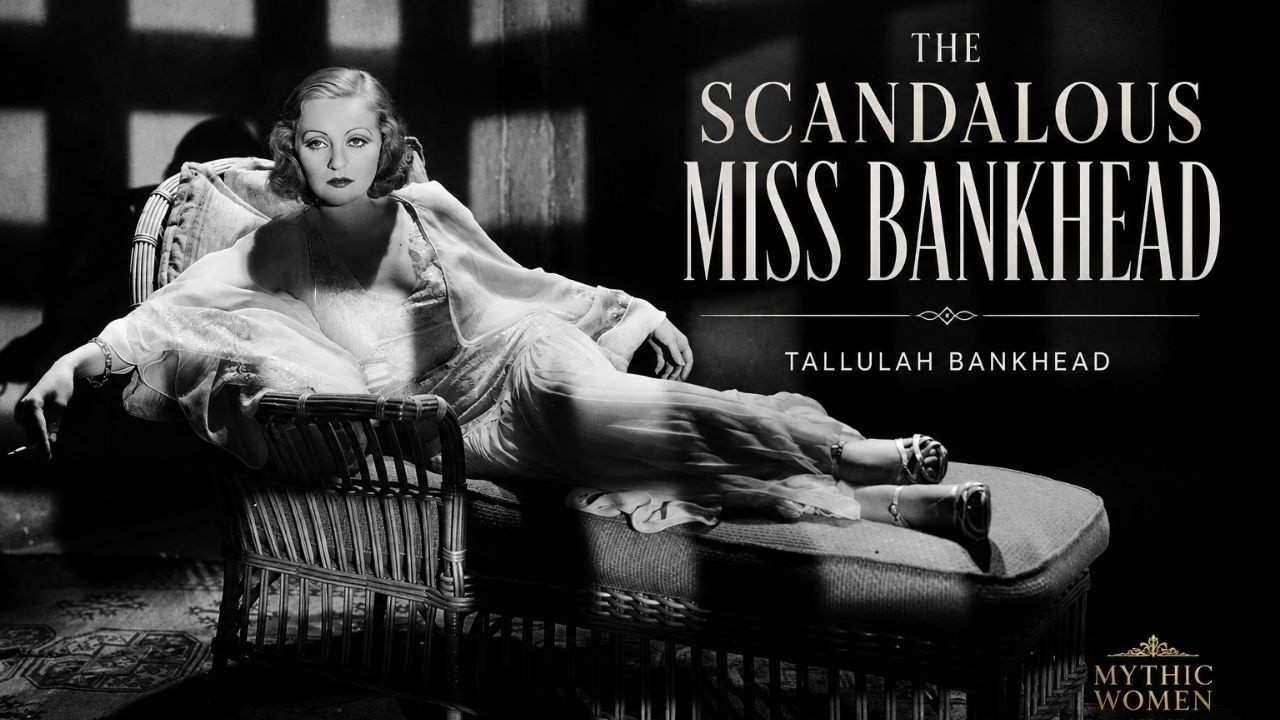 Born in Alabama in January 1902, Bankhead entered a world of immediate tragedy. Her mother, Adelaide, died of blood poisoning just three weeks after giving birth, and the infant was baptized beside her mother’s open coffin. The name itself came from a waterfall, Tallulah Falls in Georgia, a cascade so loud it can be heard before it can be seen—a fitting metaphor for a woman whose presence would dominate every room she entered.
Her father, Will Bankhead, a Confederate veteran’s son who would rise to Speaker of the House, was so consumed by grief that he waved a pistol around the house vowing to join his wife, and the young Tallulah learned early that performing was the only way to capture his attention.
By age five, she was climbing onto the dining room table in Huntsville to sing burlesque numbers for her grieving father and his drinking friends, discovering that applause did something to her spine and her mind that nothing else could match. The formula was simple and addictive: if you kept people entertained, they loved you. That single lesson governed every stage, every party, and every relationship for the rest of her 66 years.
When her father remarried, her stepmother Florence helped her shed weight and clear her acne, transforming the awkward girl into a striking beauty, and by 15 she was modeling herself on Ethel Barrymore, by 17 trading jibes with Dorothy Parker at the Algonquin Round Table.
At 21, she crossed the Atlantic with $60 in a borrowed mink, and within a season, London had turned her name into a verb. To “do a Tallulah” meant to be reckless, free, and ungovernable. Shop girls, seamstresses, and factory workers in the cheap gallery seats took scissors to their own hair and threw the locks down onto the stage, chanting “Hallelujah!
Tallulah!” The gallery goddesses, as they were called, queued 48 hours for opening nights and learned her scripts so thoroughly that innocent lines became private codes. Her scandalous 𝒶𝒻𝒻𝒶𝒾𝓇 with the married, bisexual Lord Napier Allington consumed her, and when he failed to propose, the wounds deepened into a pattern of self-destruction that would define her private life.
At 23, fired from the role of Sadie Thompson in Rain, she swallowed 20 aspirins in the dead prostitute’s costume, lying down to wait for the end while the gramophone turned. She survived, as she survived four abortions arranged in haste and secrecy by the age of 30. When Allington became engaged to an earl’s daughter, the heartbreak drove her into a brief, disastrous engagement with a con man who gave her an unpaid-for diamond necklace.
At 26, Scotland Yard opened a secret file on her, calling her in official ink a “sexual pervert” and weighing deportation—a file she never knew existed.
At 31, she read her own obituary from a hospital bed after a five-hour radical hysterectomy that left her weighing 75 pounds. The operation was the brutal settling of accounts for the decades of illegal abortions and the gonorrhea that had ravaged her reproductive system, and her response upon leaving the hospital was characteristically defiant: “Don’t think this has taught me a lesson.” She went home to Jasper for Christmas that year, haggard and pale as “the ghost of Hamlet’s father,” but with an enormous appetite.
The pattern was set: she would transform every wound, every rejection, every near-death into material for the next performance.
Her greatest professional triumph came in 1939 with The Little Foxes, when she played Regina Giddens, the cold, controlled southern beauty who watches her husband have a heart attack and does not fetch the medicine. The critics who had spent 15 years saying she couldn’t play such a role were silenced, and she received 20 curtain calls on opening night. But the triumph was shadowed by tragedy in September of that year, when her father Will and her former lover Napier Allington died within a day of each other.
She was on stage both times, playing the woman who does not go for the medicine, convinced that her father would have wanted the performance to go on.
Her marriage to actor John Emery in 1938 was a brief, expedient 𝒶𝒻𝒻𝒶𝒾𝓇 that ended in divorce in 1941, with Emery falling for another woman. She quipped that the marriage had always been pointless, but the optics of being left stung deeply. She made him promise to wait a year before remarrying so the world would not read her as the woman who had been left.
In her forties, she found new life in radio with The Big Show, a 90-minute coast-to-coast broadcast that made her a household name across America. The gallery she had played to in London had grown to the size of a continent.
The 1950s brought her to A Streetcar Named Desire, a role she played with devastating honesty, though her fans refused to let her be anyone but Tallulah. Tennessee Williams, who had originally wanted her for Blanche, came to her dressing room afterward with his head in her lap, saying, “Tallulah, this is the way I imagined the part when I wrote the play.” Hours later, at a party, he announced she was playing it for vaudeville and ruining his play.
The same fans who had once thrown their shorn hair at her feet now threw laughter at the one performance that asked them not to. She called the role harder than “18 King Leers with a Hamlet thrown in,” and she went at it honestly, but the gallery goddesses had become her greatest liability.
In her sixties, barely able to breathe between takes, still smoking, she purred her way through the role of the Black Widow on Batman, a villain built just for her. The crew braced for the terror of the Lifeboat stories and got instead what one of them called “almost childish glee.” She sat between setups because she could no longer breathe standing, and she smoked, determined that no one would think she was frail.
The voice was a husk by then, and she used the husk, adding levels to her dialogue that the writers hadn’t known were there. It was among the last times she ever played anyone, and she played it with the same ferocious commitment she had brought to everything since that dining table in Huntsville.
On election day 1968, she walked to the polls very slowly, determined to vote even if she had to crawl. In early December, a flu turned alarming, and she was checked into St. Luke’s Hospital.
The flu became double pneumonia, and pneumonia met the emphysema that years of smoking had been building. She was moved to intensive care, her heart stopped and was restarted, her sister Eugenia arrived with her son as she was losing consciousness. Her last words were a request for the two things that had sustained her through a lifetime of performances: “Codeine, bourbon.”
For 60 years, whatever stage they put her on—Windham’s, the Music Box, a soundstage, a radio booth, the Web—she had been standing in one place the whole time: on a dining table in Huntsville, five years old, midsong, watching her father’s face for the verdict.