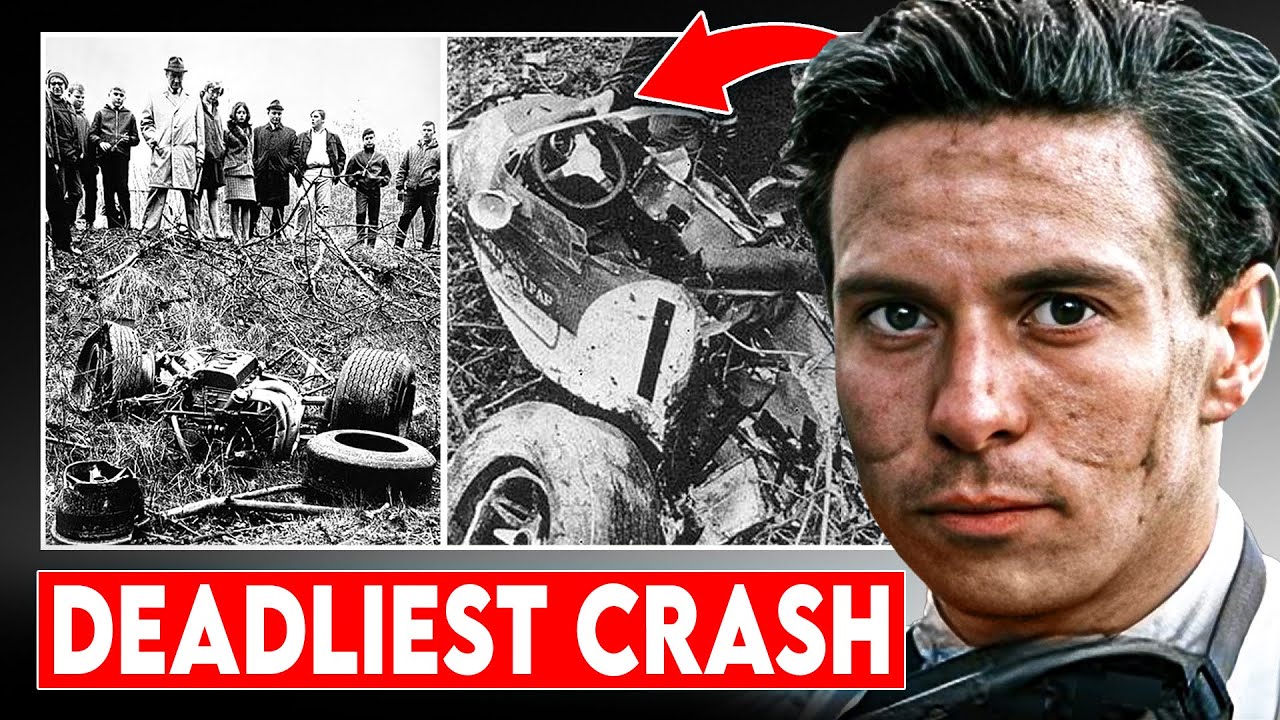
The motorsport world was plunged into mourning on April 7, 1968, as the life of Jim Clark, a two-time Formula 1 World Champion and arguably the most naturally gifted driver of his generation, was brutally cut short at the Hockenheimring in West Germany. The 32-year-old Scot, a man who seemed to defy the very laws of physics behind the wheel, died instantly when his Lotus 48 left the track during a seemingly routine Formula 2 race. The news sent shockwaves through the paddock and beyond, leaving a void in the sport that has never truly been filled, and for decades, the exact cause of the fatal accident remained a subject of intense speculation and hushed debate.
Clark, a farmer’s son from Kilmany, Fife, was not merely a racer; he was an artist whose canvas was the asphalt. His journey from local hill climbs in a Sunbeam Talbot to the pinnacle of international motorsport was meteoric, driven by an innate talent that left contemporaries like Jackie Stewart and Graham Hill in awe. He possessed a unique ability to extract performance from machinery that often seemed on the brink of failure, winning races in cars that others deemed undrivable.
 This otherworldly skill is precisely why the circumstances of his death have haunted the sport, as many refuse to accept that a driver of his calibre could make a simple, unforced error on a track he knew well.
The tragedy unfolded during the Deutschland Trophy, a Formula 2 support race that Clark was participating in only to fulfil a contractual obligation with tyre supplier Firestone. Despite being a “minor” event, the grid was stacked with the era’s best, and the daunting, tree-lined Hockenheim circuit was at its most dangerous. On the fifth lap of the first heat, witnesses reported that Clark’s car suddenly veered off the track at high speed, ploughing into the dense forest.
The impact was catastrophic, and despite the best efforts of marshals, there was nothing that could be done. The initial reports were vague, citing a possible mechanical failure, but the official investigation would later point to a slow deflation of the right rear tyre as the primary cause.
However, the truth that has “finally come out” in recent years is far more complex and troubling than a simple puncture. Detailed analysis of the wreckage and telemetry, combined with testimonies from Lotus engineers, suggests that the car may have suffered a catastrophic failure that was not immediately apparent. Some experts now theorise that a suspension component, stressed beyond its limits by the high-speed demands of the Hockenheim straights, gave way without warning.
This would explain the sudden and violent change in direction, a scenario that no driver, not even one with Clark’s supernatural reflexes, could have possibly corrected. The narrative of a slow puncture was perhaps a more palatable explanation for a public struggling to comprehend the loss of an icon.
Adding to the tragedy is the profound sense of loss felt by Clark’s closest friend and team principal, Colin Chapman. The founder of Lotus was utterly devastated, describing Clark not just as his greatest driver but as his “best friend.” Chapman was known for his innovative, often fragile, designs that pushed the boundaries of engineering.
In the wake of the crash, whispers of guilt and blame circulated within the paddock, with some suggesting that Chapman’s relentless pursuit of lightness had ultimately compromised the safety of the car. The bond between the two men was legendary, but the shadow of that fateful day in Germany would linger over Chapman for the rest of his life, a stark reminder of the perilous line between genius and catastrophe.
The aftermath of Clark’s death sent a seismic tremor through the racing community, forcing a long-overdue reckoning with the sport’s safety standards. The Hockenheimring, with its terrifyingly close trees, was immediately modified, and the section of the track where the accident occurred was rerouted. More significantly, the tragedy galvanised a movement led by Jackie Stewart, Clark’s fellow Scot and rival, who began a relentless campaign for better barriers, medical facilities, and driver protection.
The death of Jim Clark was a watershed moment, the stark realisation that the sport could no longer afford to treat safety as an afterthought. His passing did not just take a life; it fundamentally changed the direction of Formula 1, paving the way for the modern, safer era of racing.
 Clark’s legacy, however, is not defined by his death but by his extraordinary life and achievements. In 1963, he won his first World Championship in the revolutionary monocoque Lotus 25, winning seven of the ten races in a display of dominance that was unheard of at the time. He conquered the Indianapolis 500 in 1965, becoming the first European winner in nearly half a century, and he did it with a driving test that officials insisted he take, a testament to the skepticism he faced.
He won back-to-back Tasman Series titles and racked up 25 Grand Prix victories, a record at the time. His ability to adapt to any car—from a Formula 1 machine to a stock car—was legendary, and his smooth, effortless style made it look almost too easy.
The mystery surrounding the exact mechanical failure has only deepened the legend of the man. The idea that a slow puncture could have undone a driver of his calibre never sat right with those who knew him best. The new revelations point towards a more sinister mechanical gremlin, a failure of the car itself, which aligns with the fragility of the Lotus designs of that era.
It is a bitter irony that a man who could win with a “broken car,” as the title suggests, was ultimately killed by one. The narrative of the flawless driver being betrayed by his machinery is a more fitting, albeit more tragic, epitaph for a man who seemed destined to defy the odds forever.
Today, a memorial stands in the forest at Hockenheim, a quiet and somber place where the trees have grown back, obscuring the exact point of impact. Fans and drivers alike make pilgrimages there to pay their respects to a man who was more than just a champion; he was a symbol of purity in a sport that was becoming increasingly commercialised. His death was a stark reminder of the fragility of life and the immense bravery required to race at such speeds.
The “truth” that has emerged does not offer closure but rather a deeper understanding of the cruel fate that befell him, a fate sealed not by human error, but by the unforgiving nature of mechanical failure at the limit.
The impact of Clark’s death reverberated far beyond the track, influencing not just safety but the very psyche of the sport. Drivers who had previously accepted death as an occupational hazard began to question the status quo. Graham Hill, who would go on to win the 1968 World Championship, dedicated his title to Clark, carrying the weight of his fallen friend’s memory throughout the season.
The camaraderie and the shared grief forged a new solidarity among the drivers, a collective resolve to demand better from the circuit owners and the governing bodies. In a very real sense, Jim Clark’s death was the catalyst for the modern safety movement, his sacrifice saving countless lives in the decades that followed.
 As we look back on that dark day in April 1968, the story of Jim Clark remains a powerful and poignant chapter in the history of motorsport. He was a man of the soil who found his calling on the tarmac, a quiet and humble individual who let his driving do the talking. The revelation that a mechanical failure, rather than a driver error, was the likely cause of the crash serves to reinforce his status as a genius behind the wheel.
He was not defeated by the track or by his own limitations; he was betrayed by the very machine he was piloting, a cruel twist of fate that robbed the world of one of its greatest sporting talents.
The legacy of Jim Clark is one of brilliance, bravery, and an unyielding pursuit of perfection. He won races in cars that had no right to be at the front, and he did so with a grace that endeared him to millions. The truth about his death, though painful, cements his reputation as a driver who was simply too good to make a mistake.
The fault lay not with the man but with the machine, a distinction that matters deeply to those who remember him. His story is a testament to the golden era of racing, a time of immense danger and immense glory, and he remains its most luminous, and tragically, its most fleeting star.
In the annals of sporting history, few figures are remembered with such universal respect and affection. Jim Clark was not just a British or Scottish hero; he was a global icon whose appeal transcended national borders. His rivalry with the likes of John Surtees and Jackie Stewart was fierce but always respectful, and his sportsmanship was as legendary as his speed.
The news of his death was met with an outpouring of grief from around the world, a testament to the impact he had on the public consciousness. He was a man who seemed to have it all—talent, charm, and a bright future—and his sudden removal from the world stage was a tragedy of immense proportions.
The investigation into his death, which has been revisited over the years, now points to a scenario that many had suspected all along. The slow puncture theory was likely a convenient explanation to quell immediate panic, but the detailed forensic analysis of the wrecked Lotus 48 tells a different story. The evidence suggests a sudden and catastrophic failure, possibly in the rear suspension, which would have sent the car into an uncontrollable slide.
For a driver like Clark, who had an almost telepathic connection with his machinery, such a failure would have been a death sentence, leaving him with zero time to react. This truth, while grim, provides a sense of clarity about the final moments of his life.
 The memory of Jim Clark is kept alive not just by the trophies and the records, but by the stories told by those who witnessed his genius. They speak of his ability to see a racing line that no one else could, his calm demeanor in the chaos of a race, and his incredible consistency. He was a man who made the complex look simple, and the dangerous look safe.
His death was a stark reminder that even the greatest are not immune to the whims of fate and the fallibility of machinery. The truth that has finally come out does not change the outcome, but it does honor the man, absolving him of any blame and solidifying his place as a flawless performer who was let down by his equipment.
As the years pass, the legend of Jim Clark only grows. He is remembered as the benchmark, the driver against whom all others are measured. His name is spoken with reverence in the paddock, and his influence can be seen in the driving styles of the modern greats.
The tragedy of his death is forever intertwined with the glory of his career, a bittersweet reminder of what was lost. The truth about the mechanical failure that killed him is a final piece of the puzzle, a confirmation that he was a victim of circumstance, not a fallible human being. His story is a powerful narrative of triumph and tragedy, a tale that will be told for generations to come.
The world of motorsport was forever changed on that spring day in 1968. The loss of Jim Clark was a blow from which the sport took years to recover, and the void he left has never been adequately filled. He was a pioneer, a champion, and a gentleman, and his memory is cherished by all who had the privilege of seeing him race.
The truth about his death, now finally out, allows us to remember him not with questions, but with admiration. He was a man who gave everything to his craft, and he paid the ultimate price. His legacy is one of speed, skill, and an unbreakable spirit, a beacon that continues to inspire racers and fans alike.
Jim Clark was, and always will be, a legend.