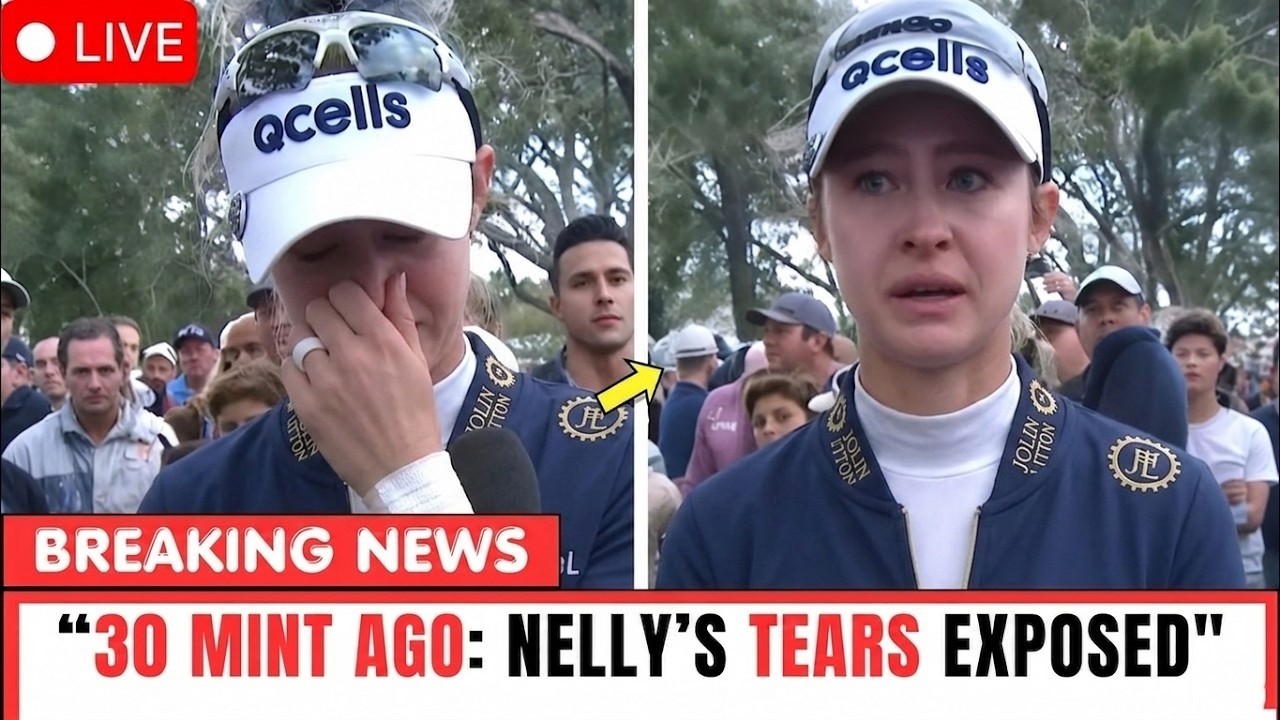
The room fell silent. The cameras were still rolling, the flashbulbs had just faded, and Nelly Korda, fresh off another dominant victory that made the world’s best look like amateurs, had just uttered a sentence that no one in the press conference expected. It wasn’t about her swing mechanics, her course management, or the trophy sitting beside her.
It was about the brutal, unspoken cost of being the best. And for a moment, the superstar with the perpetual smile looked less like an invincible champion and more like a survivor.
 Korda, who reclaimed the World Number One ranking in late April for the first time since Jeeno Thitikul held the spot, was asked about her return to the summit. The question was a softball, designed to elicit a soundbite about hard work and validation for her upcoming Hall of Fame induction, which is now just five points away. Instead, she delivered a confession that cut through the usual sports clichés with the precision of a flushed seven-iron.
“I don’t really focus on the ranking,” she said, her tone calm, almost detached. “It just means you’re playing the best golf at that moment. There’s zero advantage.
Zero advantage.”
It was a stunning admission for an athlete measured by that exact metric. The world’s number one player, standing at the apex of her sport, had essentially told millions of fans that the crown she wears is a gilded cage. It offers no buffer against the elements, no immunity from the pressure, and no comfort when the putts stop falling.
In that moment, she shrugged off the most coveted title in the game as if it were a heavy coat she was glad to shed, and in that single gesture, she confessed something far more profound than a mere press conference line.
To truly understand the weight of that confession, one must rewind twelve months. The year 2025 nearly broke her. It wasn’t just a bad season; it was a full-fledged silence.
A campaign devoid of a single victory, marking the first long drought of her illustrious career. The critics, who had been waiting for any sign of vulnerability, sharpened their knives. They whispered that the magic was gone, that the game had finally caught up to her, that the fire had been extinguished by the relentless travel and the weight of expectation.
She never hid from the scrutiny. She faced it head-on with a stoicism that belied the turmoil within.
Asked about the struggle during that dark period, she offered one of the most honest answers in modern golf history. “It’s just golf,” she said. “Ride the wave.”
Six words. No excuses. No spin.
No deflection. But privately, the wave was a tsunami. She later called the season exactly what it was: a grind.
At the US Women’s Open, she fought tooth and nail to a tie for second place, watching another name hoist the trophy she had come to believe was hers by divine right. She admitted to a tactical blunder that would terrify any weekend amateur, confessing that she changed her grip during the major championship. “I do not recommend changing your grip during a major championship,” she said with a rueful smile, owning the brutal wind, the brutal setup, and the brutal truth that on that specific week, she simply didn’t bring her best.
 But you cannot start this story in 2025. You have to go back further, to 2022, to a moment that reframed her entire existence. She was just 23 years old.
An Olympic champion. A major champion. The world was at her feet.
And then her left arm began to swell. A trip to the emergency room led to ultrasounds, and then the word every athlete fears: Blood clot. “I went to the ER, got some ultrasounds, found out that I had a blood clot, went back home and saw a specialist,” she recounted.
Within weeks, she was on an operating table undergoing surgery to remove the clot, her career flashing before her eyes. The nightmare scenario played out in her head: Was her career over? Would she ever hold a club without fear again?
She sat out. She recovered. She watched the biggest events in the world from the solitude of her couch, the silence of her own home a stark contrast to the roar of the crowds she had left behind.
And then she did something that should send a chill down the spine of every golf fan. She returned at the US Women’s Open, and she won. From a hospital bed to a major trophy in a matter of months.
That is the kind of comeback that restores your faith in human resilience. So when she says the number one ranking means nothing to her, it’s because she knows what she actually almost lost. She didn’t almost lose tournaments; she almost lost herself.
And now, we arrive at the confession that has truly ignited the golf world. When she finally opened up about her mental state, she didn’t dress it up in the armor of sports clichés. “Burnouts are very easy,” she admitted.
“It’s easy to just push through it and just tell yourself, you know, just grind it out.” She talked about forcing herself to take six weeks off, only to admit that she still spent most of that time working on her body or her game. That’s how wired she is.
“You need to give your body a break,” she said, “because you played two weeks in a row with all the travel.” She essentially admitted what the scoreboard never shows: that the most gifted player in the world fights the same internal war as the rest of us. The war between enough and more, between rest and restlessness.
“I think perfection is impossible in golf,” she declared. There it is. The queen of the game confessing that the game she makes look effortless beats her up too.
 This is a revelation that humanizes her in a way that no trophy ever could. It shatters the illusion of the invincible automaton and reveals the beating heart of a competitor who bleeds the same red as the rest of us. It’s a stark reminder that excellence is not a destination but a relentless, exhausting journey.
And the most profound part of her admission is that she recognizes the futility of chasing a ghost. Perfection is a mirage, and she is finally wise enough to stop running toward it.
But wait, because what happened next is the reason every golf fan on Earth should love this woman. She didn’t just talk about balance; she went and found it. This year, she started playing free.
“I’ll figure it out” became her answer to everything, and it stopped being a gamble and started being true. She simplified the way she practiced, the way she traveled, the way she talked to herself. She shed the layers of expectation and pressure like a snake shedding its skin.
She won the Chevron Championship with a renewed sense of purpose, and she took back the number one spot not by force, but by freedom. The analysts call this run “mental strength,” and they’re right, but it’s bigger than that. It’s living proof that admitting you’re human isn’t weakness.
It is the most powerful thing an athlete can do.
It is the ultimate paradox of sport: by letting go of the outcome, she achieved the ultimate outcome. By admitting the ranking has no inherent value, she made it hers again. By confessing that burnout is easy, she immunized herself against it.
She stopped playing to prove the critics wrong and started playing to prove nothing to anyone but herself. The result has been a seismic shift in her performance, a return to the dominance that made her a household name. She is no longer playing against the field; she is playing against her own expectations, and she has finally made peace with the fact that those expectations are just a story she tells herself.
And after yet another win, she summed it all up with a smile that reached her eyes. “I’m just enjoying myself,” she said. Enjoying herself.
The girl who once held a trophy with a fresh scar on her arm. The girl who said the rankings mean nothing. She finally means it.
This is why stories like this matter. Because golf doesn’t care who you are. It humbles world number ones, and it crowns rookies.
 It is a game of constant failure, even for the best. And sometimes, the bravest thing a champion can do is admit the crown is heavy. Nelly Korda told us the truth she didn’t have to tell.
That the top of the mountain is lonelier than it looks. That burnout is real. And that even the greatest player alive has to choose every single day to keep loving this game instead of resenting it.
She has walked through the valley of the shadow of a career-ending injury, and she has emerged not just with a rebuilt arm, but with a rebuilt soul. She has faced the wilderness of a winless season, and she has returned with a map for the rest of us who struggle to find the fairway. Her six-word mantra, “It’s just golf.
Ride the wave,” is not a dismissal of the game’s importance; it is an acceptance of its chaos. It is a surrender to the fact that the ball will not always bounce your way, but you can choose how you react to the bounce. She is no longer trying to control the uncontrollable.
She is simply riding the wave, and it is carrying her to heights she never imagined.
The implications of her confession extend far beyond the ropes of the LPGA tour. It speaks to anyone who has ever chased a goal so relentlessly that they forgot why they started. It speaks to the corporate executive who sacrifices his family for a promotion, the artist who starves her creativity in pursuit of commercial success, the weekend golfer who throws a club in frustration over a stupid triple bogey.
Korda’s journey is a masterclass in reclaiming your why. She realized that the number one ranking was a byproduct, not a goal. The trophies were a consequence, not a motivation.
The only sustainable fuel was the love of the game itself, the sound of a flushed iron on a silent morning, the pure joy of a perfectly struck shot.
So the next time you stand over a putt that actually means something, remember her six words. It’s just golf. Ride the wave.
Let go of the fear of failure. Embrace the imperfection of the moment. Because if the world’s best player can admit that the pursuit of perfection is futile, that burnout is a constant threat, and that the summit of the mountain is a lonely place, then perhaps we can all be a little more forgiving of our own shortcomings.
Perhaps we can all learn to play a little freer. Perhaps we can all learn that the secret to success is not in trying harder, but in enjoying the ride a little more. Nelly Korda has given us a gift more valuable than any trophy: permission to be human.