The forearms of a modern woman who spends her days typing show little sign of physical labor—thin bones, dormant muscles. A forensic anthropologist examining her skeleton 10,000 years from now would likely conclude she did almost nothing with her life. Her prehistoric ancestors, by contrast, carried the evidence of extreme physical exertion in their very bones. For generations, the dominant narrative of prehistory has been simple: men hunted, women gathered.
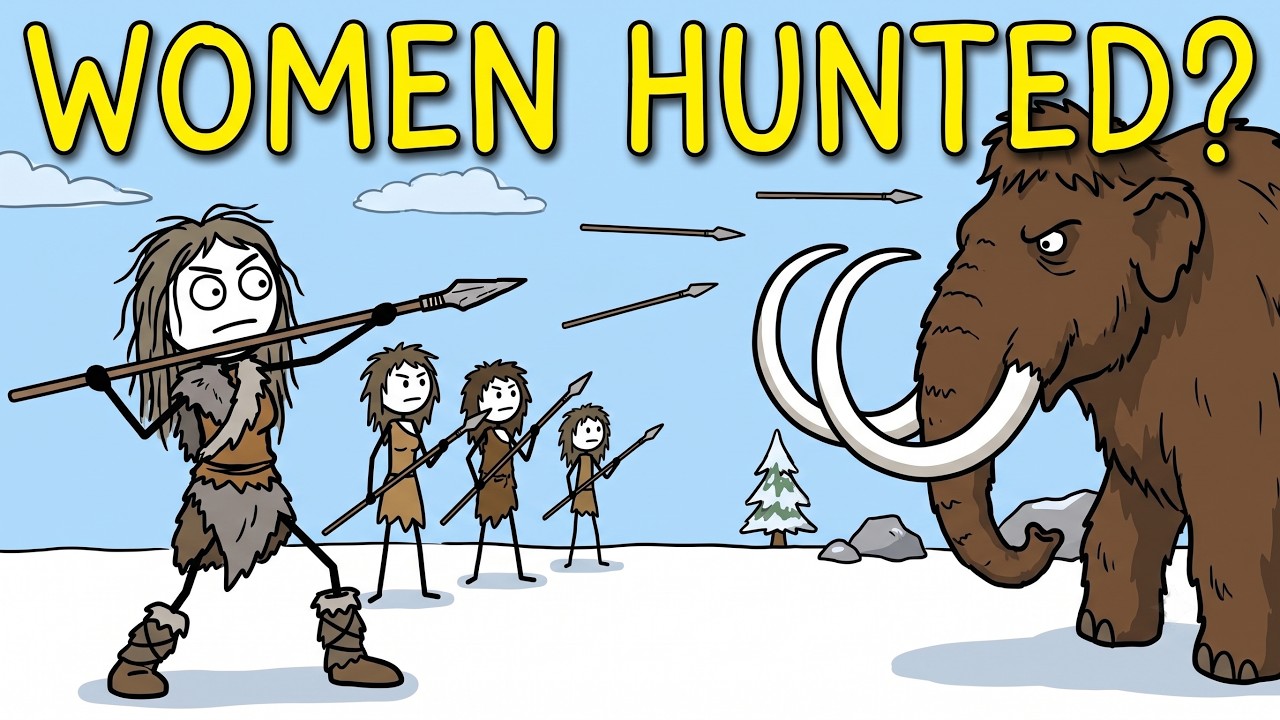
Archaeological discoveries from the past several years challenge that story at its foundation. Ancient women were not passive gatherers waiting by the fire. They were endurance hunters, weapon-wielding participants in the most dangerous survival tasks of their era. Hunting in the deep past was not a test of explosive power or brute strength.
A human cannot outrun a deer in a sprint. Instead, early humans practiced persistence hunting—a strategy built on endurance. A hunter would track an animal for 10 to 30 kilometers under a hot sun. The animal could run faster but lacked the ability to sweat efficiently.
Forced to stop and cool down, the animal would be driven to run again by the approaching hunter. Eventually, its core temperature rose beyond its limit, its organs began to fail from heatstroke, and it collapsed, functionally dead before the final blow. Modern biology suggests women held a significant advantage in this kind of exertion. Testosterone, the hormone associated with explosive force, burns through glycogen reserves quickly.
Male bodies often “hit the wall” during prolonged exercise. Estrogen, by contrast, acts as a metabolic regulator that encourages the body to burn fat first, sparing glycogen for sustained exertion. This made women particularly well-suited for the long chase. Prehistoric women also carried fuel reserves directly inside their muscle cells—intramyocellular lipids that served as localized energy packs for the legs.
These adaptations supported long, grueling travel, often while carrying children and weapons across challenging landscapes. Technology further leveled the playing field. Long before the bow and arrow, early humans used the atlatl, a simple hooked shaft that cradled a spear and extended the thrower’s arm. Acting as a lever, it multiplied launch force significantly, removing physical size and upper-body strength from the equation of the kill.
Research conducted at Kent State University tested this directly. Volunteers with no prior experience threw javelins both by hand and with an atlatl. Hand throws favored male upper-body strength. But when using the atlatl, the difference disappeared—spear velocity was identical between women and men.
The weapon relied on technique and leverage, not muscle mass. Archaeological findings support the conclusion that women were active big-game hunters. In 2018, at a high-altitude site in the Peruvian Andes called Wilamaya Patjxa, researchers excavated a roughly 9,000-year-old burial. Inside lay a complete toolkit for hunting large animals—projectile points, scrapers, and knives.
Protein analysis of the tooth enamel confirmed the hunter was a young woman, approximately 19 years old. She was not an isolated case. A review of more than 400 late Pleistocene burials across the Americas found 27 individuals buried with big-game hunting tools whose sex could be verified through biological analysis. Eleven were female—nearly half.
Researchers now estimate that between 30 and 50 percent of all big-game hunters in the ancient Americas were biologically female. The physical record of this labor is also visible in female skeletons. A specimen from Central Europe dating back 9,000 years shows a humerus—the upper arm bone—that is notably dense and thick, warped by constant muscle pull. The bone is about 16 percent stronger than those of modern elite Olympic rowers.
These are individuals who train for hours daily pulling oars under heavy resistance—yet the ancient woman’s arm bone was built without gyms or modern nutrition, from the daily grinding reality of survival. For a long time, archaeology projected modern assumptions onto ancient remains. Graves containing weapons were often assumed to belong to males, especially when bones were too degraded for easy identification. Modern prejudice, critics argue, was written over ancient evidence, erasing women who stood on the front lines of the hunt.
The era of the female hunter did not last forever. The shift to agriculture changed the logic of survival. Farming required labor and families needed more children. Hunter-gatherer women typically spaced pregnancies four to five years apart, using extended breastfeeding and high physical activity to suppress fertility.
Settled agricultural life dismantled that natural spacing, and women were expected to bear children every two years or less. Their daily work also moved from the open forest to the domestic sphere. Women spent long hours bent over grinding stones, performing repetitive labor that wore down joints and weakened skeletons. The heavy plow, demanding significant upper-body strength, became men’s work.
Women were pushed out of the fields and confined to domestic roles, with reproduction prioritized. Agriculture also brought private property, and the need to guarantee paternity drove societies to restrict women’s movement and deeply control their bodies. The freedom to wander, hunt, and carry weapons was stripped away. The idea that women are naturally fragile, researchers now argue, is not a biological default but a relatively recent social construction.
For roughly 99 percent of human history, women were active, powerful participants in the most dangerous survival tasks—running down animals, launching lethal projectiles, and carrying heavy loads. Their bodies still carry the biological code of those prehistoric runners: the stamina, the fat-burning efficiency, the structural capacity. The 9,000-year-old hunter buried in the Peruvian Andes with her knives, and the ancient women whose arm bones surpass modern rowers, stand as evidence that the weakness of women is not a fact of nature.
It was a historical development, and one that ran against the grain of most of human existence.