For decades, the story of the Great Pyramids of Giza has been told with a single, grim image: an army of slaves, driven by whips, hauling stone for a tyrannical pharaoh. It is one of the most durable and cruel myths in history, popularized by Hollywood epics and repeated in classrooms for generations. The ancient Greek historian Herodotus is often cited as its origin, but he was writing nearly 2,000 years after the pyramids were built, relying on traveler tales and local gossip. Modern archaeology tells a very different story.
Egyptologist Zahi Hawass and his team discovered the workers’ village near Giza in the 1990s, and it does not resemble a slave camp. The workers had their own neighborhoods, organized into groups with names like “Friends of Khufu,” complete with bakeries and breweries. Analysis of their skeletons shows healed fractures and treated compound breaks, evidence they had access to medical care. Their bodies were buried near the pyramids, an enormous honor in Egyptian cosmology.
The workforce was largely rotated, with permanent skilled artisans living at Giza year-round and seasonal farmers coming to work for wages in grain, oil, and cloth during the Nile’s flood season. It was brutal labor, but the builders were respected workers, not enslaved captives. Cleopatra, the most famous woman of the ancient world, is another figure whose image is almost entirely a later invention. She was not Egyptian in the ethnic sense; she was a Macedonian Greek, the first of her Ptolemaic dynasty to bother learning the language of the people she ruled.
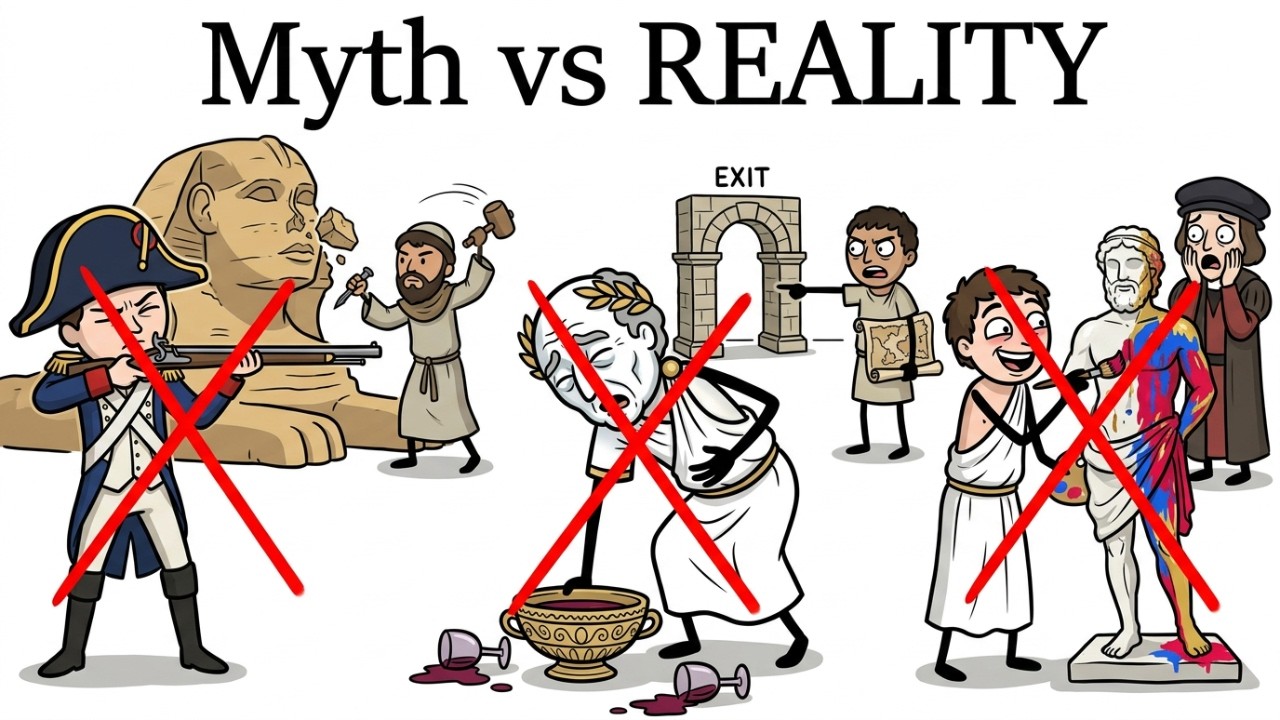
Ancient coins minted during her lifetime show a woman with a strong jaw and a prominent nose, and ancient authors conspicuously avoid calling her beautiful. Plutarch wrote that her real power lay in her voice, her intelligence, and her sheer force of personality. The image of her as a tragic seductress was built by Roman propagandists who had every political reason to minimize the threat she posed to their empire. Even the famous Sphinx has a myth attached to the missing piece of its nose, which is often blamed on Napoleon’s soldiers in Egypt.
The claim that they shot it off for sport is false; a Danish explorer made detailed sketches of the Sphinx without a nose in 1738, six years before Napoleon was even born. A more credible account comes from a medieval Arab historian writing around 1378, who described a Sufi fanatic defacing the Sphinx as an act of religious iconoclasm. Moving to Rome, the idea that wealthy Romans used special “vomitoria” to purge between banquet courses is completely made up. The rooms were real, but they were exit corridors in amphitheaters designed to let crowds of thousands disperse quickly.
The term derives from the Latin for “spewing forth,” applied to the flow of people out of a building, not the flow of food out of a stomach. The misconception appears to trace back to a passing joke in a 1920s novel by Aldous Huxley, which generations of textbooks and documentaries then took as fact. The gladiators of Rome suffer from a similar distortion. Most fights did not end in death; they were expensive, trained investments, and killing them every week was bad economics.
Estimates suggest roughly one in five bouts ended fatally, and successful fighters retired into positions as trainers and celebrities with fan art preserved in Pompeii. The idea that a “thumbs down” from the emperor meant death is also debated, with evidence suggesting the signals were far more complex and may have involved a concealed thumb symbolizing mercy. The infamous image of Nero fiddling while Rome burned is almost certainly false on multiple levels. He was about 35 miles away when the fire broke out, and contemporary accounts suggest he rushed back to organize relief efforts, opening his gardens to the displaced and arranging grain supplies.
The stories of his musical indifference were written decades later by historians working under emperors with political reasons to ruin his reputation. Furthermore, the fiddle did not exist in the first century; if Nero played anything, it was a kithara, a type of lyre. The iconic white marble statues of Greece and Rome are a similar accident of history. The statues were originally painted in vivid, lifelike colors, a fact proven by modern spectroscopic analysis that finds traces of pigment in the stone.
The white aesthetic we admire today is a Renaissance mistake, born from excavators who saw only the faded result of two thousand years of chemical decay. The Spartans, whose martial reputation is perhaps the most aggressively maintained in history, actually lost several of their most important battles. While they famously held the pass at Thermopylae, it was a defeat that did not stop the Persian advance. Worse, they lost a catastrophic battle at Leuctra in 371 BCE, where they were invaded by the Thebans, had their helot labor force liberated, and never recovered their power.
They even surrendered en masse at the Battle of Sphacteria in 425 BCE, a shock so profound that the historian Thucydides felt compelled to explain it at length. Another popular classroom claim with no basis in physics is that the Great Wall of China is visible from space. Astronauts, including China’s own Yang Liwei, have confirmed they cannot see it with the naked eye. The wall is simply too narrow, averaging less than eight meters wide, to be resolved from orbital altitude.
Finally, the Viking helmets with horns that adorn costumes and logos are a complete fabrication of the nineteenth century, specifically the costume designs for Richard Wagner’s operas. Archaeological evidence, including the only intact Viking helmet ever found, shows simple, functional iron caps designed for actual combat. The idea that medieval people thought the Earth was flat is also a myth invented to make Columbus look like a singular genius. Ancient scholars like Eratosthenes calculated the Earth’s circumference with remarkable accuracy in the third century BCE.
What Columbus got wrong was not the shape, which was universally known, but the size, leading him to underestimate the distance to Asia. And the Maya calendar did not predict the end of the world in 2012; it simply completed a major cycle and rolled over to a new one, much like an odometer turning to zero. The apocalypse scare of 2012 was an invention of New Age writers and amplified by internet media, despite the protests of actual Maya communities and scholars.


