Roughly 12,000 years ago, a weedy, foul-smelling plant grew wild on a rocky hillside on the edge of the Tibetan plateau. It stood about a meter tall, scattered its seeds without help, and had grown that way for millions of years. Nobody planted it. Nobody bred it.
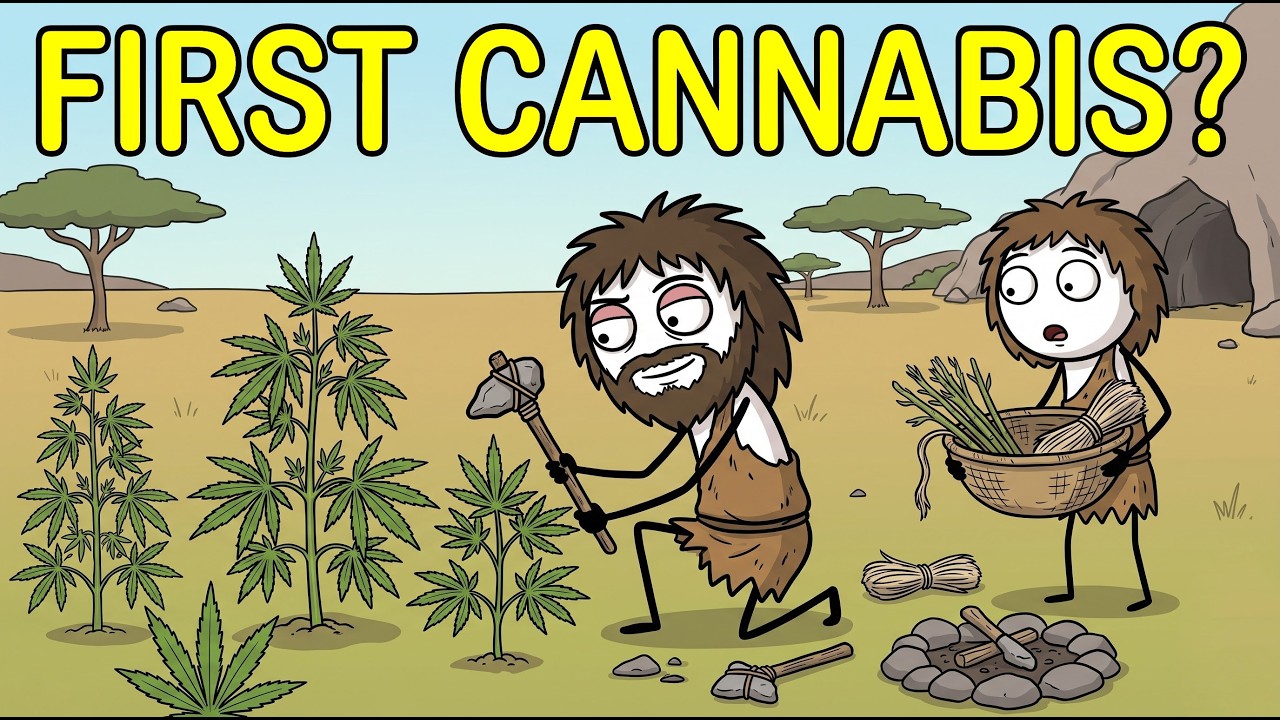
It was one of the most unremarkable organisms on the planet. Fast forward to today, and that same species has been split into two plants that barely resemble each other. One grows five meters tall, produces almost no resin, and is harvested for rope and fabric. The other is short, bushy, and dripping with sticky crystals containing a chemical potent enough to alter how the brain processes reality.
That transformation is one of the most dramatic feats of selective breeding in agricultural history. Cannabis belongs to the Cannabaceae family, and its closest living relative is hops, the plant that flavors beer. In 2019, botanist John McPartland published a study using fossil pollen records to estimate when the two lineages split. His answer: roughly 19.
6 million years ago on the northeastern Tibetan plateau. Cannabis existed long before humans, before the genus Homo, before the great apes. The plant was already shaped by natural selection into a fast-growing, wind-pollinated annual that thrived in disturbed, nitrogen-rich soils. Those conditions were found around animal herds and eventually human camps.
Cannabis did not have to be discovered; it came to humans, growing in garbage heaps, latrines, and cleared land. The question of where domestication happened was long answered with Central Asia. Nikolai Vavilov, the Soviet botanist who mapped the origins of major crops in the 1920s and 1930s, placed cannabis in a zone stretching from the Caspian Sea to western China. That became the textbook answer for nearly a century.
Then in 2021, a team led by Ling Ren at the University of Lausanne and the Kunming Institute of Botany published a study in Science Advances that rewrote the story. Researchers sequenced 110 complete cannabis genomes, the largest study of the plant ever conducted, sampling wild plants, feral populations, ancient landraces, and modern cultivars from six continents. The genetic family tree pointed to a single place: eastern China, the northeastern edge of the Tibetan plateau, in Qinghai and Gansu provinces. That is where the oldest and most genetically diverse cannabis populations still grow.
The feral plants there are the closest living relatives of the original wild ancestor. Everything else, every hemp field in France, every strain sold in Amsterdam, descends from that population. The study points to one domestication event roughly 12,000 years ago, at the beginning of the Neolithic. That timing places cannabis alongside the very first crops on Earth, einkorn wheat in the Fertile Crescent around 10,500 years ago, barley around 10,000, rice in the Yangtze Valley around 9,000.
Cannabis was not a latecomer; it was one of the founding crops of the agricultural revolution in East Asia. The reason early humans kept it is that it could do everything. First, fiber. The stalks contain long bast fibers that can be twisted into cord or woven into fabric.
Hemp cord impressions have been found on Neolithic pottery in China and Japan dating back roughly 10,000 to 12,000 years, some of the oldest textile evidence anywhere on Earth. Second, food. Cannabis seeds are roughly 30% oil and 25% protein and contain all essential amino acids. Hempseed oil was used for cooking, lighting lamps, and waterproofing.
Third, medicine. The oldest surviving reference to cannabis as medicine comes from the Pencao Jing, traditionally attributed to the legendary emperor Shennong. Compiled around the 1st or 2nd century AD from older oral traditions, it recommended cannabis for joint pain, constipation, malaria, and absent-mindedness. Fourth, the use everyone knows about.
The plant produces resin containing delta-9-tetrahydrocannabinol, or THC. It plugs into a receptor system the body already has, built around a molecule produced naturally called anandamide, named from the Sanskrit word for bliss. The brain had a lock; cannabis had a spare key. But you cannot optimize a single plant for all four uses at once.
A tall plant bred for long fibers is a terrible drug plant. A short, resin-drenched plant is useless for rope. The moment humans started selecting for specific traits, they began pulling the species apart. Ren’s 2021 study found the split between hemp-type and drug-type cannabis happened roughly 4,000 years ago.
Before that, for about 8,000 years, humans grew cannabis as a general-purpose crop. They selected casually for seed size and basic domestication traits like seeds that do not shatter, stems that grow taller and straighter, and faster germination. Around 4,000 years ago, the selection pressure split. The genetic evidence is specific.
Cannabis produces cannabinoids through a pathway starting with a precursor molecule called CBGA. From that precursor, two competing enzymes go to work. One is encoded by a gene called THCAS, which converts the precursor into THCA, which becomes THC when heated. The other is encoded by CBDAS, which converts the same precursor into CBDA, which becomes CBD.
These two genes sit at the same location on the same chromosome. They are allelic variants competing for the same slot. A plant that expresses a lot of THCAS produces a lot of THC and very little CBD. A plant that expresses a lot of CBDAS produces a lot of CBD and very little THC.
This is the genetic switch separating hemp from drug cannabis. In drug cultivars, Ren’s team found the THCAS gene had been amplified, with multiple copies increasing expression. In hemp cultivars, the opposite had happened: THCAS was reduced or non-functional, and CBDAS had taken over. Same species, same genome, two opposite outcomes driven by thousands of years of people picking the plants they liked and replanting the seeds.
Wild cannabis produces THC at roughly 1 to 3% by dry weight. Modern drug varieties can hit 25 to 30%, a tenfold increase achieved entirely through selective breeding. Modern hemp, by legal definition in most countries, contains less than 0. 3% THC.
That threshold was set in 1976 by Canadian botanist Ernest Small, who proposed the line as a practical cutoff. Governments adopted it as law; a botanical observation became a legal boundary. The domestication story is also visible in the plant’s architecture. Wild cannabis is a moderate-sized annual, maybe one to two meters tall, with a branching pattern distributing energy across multiple stems.
Humans pulled that shape in two directions. For fiber, they selected for tall, straight plants with minimal branching. Modern hemp can grow to five meters in a single season. For drug production, they selected for short, bushy plants with dense clusters of resinous buds.
Growers eventually developed the technique of sinsemilla, growing only female plants and removing all males so females never get pollinated. Unpollinated female cannabis produces dramatically more resin because the plant keeps producing trichomes in a prolonged effort to catch pollen that never arrives. Cannabis may be the only plant in history simultaneously domesticated for fiber, food, medicine, and its effect on consciousness. Cotton gives fiber but not food.
Wheat gives food but not fiber. Poppies give medicine and altered consciousness but no rope. Cannabis did all of it. It was the original multi-purpose crop, and the fact that humanity eventually split it into specialists reflects how agriculture generally works: generalists get replaced by specialists.
The spread of cannabis across Eurasia is documented in pollen and archaeological records. Cannabis pollen appears across China starting roughly 10,000 years ago, with a significant increase around 5,000 years ago. By around 5,000 to 4,000 years ago, it was spreading westward along what would become the Silk Road, carried by nomadic herders and traders moving horses, wheat, and bronze technology. In 2008, neurologist Ethan Russo and his team published a study in the Journal of Experimental Botany describing the contents of Tomb M90 at the Yanghai burial site in the Turpan Basin of western China.
In a 2,700-year-old grave belonging to a Gushi culture shaman, they found roughly 789 grams of cannabis. The seeds and stems had been carefully removed, leaving only the flowering tops. Chemical analysis confirmed the presence of THC. This was cannabis cultivated for its psychoactive properties, processed with expertise, and buried with a man whose community considered it valuable enough to accompany him into the afterlife.
About 500 years later, around 500 BC, in the Pamir Mountains along the border of modern China and Tajikistan, people at a site called Jirzankal Cemetery were burning cannabis on heated stones inside wooden braziers during funeral rituals. In 2019, Yimin Yang of the University of Chinese Academy of Sciences led a team that analyzed residue from those braziers using gas chromatography-mass spectrometry. The cannabis had significantly higher THC levels than wild plants in the same region. These people were selecting, possibly cultivating high-potency cannabis for ritual use at altitudes over 3,000 meters, where more intense UV radiation naturally pushes cannabis to produce more THC.
Around 440 BC, the Greek historian Herodotus described Scythian nomads on the Central Asian steppe crawling inside small felt tents, throwing cannabis onto red-hot stones, and inhaling the smoke as a ritual. He wrote that they howled with delight. Scholars long assumed he was exaggerating. Then Soviet archaeologist Sergey Rudenko excavated the frozen Pazyryk tombs in the Altai Mountains of Siberia starting in 1947.
He found tent frames, heated stones, and cannabis seeds preserved in permafrost for over 2,000 years. Herodotus was reporting what he saw. By roughly 2,500 years ago, domesticated cannabis had spread from China to the Caucasus, from India, where the Atharvaveda compiled between roughly 1500 and 1000 BC lists cannabis as one of five sacred plants, to the eastern Mediterranean, where the Assyrians called it kunibu, the word from which cannabis derives, and recorded its use as a fumigant and medicine in texts from the library of Ashurbanipal around 660 BC. In 2020, a team led by Eran Arie published a finding in the Tel Aviv journal of the Institute of Archaeology.
At Tel Arad in the Negev desert, a shrine dating to the ancient kingdom of Judah around 750 to 715 BC had two altars. One was burning frankincense. The other was burning cannabis mixed with animal dung. The dung was used to control burn temperature and release the smoke slowly.
Someone in an ancient Judahite temple understood combustion chemistry well enough to optimize the delivery of THC to a room full of worshippers. The fiber side of the story was just as consequential. Hemp rope and fabric have been found at sites across China, Japan, and Europe spanning thousands of years. By the medieval period, hemp was one of the most important industrial crops on the continent, used for rope, sailcloth, and canvas, a word that comes from the Latin cannabis.
The Age of Exploration depended on hemp rigging. When European colonists arrived in the Americas, they brought hemp seeds. The Virginia Assembly passed a law in 1619 making hemp cultivation mandatory for farmers. The two domestication directions, fiber and drug, pulled the species further apart.
Fiber growers wanted tall, uniform plants with as little resin as possible because resin makes processing messy. Drug growers wanted the opposite. Because cannabis is an outcrossing species that relies on wind to carry pollen, isolation was critical. If a drug field was downwind from a hemp field, the offspring would be somewhere in between.
Over centuries, this pressure drove hemp cultivation toward Northern Europe and East Asia and drug cultivation toward South Asia, the Middle East, and parts of Africa. Geographer Barney Warf at the University of Kansas traced these migration routes in a 2014 paper in the Geographical Review titled “High Points: A Historical Geography of Cannabis. ” Cannabis reached sub-Saharan Africa via East African trade routes and Arab merchants roughly 1,000 to 500 years ago. It reached the Americas with European colonists in the 16th century.
By the 20th century, it was growing on every inhabited continent. Then something happened that had never happened in 12,000 years of co-evolution: humans tried to uninvent it. In 1930, Harry Anslinger became head of the U. S.
Federal Bureau of Narcotics and launched a campaign that tied cannabis to racial minorities, fabricated links between the plant and violent crime, and rebranded it with the Spanish word marijuana to make it sound foreign and threatening. In 1937, the Marijuana Tax Act effectively criminalized the plant. In 1970, Richard Nixon’s Controlled Substances Act placed it in Schedule I, the same classification as heroin, defined as having no accepted medical use and a high potential for abuse. The 1961 UN Single Convention on Narcotic Drugs placed cannabis under international restrictions affecting every signatory nation.
Prohibition did not stop domestication. It moved it underground and arguably accelerated it. Illicit growers working in basements under artificial lights applied selection pressure at a pace that would have stunned any Neolithic farmer. They crossed Afghan indica varieties with Southeast Asian and South American sativas.
They selected obsessively for THC content, flavor, growth speed, and compact size. They developed hydroponic and indoor systems giving total control over light, nutrients, and flowering schedules. In roughly two generations, they pushed THC levels from the 3 to 5% typical of the 1970s to the 20 to 30% common today. It took thousands of years to get from wild THC levels to 5%.
It took prohibition-era breeders about half a century to triple or quadruple that number. The answer to how humans domesticated cannabis is the same way they domesticated everything else: slowly, then all at once. A useful plant appeared in waste piles roughly 12,000 years ago in eastern China. People saved seeds from the plants they liked, taller ones for fiber, oilier seeds for food, more resinous flowers for medicine and ritual.
Over thousands of years, those preferences compounded. Without understanding any biochemistry, humans pushed the competing genes for THC and CBD production in opposite directions. They bred hemp that grows five meters tall with almost no THC. They bred drug cannabis that barely reaches waist height and contains 30 times the THC of its wild ancestor.
They moved it across every continent, adapted it to every climate, and integrated it into religions, pharmacopoeias, navies, and economies. According to the best available genetic evidence, cannabis domestication is a single story from a single origin. The 2021 Ren study points to one domestication event from one ancestral population in eastern China, branching into hemp and drug lineages around 4,000 years ago. The probability of a single origin is roughly 85 to 90%.
But the probability that wild-type cannabis still exists anywhere untouched by human selection or hybridization is close to zero. Nearly every wild population sampled showed genetic signatures of past contact with domesticated varieties. The original unmodified version may no longer exist. It has been absorbed and overwritten by the versions humans preferred.
Today, a farmer will plant hemp seed that grows 16 feet tall and produces fiber strong enough to reinforce concrete. Somewhere else, someone will tend a squat, crystalline plant bred to produce 30% THC by dry weight. Both are the same species, carrying the same genome, and both are the product of 12,000 years of human decisions, most made by people who had no idea they were running one of the longest genetic experiments in history.