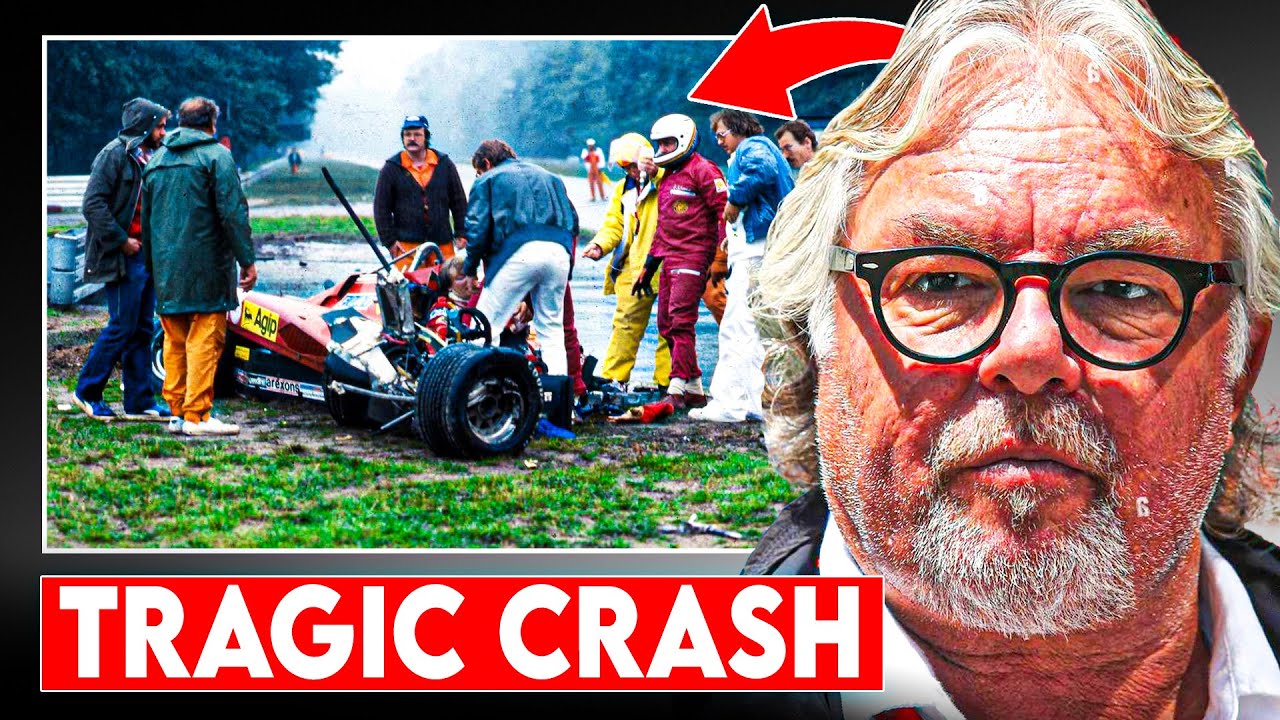
The roar of turbocharged engines has long since faded into the quiet hum of memory for Keke Rosberg, but at 75 years old, the 1982 Formula 1 World Champion is not looking back with unbridled nostalgia. In a candid reflection that has sent ripples through the motorsport community, the Finnish icon has admitted to a profound sense of regret regarding the trajectory of his career, specifically the circumstances surrounding his departure from the Williams team.
Speaking with a level of honesty that is rare among titans of the sport, Rosberg revealed that his exit from the Grove-based squad was not a calculated strategic move, but rather a reaction to a deteriorating personal environment. He stated that had he remained with Williams, the friction and internal politics might have forced him into early retirement, a confession that adds a new layer of complexity to his legendary status.
 The root of this discord, according to Rosberg, lay in the shifting power dynamics within the team following the devastating accident of founder Frank Williams. With Frank sidelined, the role of technical director Patrick Head expanded significantly, creating a working relationship that Rosberg found increasingly untenable. The synergy that had propelled him to championship glory had evaporated, replaced by a strained dynamic that made the paddock a battleground rather than a sanctuary.
Rosberg’s journey to the pinnacle of motorsport was anything but conventional, a fact that makes his later reflections all the more poignant. He was already a seasoned veteran at 29 when he finally secured his Formula 1 debut, having honed his craft in the brutal proving grounds of Formula V, Super V, and Can-Am. His path was paved by the support of American patron Fred Opert, a lifeline that eventually led to a seat with the Theodore team in 1978.
His raw talent was immediately evident, as he stunned the establishment in just his second race, winning the BRDC International Trophy at Silverstone in a torrential downpour that caught many seasoned drivers off guard. Yet, the machinery beneath him was unreliable, forcing a frustrating game of musical chairs between Theodore and ATS as he struggled to qualify consistently in cars that were simply not up to the task.
The 1979 season offered a glimmer of hope with the Wolf team, but financial instability plagued the outfit, and Rosberg’s race finishes were few and far between. When Wolf shuttered its doors, he landed at Fittipaldi Automotive, a team that had absorbed Wolf’s remnants. While he managed a podium at the season opener in Buenos Aires, the car’s lack of competitiveness meant that 1981 was a barren year, devoid of championship points.
It was the retirement of Alan Jones that opened the door at Williams for 1982, a season that would become the stuff of legend. Despite the fact that no driver won more than two races that year, Rosberg’s relentless consistency, coupled with the turmoil at Ferrari and the unreliability of the turbocharged cars from Brabham and Renault, allowed him to clinch the Drivers’ Championship by a narrow five-point margin over Didier Pironi.
That title, secured with the venerable Cosworth DFV engine, would be the last for the old V8, marking the end of an era in Formula 1. However, the subsequent seasons were a struggle against the rising tide of turbocharged power from Ferrari, Renault, and BMW. Rosberg’s 1983 campaign was hampered by a lack of competitive horsepower, though he still managed to secure a memorable win at the Race of Champions in Monaco.
The 1984 season was a mixed bag, with chassis issues plaguing his efforts despite a victory at the Dallas Grand Prix. A trip to Australia for the non-championship race at Calder Park saw him finish second to Roberto Moreno, a precursor to the dramatic events that would unfold in Adelaide the following year. The 1985 season, however, brought a resurgence as Williams introduced the all-carbon fiber FW10 chassis.
With new teammate Nigel Mansell, Rosberg rediscovered his winning form, taking victory at the Detroit Grand Prix and setting a lap record at Silverstone that would stand for nearly two decades. His final Grand Prix win came at the 1985 Australian Grand Prix on the new Adelaide street circuit, a fitting swan song for his time with the team. In a symbolic gesture, he handed the winner’s trophy to his race engineer, Frank Dernie, as the Honda engine was finally beginning to show its true potential.
Despite this upward trajectory, the internal strife proved too much. Rosberg made the decision to leave Williams at the end of 1985, signing with the reigning champions, McLaren. It was a move that seemed brilliant on paper, but the reality was starkly different.
 The 1986 McLaren, designed for the smooth driving styles of Alain Prost and Niki Lauda, was not suited to Rosberg’s aggressive, late-braking technique.
He struggled immensely until designer John Barnard announced his departure to Ferrari, which finally allowed Rosberg the freedom to adapt the car to his liking. This change led to his only pole position of the season in Germany, a tantalizing glimpse of what might have been. The season was further darkened by the tragic death of his close friend, Elio de Angelis, during a testing session at Paul Ricard, a loss that weighed heavily on his psyche.
By the end of 1986, Rosberg had decided to retire, a decision he now believes may have been premature. In his final race in Adelaide, he led for much of the distance before a rear tire failure forced him to pit. Thinking the problem was engine-related, he retired the car, only to realize later that a simple tire change would have allowed him to continue and potentially assist Prost in his championship battle.
Rosberg had privately decided in mid-1984 that he would race for only two more years, but he now reflects that the toxic atmosphere at Williams might have accelerated his exit even further. He has expressed relief that he left when he did, suggesting that had he stayed, he might have quit racing early in 1986 due to the difficult working relationship with certain team members, widely believed to be Patrick Head.
The irony is not lost on observers. The very team that gave him his championship, Williams, also became the source of his deepest professional frustration. The combination of Patrick Head’s engineering genius and Rosberg’s driving talent was potent, but the human chemistry was explosive in the wrong way.
He has often wondered what it would have been like to work with Head without the pressure of Frank Williams’s absence.
After his driving career concluded, Rosberg transitioned into management, guiding the careers of fellow Finns JJ Lehto and Mika Hakkinen, the latter of whom would go on to win two world championships. He also managed his son, Nico, who began his own F1 career with Williams in 2006, creating a unique family legacy within the sport.
In a memorable moment in 2013, Keke and Nico became the first father and son to win the Monaco Grand Prix, with a 30-year gap between their victories. Then, in 2016, they achieved another milestone by becoming the second father-son pair to win Formula 1 World Championships, following in the footsteps of Graham and Damon Hill.
 Yet, even with these accolades, the shadow of regret lingers. Rosberg’s candid admission serves as a reminder that even at the pinnacle of success, the human cost of internal conflict can be immense. His story is not just one of speed and glory, but of the delicate balance between ambition and well-being, a lesson that resonates far beyond the confines of the racetrack.
The 1986 season, his last, was a testament to his resolve. Despite the uncompetitive car and the personal grief, he pushed forward, securing that pole position in Germany and leading the final race until mechanical failure intervened. His plan to help Prost win the title was thwarted, but Prost did prevail, while his replacement at Williams, Nelson Piquet, also suffered a dramatic end to his race.
Rosberg’s legacy is secure as a hard-charging, no-nonsense driver who squeezed every ounce of performance from his machinery. But his recent reflections reveal a man who still grapples with the “what ifs” of his career. The decision to leave Williams, while rational at the time, now appears to him as a moment where external pressures dictated his path more than his own desires.
He has often spoken of the intense concentration required to race on street circuits like Detroit, where one slip could be fatal. That level of focus, he says, was easy compared to the political maneuvering he faced within the team. The car problems he expected, but the human problems were a different beast entirely, one that ultimately drove him away.
As he looks back from the vantage point of 75, Rosberg’s story is a powerful narrative about the choices we make under pressure. He acknowledges that his move to McLaren, while initially seeming like a step up, was actually a step into a team in decline, while Williams and Honda went on to dominate the following seasons. The timing of his departure was, in hindsight, disastrous for his competitive ambitions.
Yet, he maintains that he has no regrets about leaving Williams for McLaren, despite the Honda engine’s potential. The relief of escaping the toxic environment outweighed the frustration of driving an uncompetitive car. This paradox—choosing peace over performance—is a defining characteristic of his post-championship career.
His son Nico’s journey to the 2016 title, which involved a similarly fraught rivalry with teammate Lewis Hamilton, perhaps gave Keke a new perspective on the pressures of the sport. Watching his son navigate the cutthroat world of F1 might have softened his own retrospective bitterness, allowing him to see his own career with more nuance.
The record he set at Silverstone in 1985, which stood until 2002, is a testament to his raw speed. But it is his candid admission of regret that has captured the attention of the current generation. In an era where drivers are often media-trained to perfection, Rosberg’s blunt honesty is a refreshing, if sobering, change.
 He has said that the level of concentration in Detroit was so high that one slip meant you were gone. That same level of intensity, applied to his interpersonal relationships, may have been his undoing. He was so focused on the driving that he had little patience for the gamesmanship that often defines team politics.
The tragedy of Elio de Angelis’s death was a turning point for Rosberg. It made him question the value of the sport and the risks involved. When combined with the daily grind of his strained relationship at Williams, it created a perfect storm that pushed him toward an early exit from the sport he loved.
He has admitted that he might have stepped away from racing too soon, a sentiment that echoes through the decades. The 1986 Australian Grand Prix, where he led before a tire failure, was a microcosm of his entire season: flashes of brilliance undermined by forces beyond his control. He thought the problem was the engine, but it was a simple tire.
That final race, where he had planned to help Prost win the championship, ended with him parked at the side of the track, a spectator to the drama unfolding around him. It was an anticlimactic end to a career that had been defined by dramatic overtakes and fearless commitment.
Now, at 75, Rosberg’s reflections serve as a cautionary tale. His success was undeniable, but his regrets are equally real. The choices he made in the mid-1980s, driven by a desire to escape a toxic work environment, ultimately cost him the chance to compete for more titles with a dominant team.
He has often spoken of the combination of Patrick Head and his own father, Nico, as one he would have loved to experience. That hypothetical partnership, which never came to be due to the timing of Nico’s career, represents a missed opportunity for Rosberg senior to see his legacy continue within the same engineering fold.
The fact that he handed his final winner’s trophy to his engineer, Frank Dernie, rather than to the team principal, speaks volumes about where his loyalties lay. He was a driver’s driver, more connected to the mechanics and engineers who worked on his car than to the management who made the strategic decisions.
As the F1 world digests his latest comments, it is clear that Rosberg’s story is far more complex than a simple tally of wins and championships. It is a story about the human cost of ambition, the importance of environment, and the enduring nature of regret. Even champions, it seems, are not immune to the what-ifs of life.
His legacy as the first Finnish World Champion is secure, but his personal journey reveals a man who paid a heavy price for his success. The relief he felt upon leaving Williams was palpable, but so too was the sense of loss for what might have been. In the end, Keke Rosberg’s greatest race may have been the one against his own inner turmoil, a battle he continues to reflect upon to this day.