In 2020, a team of Indonesian and Australian archaeologists exploring a remote river valley in the rainforest of Borneo scaled a cliff face to reach a limestone cave called Liang Tebo. Inside, buried beneath the cave floor, they found a skeleton. The person had died young, probably in their early 20s. But that was not the strangest part.
The lower portion of their left leg was missing. Not crushed, not lost to decay or animal activity after death. The bone had been cleanly cut at an angle with a sharp tool. And around that cut, the bone had grown back—smooth, sealed, and healthy.
The kind of regrowth that takes years and requires no infection whatsoever. This person had their lower leg surgically removed and survived. The surgery happened at least 31,000 years ago. There were no hospitals, no antibiotics, no operating rooms, and no sterile equipment.
The people who performed the procedure lived in caves, hunted animals for food, and had no written language. The nearest thing to a city would not be invented for tens of thousands of years. The question is not just how the bone healed. It is what kind of people looked at a child with a shattered or diseased leg in the middle of a tropical rainforest and decided to cut it off—carefully and cleanly—then keep that child alive for nearly a decade afterward.
To understand why healed ancient bones are so remarkable, it helps to understand what life looked like for most of human history. For roughly 95 percent of the time our species has existed, humans lived as hunter-gatherers. Small groups, rarely more than a few dozen people, moved constantly across large territories in search of food. There were no stored crops, no permanent shelters in most cases, and no ability to call for outside help.
In this world, survival depended entirely on the ability to move. Ethnographic studies of modern hunter-gatherer groups like the Kung San of Southern Africa give some sense of that movement. Their home territories cover around 10,000 hectares—roughly the footprint of a large carnivore like a lion. Daily life required walking, lifting, climbing, and carrying.
Adults covered extraordinary distances on foot, tracking animals across difficult terrain, sometimes for days at a time. In this system, there was almost no room for sustained physical incapacity. If you could not walk, you could not hunt. If you could not hunt, you produced no food.
And the group now had to feed an extra person out of whatever they found that day. Movement was not optional. Groups moved to follow game and seasonal plants. An injured person who could not travel was either left behind or carried.
Carrying someone across rough terrain for weeks or months, while also hunting and gathering enough food for everyone else, was an enormous physical and logistical burden. The Pleistocene world was not a safe place to be stationary. Apex predators that no longer exist in most of the world—cave hyenas, cave lions, short-faced bears—actively hunted large mammals including humans. An immobile person unable to flee would have been a target, requiring someone to guard them day and night throughout their recovery.
Then there was infection. Before any understanding of bacteria or sterile technique, an open wound—the kind that occurs when a bone breaks through the skin—was an almost automatic death sentence. Soil bacteria would enter the wound within hours. Without anything to kill those bacteria, infection would spread through the bone into the bloodstream and kill the person within days or weeks.
This is what doctors today call sepsis. In the modern world, sepsis still kills millions of people every year despite antibiotics and intensive care units. In a cave 30,000 years ago with no treatment at all, an infected open fracture was almost certainly fatal. Even if the wound stayed closed, a fractured leg caused something many people do not think about.
The muscles around the break go into violent involuntary spasm, pulling the broken bone ends past each other and causing severe internal bleeding. A fractured femur can cause a person to lose nearly a liter of blood into the surrounding muscle before the bleeding stops on its own. Without fluids, rest, and time, that internal bleeding alone could be fatal. A broken leg in the ancient world was not just painful.
By almost every logical measure, it was a death sentence. The first part of the answer is hidden inside the bone itself. Most people think of bone as something like stone—hard, fixed, essentially dead. But bone is a living organ.
It has blood vessels running through it. It has cells that constantly break down old bone and build new bone. It is one of the only tissues in the human body capable of healing without leaving a scar. When a bone breaks, the body immediately begins a repair process.
In the first few days, blood pools around the fracture and forms a clot. Immune cells flood in and clear away dead tissue. Over the next few weeks, the body builds a soft callus—a bridge of cartilage stretching across the gap between the broken ends. Over the following months, cells called osteoblasts deposit calcium and other minerals into the cartilage scaffold, turning it hard.
Then, over years, the bone remodels itself. Cells dissolve the rough callus and replace it with organized, structured bone that increasingly resembles the original. Given enough time, a healed fracture can become almost invisible. But there is one absolute requirement.
The broken ends of the bone must stay still. If they keep moving, the delicate new bridges of cartilage and blood vessels are torn apart before they can strengthen. The process resets. The bone cannot finish healing.
The body knows exactly how to fix a broken bone. What it cannot do is hold itself still. That is where ancient humans came in. The skeleton from Liang Tebo cave is the most dramatic example of prehistoric surgery ever found, but it is not the oldest evidence of ancient humans surviving severe bone injuries.
At Shanidar Cave in northern Iraq, archaeologists discovered the remains of a Neanderthal male who lived roughly 45,000 to 70,000 years ago. Researchers nicknamed him Nandy. At some point in his youth, Nandy sustained a crushing blow to the left side of his head. The damage likely blinded him in his left eye.
It also damaged the part of the brain that controls the right side of the body, causing the muscles of his right arm to waste away. His right arm was eventually amputated or lost above the elbow. He walked with a severe limp due to damage to his right leg and foot. Later analysis revealed that bony growths inside his ear canals had caused significant, possibly total, hearing loss.
Despite all of this, he lived to somewhere between 35 and 50 years old—genuinely old by the standards of the time. He was physically incapable of hunting. He could not hear danger approaching. He could barely walk.
He survived anyway. The only explanation is that other members of his group took care of him for years, possibly decades. They fed him, protected him, and kept him safe in an environment where carnivores were constant threats. The Smithsonian Institution’s Human Origins Program, which has studied Shanidar extensively, notes that Nandy could not have survived to his age without the active support of others.
Nandy is not alone. A second skeleton from the same cave, Shanidar 3, shows a partially healed puncture wound through a rib—an injury that would have collapsed part of the lung. That person survived for months afterward. From Krapina in Croatia, scientists have found Neanderthal bones from around 130,000 years ago showing healed breaks in the collarbone, wrist, and skull.
From Dmanisi in the country of Georgia, a skull dating to approximately 1,770,000 years ago shows a member of an even earlier human species, Homo erectus, who had lost all of their teeth years before death and survived anyway, almost certainly because group members provided food they could eat without chewing. The pattern across thousands of years and multiple human species is consistent: severe injuries followed by healing and survival for months or years. Someone was helping. Here is where most assumptions about our ancestors go wrong.
The standard assumption is that ancient humans were primitive in the sense of being ignorant and barely functional. That assumption does not hold up. Hunter-gatherers spent their entire lives in intense practical engagement with the physical world—and a significant part of that world was animal bodies. After killing a large animal, they butchered it, repeatedly, from childhood.
In the process, they learned exactly where the major blood vessels run, how joints are constructed, what the inside of a limb looks like, and how muscles attach to bone. This is not trivial knowledge. Surgeons today spend years learning anatomy. Hunter-gatherers learned a version of it through direct, repeated, hands-on experience across decades.
They also observed injuries within their own group, noticed which healed and which killed, and developed a practical understanding of what the body needed to recover. They were not doctors in any formal sense, but they were not ignorant either. They were experienced empiricists working with the information available to them. The most important invention in the history of bone healing is also one of the simplest: the splint.
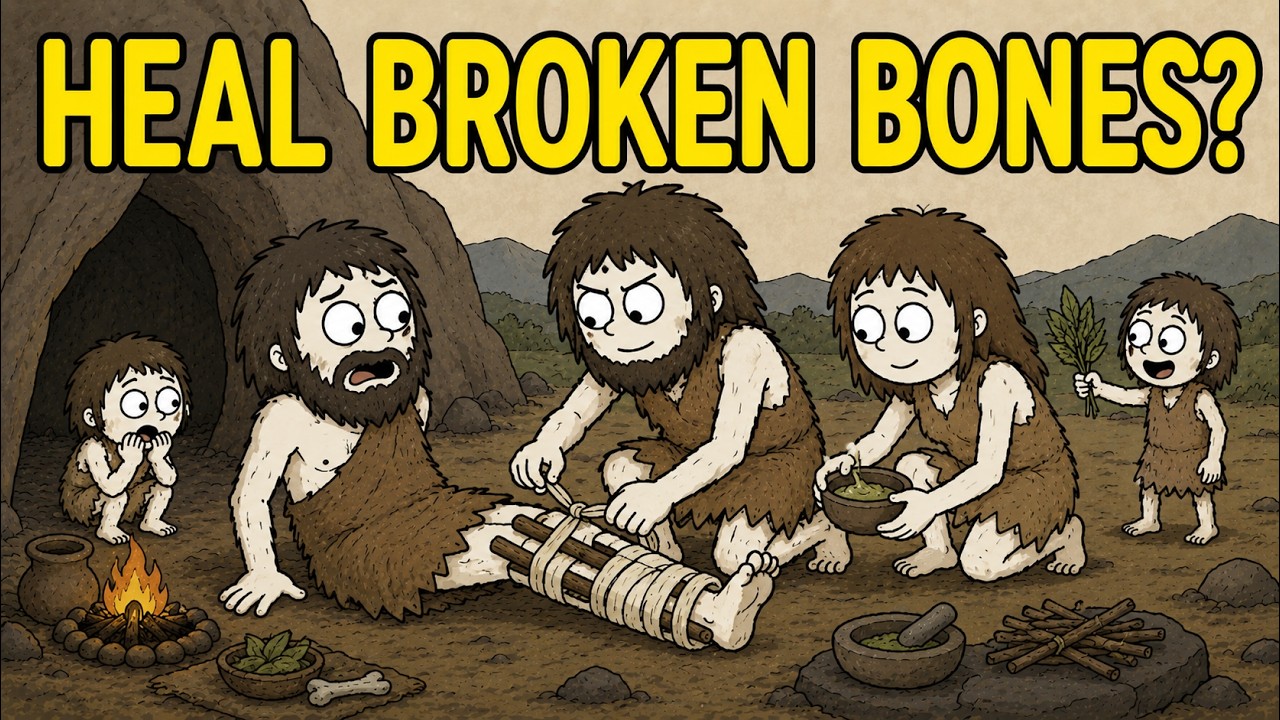
If the bone needs to stay still and the body cannot hold it still on its own, you build something that does. Two rigid pieces of material placed on either side of the broken limb, wrapped tightly, prevent the broken ends from moving relative to each other. Ancient people had everything they needed. Straight, rigid sticks.
Sheets of tree bark, particularly birch and cherry bark, which are naturally curved and strong. Dry grass or animal fur as padding. And leather strips cut from animal hides or lengths of dried animal tendon to tie the assembly together. The mechanics were not complicated.
What is remarkable is that they worked out the logic at all. The invisible process happening inside the bone—the cartilage bridge forming, the minerals being deposited—was entirely hidden from view. Ancient healers could only observe that when a broken limb was held still, the person eventually got better. When it was not, they did not.
Archaeologists have found some of the earliest physical evidence of splinting in ancient Egypt. At a site called Naga ed-Der, researchers excavated specimens with palm bark splints still attached to the bones, wrapped in linen bandages. The Edwin Smith Papyrus, an Egyptian medical text copied around 1,600 years before our era that appears to draw on even older knowledge, described specific techniques for splinting fractures of the collarbone, shoulder, and forearm. It was documented procedure, not improvised guesswork.
Beyond simple splints, prehistoric healers had access to a material researchers believe may have functioned as an early version of the plaster cast. Fresh animal hide—rawhide before it is treated or tanned—is soft and pliable when wet. As it dries, it shrinks, tightening around the limb. Once fully dry, rawhide becomes almost completely rigid, holding the shape it dried in.
This is functionally very similar to what a modern plaster cast does. Structural immobilization was only half the battle. The other half was infection. Ancient healers fought infection with what they had—and what they had was more effective than most people realize.
Wild honey was almost certainly the most important wound treatment in the prehistoric world. Its high sugar concentration draws water out of bacterial cells through osmosis, killing them. An enzyme bees add during honey production generates hydrogen peroxide at the wound surface. Its thick consistency creates a physical barrier against contamination.
Ancient Egyptian medical texts describe using honey directly on open wounds as standard treatment. Modern research has confirmed that honey genuinely inhibits the growth of bacteria, including strains that resist modern antibiotics. Resin served a similar purpose. Pine pitch, myrrh, and other resins contain compounds with antimicrobial properties.
Resins also create a waterproof physical seal over a wound. Evidence of resin use has been found associated with ancient burial sites and skeletal remains across different time periods and cultures. Willow and poplar bark contains a compound called salicin, which the body converts into salicylic acid—the active ingredient in aspirin. It reduces pain and decreases inflammatory swelling that in excess damages healing tissue.
The Sumerian civilization recorded the use of willow as pain relief on clay tablets around 4,000 years ago, and researchers have found chemical traces suggesting Neanderthals were consuming plants with similar properties. Plant materials like yarrow and chamomile found in the dental tartar of prehistoric remains in Spain contain anti-inflammatory compounds that researchers believe were used medicinally. These plants appear repeatedly across ancient medical traditions in cultures with no contact with each other, which strongly suggests the knowledge of their properties was discovered independently multiple times. None of this was equivalent to a modern hospital.
Infections still killed people. Fractures still went wrong. But the ancient pharmacopoeia was a genuinely effective collection of tools developed through careful, generations-long observation of what worked and what did not. Healing a bone is metabolically expensive.
The body is building new tissue from scratch, requiring enormous amounts of energy, protein, calcium, and other nutrients. People recovering from serious fractures need to eat substantially more than healthy adults. An immobile person with a fractured femur cannot hunt, gather food, or walk to a water source. Someone had to hunt for them, bring them water, carry them when the group moved, and stay behind to protect them from predators.
Every healed fracture in the ancient record represents not just a biological event, but a social decision: a group of people who looked at an injured member and decided collectively to spend their limited time and resources keeping that person alive. The healed bones we find are not just evidence of anatomy. They are evidence of a social contract—a decision that the group was responsible for its individual members, even when those members could contribute nothing in return. For much of the 20th century, scientists assumed this kind of sustained social care was a distinctly modern human behavior.
That assumption has been dismantled by physical evidence. Across multiple Neanderthal sites, researchers have found skeletal remains showing people who survived injuries that required long-term care. A study published in the journal World Archaeology concluded that Neanderthals demonstrated social complexity in their care for the injured and disabled that had previously been attributed only to modern humans. Erik Trinkaus, a professor of anthropology at Washington University in St.
Louis who has spent decades studying Neanderthal remains, said of Shanidar 1 that the combination of deafness, visual impairment, and physical disability would have made him easy prey in his environment and dependent on other members of his social group for survival. Yet he lived for years, possibly decades. The implication is that the capacity for sustained care of the injured and sick is not something that appeared with modern humans. It appears to be deeply embedded in the social nature of the broader human family.
Both modern humans and Neanderthals, who shared a common ancestor roughly 400,000 to 700,000 years ago, independently developed and maintained the practice of caring for their most vulnerable members. Or perhaps it is not independent at all—perhaps the common ancestor already had this capacity. Not every broken bone in the ancient world healed cleanly. If the ends are not repositioned into correct alignment before healing begins, the bone unites in the wrong position—a condition called malunion.
It can cause permanent limb shortening, chronic pain, and a gait that puts extra stress on other joints. At a site called Tombos in ancient Nubia, dated to between 3,100 and 2,900 years ago, researchers found a woman whose hip had fractured and healed with significant deformity. The fracture was well healed, meaning she survived the initial injury and recovery period, but she walked with a pronounced limp for the rest of her life. Her bones show the kind of robust muscle development that only comes from regular physical activity.
Her community had kept her alive, and she had continued to contribute. The most dramatic evidence of ancient medical capability is intentional surgical intervention. The people who performed the amputation at Liang Tebo 31,000 years ago made a deliberate decision to remove a limb. They controlled bleeding—because without that, the patient dies within minutes.
They managed the wound afterward in a way that prevented infection in a tropical rainforest, one of the most pathogen-rich environments on Earth. The patient survived for nearly a decade. As researchers from the University of Sydney noted when describing the find, it is notoriously difficult to prevent infections in surgical amputations even today with the tools of modern medicine. Thirty-one thousand years ago, a community managed this in a remote cave accessible only by boat at certain times of year.
Evidence of trepanation—deliberately drilling or scraping holes in the skull—adds another layer. The procedure appears in skulls from multiple sites across the world, including Ukraine, where skulls more than 9,000 years old show evidence of it. It appears in ancient Greece, in the Incan Empire, and across multiple sites in Europe. In many cases, the bone around the opening shows healing, meaning the person survived.
In some populations, researchers estimate survival rates above 80 percent. By the time the Edwin Smith Papyrus was written down in ancient Egypt, there was already a formal, structured medical tradition for handling bone injuries. The text describes a physician examining a fracture, assessing its severity, deciding whether it is treatable, positioning the patient, and applying splints made of wood and bark wrapped in linen. It even describes what looks like the first documented system of medical triage.
The knowledge that produced that text was accumulated, refined, and passed down across thousands of years. Scientists know all of this because forensic bioarchaeologists have developed sophisticated techniques for reading the stories embedded in ancient bone. The most basic indicator of a healed fracture is the bony callus—denser and different in texture from the surrounding bone, often visible to the naked eye. Under a microscope, the disorganized structure of woven callus bone looks distinct from mature lamellar bone.
By examining how much remodeling has occurred, scientists can estimate how long the person survived after the injury. X-rays and CT scanning have transformed what is possible. A CT scan can show the internal structure of the bone, the alignment of the medullary canal, internal scarring, and signs of old infection deep inside the bone that would never be visible on the surface. This combination of techniques is what allowed researchers examining the Liang Tebo skeleton to be confident that the lower leg had been surgically removed.
The bone ends showed smooth, organized regrowth that only occurred during life, not after. The cut angle was consistent with tool use rather than gnawing. And there was no sign of infection in the healed tissue. One detail that is easy to miss: children’s bones heal very differently from adult bones.
A child’s skeleton is still growing, with a thick, highly active outer layer that produces new bone rapidly. Children’s bones are more flexible, sometimes bending and partially breaking rather than snapping completely. Childhood fractures heal roughly twice as fast as adult fractures. A growing child’s skeleton can, over years, completely remodel and correct even significant deformities.
This means the archaeological record substantially undercounts childhood injury. The healed childhood injuries we do find are probably just a fraction of the injuries that actually occurred and were treated. The fundamental principles used to heal broken bones have not changed. Modern orthopedic surgery deploys titanium rods, computerized imaging, chemical antibiotics, synthetic bone grafts, and surgical robots.
But underneath all of that technology, the biology is the same as it was 30,000 years ago. A broken bone still needs to be aligned, immobilized, and given rest and nutrition. Infection still needs to be prevented. The logic that an ancient healer in a cave was following when they wrapped a fractured limb in leather and propped it up with sticks is the same logic an orthopedic surgeon follows when applying a fiberglass cast in an emergency room today.
There is a line that appears sometimes in anthropology: a healed femur is evidence of civilization. In the animal kingdom, a broken femur is a death sentence. No wild creature survives long enough for a fractured thigh bone to mend. A human femur that has healed is proof that others provided food, that someone offered protection, that the group restructured itself around one of its members who needed help.
Every healed fracture in the fossil record is a record of a decision. Someone chose to stay. Someone chose to help. That choice was made 10,000 years ago, 45,000 years ago, 1,700,000 years ago.
Think about what recovery from a broken leg actually looked like 30,000 years ago. The injury happened suddenly—a fall, a misstep, a collision during a hunt. Within the first hour, the people around them had to decide where to move them, how to stabilize the limb, and how to manage the wound. Then the weeks began.
For six to twelve weeks, the patient lay mostly still while the bone slowly built its bridge across the gap. Someone brought food every day—food soft enough to eat, rich enough in the proteins and fats healing bone requires. Someone brought water. Someone stayed present to drive away animals.
If infection began, the patient developed fever, the wound swelled and warmed, and there was almost nothing more to do except watch and wait and hope the body’s own defenses were strong enough. The people caring for them gave freely, day after day, for months. Not because a legal system required it. Not because a hospital billing department recorded the services.
But because in a small group where everyone is kin or close to it, someone suffering is everyone’s concern. The tools changed. The materials changed. The understanding of what was happening inside the bone changed enormously.
What did not change was the behavior. The refusal to leave an injured person behind, the decision to feed someone who cannot feed themselves, the willingness to carry a burden that produces no immediate return—this is not a product of civilization. It preceded civilization by an enormous margin. The skeleton from Liang Tebo cave—a child with a surgically removed leg in a tropical rainforest 31,000 years ago—survived because the people around them made a sustained, costly, daily decision to keep them alive.
They had no hospitals, no degrees, no sterile instruments. What they had was the knowledge of their elders, the resources of their environment, the skills built from a lifetime of butchering animals and observing wounds, and a community that had decided this child’s life was worth the cost. The oldest evidence we have of medicine is not a bottle or a needle or a written prescription. It is a child’s bone, cleaned and sealed and healed, in a cave by a river in Borneo.
It is evidence of a surgery performed without a single instrument we would recognize, and evidence of nine years of continued life that could only have been possible if the people nearby refused every single day to let that child go. Long before hospitals existed, humanity itself was the medicine.