Before humans learned to write, farm, or build permanent settlements, they were already performing ritual behaviors and burying their dead with care. Evolutionary archaeologists have uncovered evidence of religious practices dating back between 45,000 and 200,000 years to the middle Paleolithic era—tens of thousands of years before the invention of agriculture. This suggests that the belief in the supernatural was not something humans were taught, but something that emerged on its own across scattered populations. The earliest traces of this spiritual awakening appear in how our ancestors treated their dead.
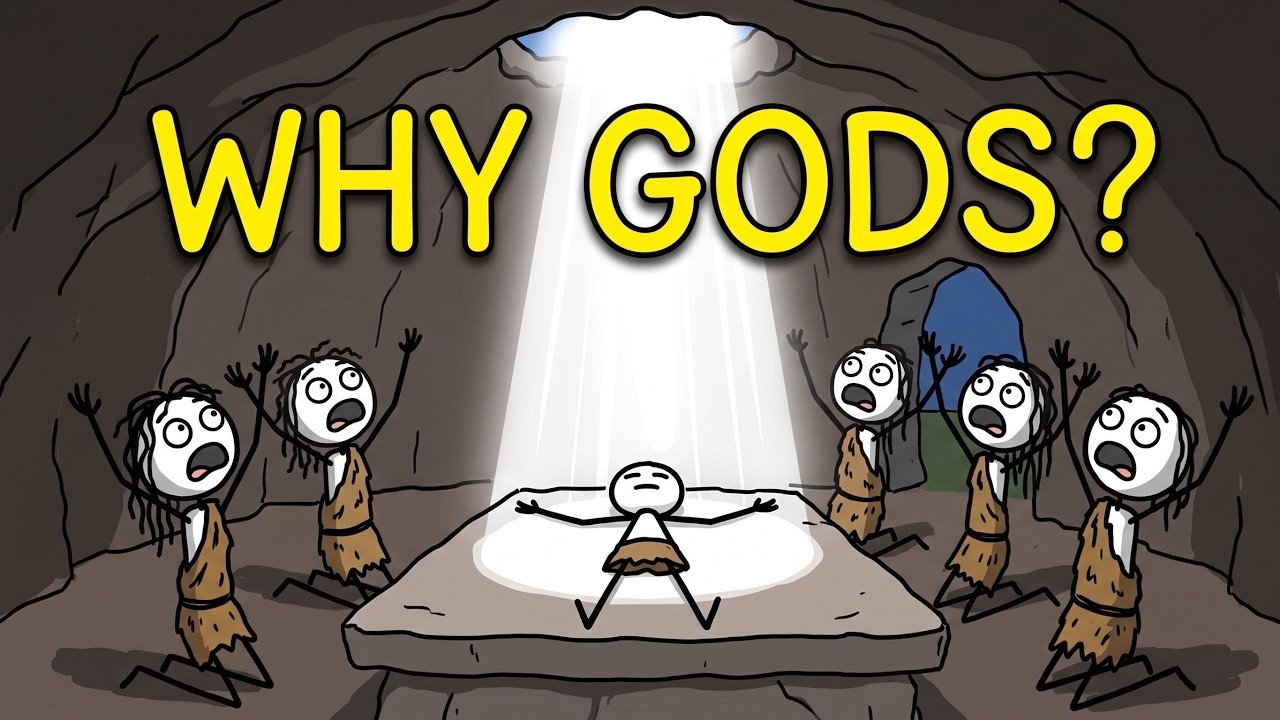
In the animal kingdom, death is met with indifference; a chimpanzee mother may carry her dead infant for a few days before dropping it and moving on. But at some point in human evolutionary history, corpses stopped being treated as discarded organic matter and became sacred objects. This shift is one of the most significant behavioral deviations in the history of life on Earth. Archaeological digs around the globe have uncovered early graves filled with weapons, bone jewelry, stone tools, and traces of food placed alongside skeletal remains.
If ancient humans believed death was the absolute end of existence, these burials would represent a massive waste of scarce resources. In a world where crafting a single stone handaxe took hours of intense labor, burying it with a corpse was a genuine sacrifice. The presence of grave goods is considered physical evidence of a belief in the afterlife. One of the earliest examples comes from the Sima de los Huesos, or “Pit of Bones,” in northern Spain.
Researchers had to crawl through narrow passages to reach a 13-meter vertical shaft at the bottom of which they found the fossilized remains of at least 28 individuals of Homo heidelbergensis, dating back roughly 400,000 years. Among the scattered bones, archaeologists discovered a single beautifully crafted handaxe made of rare red quartzite. Named Excalibur, the tool showed no signs of wear from butchery or woodwork, suggesting it was deliberately placed in the pit as a ritual offering. More recent evidence includes 90,000-year-old skeletons buried with red ochre and marine shells in Qafzeh Cave in Israel, and Neanderthal burials on beds of wildflowers in Shanidar Cave in Iraq.
These findings point to a consistent pattern: ancient humans believed the dead had not ceased to exist but had simply moved to another realm. Ritual behavior was not exclusive to modern humans. In 2016, researchers studying Bruniquel Cave in southwestern France discovered complex circular structures built from nearly 400 broken stalagmites more than 300 meters inside the cave, far beyond the reach of natural light. Dated to approximately 176,000 years ago, long before Homo sapiens arrived in Europe, these stone rings were arranged in concentric circles with burnt bones found inside.
The Neanderthals who built them had to bring fire deep underground, indicating the structures served a symbolic or ritual purpose. This deep-seated belief in the supernatural raises a central question: is the human brain naturally programmed to believe in gods? Evolutionary anthropologists have proposed a two-stage theory. First, our ancestors evolved specific mental mechanisms useful for physical survival and reproduction.
Second, these survival mechanisms accidentally misfired, creating a natural tendency to believe in spirits, ghosts, and deities. In this view, religious belief is not a direct adaptation but an evolutionary byproduct of cognitive tools designed to keep early humans alive on the savannah. A core survival tool, known as theory of mind, allowed early humans to attribute mental states like desires, beliefs, and intentions to others. This helped them navigate complex social hierarchies.
However, the system was so active that human brains began projecting intentionality onto non-living things. Rain was not seen as water condensing in the atmosphere but as water falling because the sky wanted to wet the earth. A volcanic eruption was interpreted as the mountain acting out of anger, and wind howling through trees was a spirit expressing sorrow. This cognitive overprojection is considered the foundation of animism, the oldest form of human religion.
Our ancestors believed spirits inhabited the sun, wind, rivers, and trees, and that these forces required the same kind of negotiation as human relationships. Worship began as a pragmatic strategy to appease powerful natural forces, turning a chaotic universe into a network of relationships in which humans could bargain for their survival. This evolutionary programming remains dominant in the modern world. Nearly 84 percent of the global population—around 6 billion people—identifies with a formal religion today.
Even among self-identified atheists, surveys show that one in five still believes in a higher power, a cosmic force, or spiritual energy. Belief in gods did more than explain the natural world; it solved a massive social problem. As human groups grew larger, keeping order became increasingly difficult. In a small band of 30 hunter-gatherers, everyone knew everyone, and those who stole or refused to help were punished through gossip, mockery, or banishment.
But as communities expanded, people had to interact with strangers, creating what researchers call the free-rider problem: without face-to-face accountability, the incentive to cheat and act selfishly skyrocketed. Religion evolved to include moralizing forces that addressed this issue. By extending social surveillance to all-seeing spirits, ancestors, and deities, human societies found an effective way to curb selfishness. A person might escape human justice, but could not hide from the gods, who could strike them down with disease or ruin their crops.
This shared belief acted as a psychological police force, forcing individuals to behave honestly even when completely alone. This invisible surveillance gave religious groups a significant evolutionary advantage. A tribe whose members believed in an all-seeing deity cooperated more effectively, shared food more reliably, fought together more courageously, and built stronger communities. In the competition for survival, the cooperative group outcompeted the selfish one.
At its origin, belief in gods was a practical social technology designed to keep the tribe from splintering into chaos. For decades, the standard theory of civilization held that humans first invented agriculture, then settled in permanent villages, produced food surpluses, and only then developed organized religion and built temples. This timeline was completely shattered in 1994 with a discovery in southeastern Turkey. Göbekli Tepe is a massive stone temple complex dating back approximately 11,500 years, constructed around 9,500 BCE.
The site features dozens of T-shaped limestone pillars, some up to 5 meters tall and weighing between 10 and 20 tons, arranged in concentric circles and carved with reliefs of lions, wild boars, scorpions, and venomous snakes. Remarkably, the temple was built entirely by pre-agricultural hunter-gatherers. They had no metal tools, no wheels, and no domesticated beasts of burden. They did not even have permanent houses.
The oldest archaeological layers contain no hearths, trash pits, or living quarters; the structures were purely ceremonial. Domestic remains only appear in much later, shallower layers. This discovery reverses the traditional arrow of history. It was not agriculture that created religion; it was religion that forced the birth of agriculture.
To build a monument on the scale of Göbekli Tepe, hundreds of people from different nomadic bands had to gather and work together for months. Feeding this workforce with wild game and berries alone was impossible. Genetic mapping of wild einkorn wheat shows its closest wild relative still grows on the slopes of the Karacadağ Mountains, just 30 kilometers from the site. The need to feed the temple builders drove the domestication of wheat.
Göbekli Tepe was not an isolated phenomenon. In 2021, the Turkish government and international archaeologists launched the Taş Tepeler project, coordinating excavations across a dozen contemporary Neolithic sites in the region. Among these, Karahantepe, located 63 kilometers away, contains similar T-shaped anthropomorphic pillars but with a crucial difference: many structures were carved directly into the natural limestone bedrock, and the site shows clearer evidence of daily residential areas alongside monumental ritual spaces. This suggests southeastern Turkey was home to an extensive interconnected network of ritual centers, indicating that pre-agricultural humans were part of a culturally unified society sharing a complex symbolic language.
Researchers continue to debate whether religion was a biological byproduct or a direct evolutionary adaptation. The byproduct model holds that religious beliefs are side effects of cognitive systems that evolved for other survival tasks, such as reading faces and detecting predators. The adaptation model argues that religion was actively selected for because it allowed humans to scale up their societies, providing the shared mythology needed to coordinate millions of strangers. The evolutionary roots of ritual behavior may even predate the split from other primates.
Scientists at the Max Planck Institute for Evolutionary Anthropology have observed wild chimpanzees in West Africa performing “accumulative stone-throwing,” repeatedly hurling rocks at specific trees and leaving piles of stones at their bases. The chimps specifically choose resonant trees that produce a loud booming sound. This behavior has no biological or survival purpose, leading some primatologists to suggest it shows the evolutionary scaffolding of ritual: the socially learned action of marking specific spaces as special through non-functional acts. Ritual behavior also provided a biological placebo effect.
Life in the ancient world was filled with trauma, disease, and sudden death, and the chronic stress of survival would have been psychologically crippling. Chronic stress floods the body with cortisol, damaging the immune system and increasing mortality. Collective rituals, chanting, and prayer acted as stress relievers. Neuroimaging studies show that intense prayer or meditation deactivates the default mode network in the brain, reducing anxiety and inducing feelings of peace.
These practices lowered physiological stress, protected immune systems, and helped keep early humans alive. Synchronized activities like group dancing, chanting, or shared prayer also triggered chemical changes in the brain, releasing endorphins and oxytocin. This chemical cocktail lowered social anxiety and increased empathy, making a group of unrelated strangers feel like biological siblings. This neurochemical bonding allowed early humans to form larger, more cohesive groups capable of building cities, digging irrigation systems, and defending territory.
To ensure community members were genuinely committed to all-seeing gods, religions developed costly rituals. Under costly signaling theory, a behavior is only a reliable signal of commitment if it is difficult or painful to perform. Anthropologist Richard Sosis studied historical communes and found that religious ones demanding strict rituals and daily prayer survived much longer than secular ones. He also studied Israeli kibbutzim, discovering that religious members who engaged in costly daily prayers were significantly more cooperative in economic games than secular members.
The cost of the ritual acts as a barrier to entry, keeping out those who might exploit the group. This theory explains why some ancient rituals escalated to extreme levels. In Carthage, during times of military siege or environmental crisis, elites practiced child sacrifice to the god Moloch. Giving up a child is the ultimate impossible-to-fake demonstration of loyalty to the state.
By participating in this horrific ritual, the ruling class proved their commitment to collective survival. The shared trauma bonded the community, preventing internal panic and rebellion when the city was threatened. As societies grew, the structure of the spirit world shifted from small-scale negotiation to cosmic warfare. In ancient Persia, Zoroaster introduced cosmic dualism, dividing the universe into absolute good and absolute evil.
The old gods became soldiers in a war between light and darkness. This transition changed human morality: actions now had cosmic significance, requiring individuals to choose a side in a war determining the fate of the universe. This dualism was inherited by Judaism, Christianity, and Islam. Traces of this evolutionary transition remain visible today.
People knock on wood to prevent bad luck, avoid walking under ladders, make wishes when blowing out birthday candles, and carry lucky charms or wear specific jerseys during sports games. These behaviors are functionally identical to the dances ancestors performed to bring rain—attempts to negotiate with unseen forces and buy a small measure of control over an unpredictable future. Tens of thousands of years before the first word was written, ancient humans looked up at the sky and asked whether anyone was looking back down. That question never disappeared.
Belief in the supernatural did not need to be taught; it was the default setting of the human brain, a product of millions of years of survival and the social architecture that allowed humanity to build the modern world.