Around 20,000 years ago, at the height of the last glacial maximum, humans were surviving on the mammoth steppe, a frozen grassland stretching from modern-day France to Canada. With no synthetic clothing, no technology, and no way to call for help, early humans faced a landscape designed to freeze them solid. Yet they not only survived, they thrived. Their success was not a matter of luck but a series of calculated gambles and biological adaptations that should have failed.
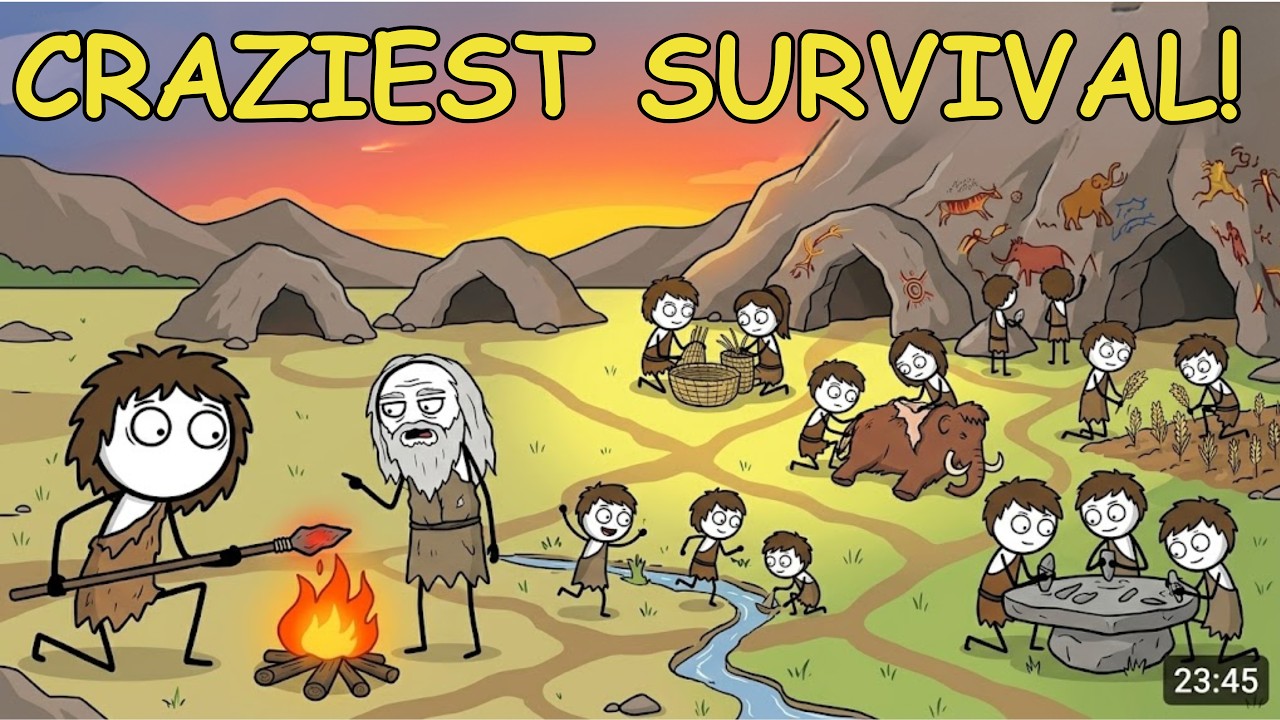
Ancient humans are often viewed as primitive, but they were engineers of the immediate and scientists of the skin. Every method they used was a transaction in what could be called the biological ledger, where the currency was life itself. A mistake closed the ledger permanently, but success became a permanent part of the human toolkit. One of the most effective survival methods was the persistence hunt, which turned the heat of the sun into a weapon.
Most mammals are covered in fur, which is good for insulation but terrible for shedding heat. When a kudu or zebra runs, its muscles generate massive internal heat, and because the animal can only pant to cool down, it eventually hits a thermal ceiling. Humans, however, traded fur for millions of sweat glands. A 2011 study in the Journal of Human Evolution, involving researchers like Daniel Lieberman of Harvard University, highlighted that the ability to dump heat through evaporation is humanity’s greatest biological advantage.
Humans became the only animal on the planet that can run and cool down at the same time. In a persistence hunt, a group of hunters would pick a target and start running. The animal would bolt, but the hunters would track it, find it resting, and force it to run again. After four or five hours, the animal’s cooling system would fail, and it would collapse from heatstroke while the humans remained perfectly cooled by their own sweat.
Another surprising survival method was geophagy, the deliberate eating of specific clays. Many reliable food sources for ancient humans, such as acorns in North America or wild potatoes in the Andes, are defended by bitter tannins and alkaloids designed to make the consumer sick. Specific types of clay, particularly kaolin, act as molecular sponges. Through adsorption, the clay binds to toxins in the digestive tract before the body can absorb them, effectively neutralizing the poison.
In the American Southwest, the Pima people mixed clay with wild potatoes to make them edible. Without the clay, the potatoes were toxic. In the Arctic, the Inuit developed the kiviak, a food source that sounds unappealing to a modern palate but was a master class in nutritional preservation. They would take hundreds of little auks, small seabirds, and sew them into a seal skin, feathers and all, then bury the skin under a rock for several months to allow the birds to ferment in their own oils.
The result was a calorie-dense meat loaded with vitamins that are otherwise impossible to find in a landscape with no plants. While European explorers died of scurvy because they refused local foods, the Inuit thrived on fermented food that pre-digested the meat and synthesized B vitamins. In ancient Egypt, the thick black eyeliner known as kohl was more than aesthetic. In 2010, researchers at the Louvre and the CNRS in France analyzed 52 samples of ancient Egyptian kohl and found two lead salts, laurionite and phosgenite, that do not occur naturally.
The Egyptians synthesized them in a process that took weeks. In low concentrations, these lead salts stimulate the production of nitric oxide in skin cells, which boosts the immune system and helps fight bacterial infections rampant in the fly-infested Nile Delta. The makeup was a topical antibiotic delivery system disguised as a beauty ritual. The Polynesian navigators performed what may be the greatest intellectual feat in human history.
They colonized thousands of islands across a third of the Earth’s surface using nothing but their senses. Using a technique called wayfinding, a master navigator could sit in a canoe and distinguish between up to five different swell patterns hitting the boat simultaneously. They could feel the refracted waves that bounce off a distant island and travel back out to sea, using their bodies as a biological sonar system. They also watched birds, knowing the white tern flies out to sea to fish in the morning and returns to land at night.
Following a single bird at dusk could lead them to an island in the middle of a vast ocean. In Australia, indigenous populations practiced firestick farming for at least 50,000 years. By lighting small, cool fires during specific seasons, they cleared dry underbrush that causes catastrophic wildfires and encouraged fresh green shoots that attracted game animals. This turned the continent into a managed grassland.
When Europeans arrived and stopped these practices, fuel built up and fires became uncontrollable monsters. The ancient method was land management on a continental scale. During the 1536 expedition of Jacques Cartier, his crew was trapped in the ice of the Saint Lawrence River and dying of scurvy. Their teeth were falling out, and they had no idea that scurvy is caused by a lack of vitamin C.
The local Saint Lawrence Iroquoians showed them a survival method they thought was magic: boiling the needles and bark of a specific tree, likely Eastern white cedar, into a tea. Within days of drinking the tea, the men on the brink of death began to recover. The Iroquoians had discovered that evergreen trees are a massive untapped reservoir of vitamin C. On the Tibetan Plateau, humans live at elevations where oxygen is 40% thinner than at sea level.
A study led by Rasmus Nielsen at UC Berkeley in 2010 found that a gene called EPAS1 regulates how the body produces hemoglobin. In most people, thin air causes the body to overproduce red blood cells, making the blood thick and leading to heart failure. The EPAS1 variant in Tibetans keeps their blood thin and efficient even in low oxygen. Remarkably, this gene was not evolved on its own.
It was acquired through interbreeding with a now-extinct species of human called the Denisovans. The Denisovans are gone, but their ability to breathe thin air lives on in the people who still walk those mountains. These survival methods, from the persistence hunt to eating clay to reading the memory of the waves, were necessary steps in a journey that led directly to the present. Every generation paid into the biological ledger, and their descendants continue to carry the sweat glands of the persistence hunter, the immune system primed by chemicals, and the genes of the high-altitude Denisovans.
The question remains whether modern humans are still paying into that ledger or merely spending the interest. The ancient world did not care about potential or plans. It only cared about results. The people who survived were those who paid attention to the subtlest rhythms of the earth, who knew the difference between a feast and a funeral was often found in the bark of a tree or the flight of a bird.
They were the readers of the fine print of the environment, and their legacy is not just curiosity but a profound respect for the adaptability and resilience of the human species.