Rice feeds more people than any other crop in history. Over 3. 5 billion people depend on it for at least a fifth of their daily calories, and global production now exceeds 530 million tons every year. In dozens of languages, the word for rice and the word for meal are the same.
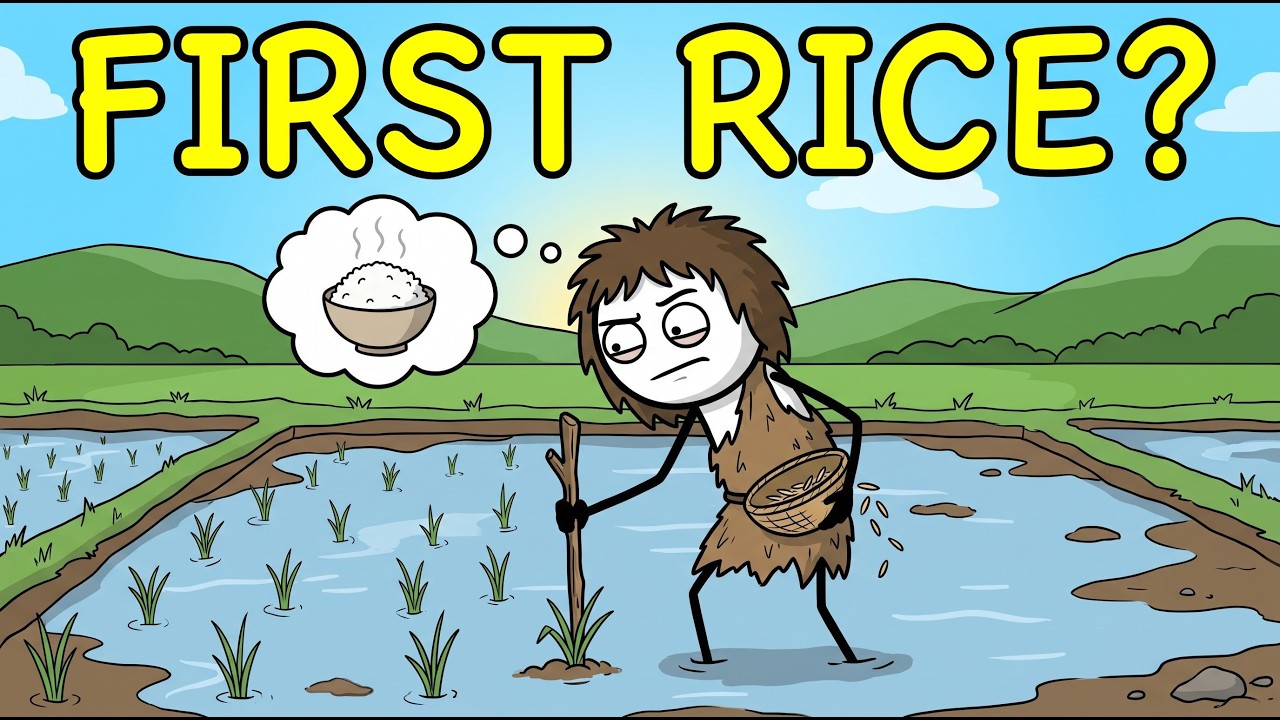
In Japanese, gohan means cooked rice and also means meal; breakfast is asa gohan, literally morning rice. In Mandarin, chifan, literally eat rice, simply means “have you eaten? ” Yet the journey from useless swamp weed to the foundation of half the world’s diet took roughly 4,000 years and was never a deliberate invention. Most people assume rice farming began when someone had a bright idea and planted a crop.
The evidence tells a different story. At Shangshan, an archaeological site in Zhejiang province in the lower Yangtze River Valley dating to roughly 10,000 years ago, researchers found scattered remains of wild rice mixed with the tools and pottery of hunter-gatherers who were collecting, not cultivating, the grain. They picked it from wild stands and processed it with crude stone tools. There were no sickles or plows.
In 2024, researchers from the Chinese Academy of Sciences published a study in Science using phytolith analysis to trace the evolution of rice at Shangshan over thousands of years. They examined bulliform cells, tiny silica structures in rice leaves that differ in shape between wild and domesticated varieties. They found a continuous, unbroken sequence of change over nearly 4,000 years. The cells shifted gradually from wild type to domesticated type.
That is not someone planting a crop. That is natural selection being quietly redirected by human behavior without anyone understanding what they were doing. The people at Shangshan were foragers who preferred certain rice plants over others. They harvested the ones easiest to collect and carried those seeds back to camp.
Some seeds fell and sprouted near the settlement. The next year, the plants growing near camp were slightly different from those in the wild. This repeated year after year, century after century, until the rice growing near human settlements became genetically distinct. Nobody designed it.
Evolution did most of the work. Climate made this possible. During the last glacial maximum roughly 20,000 years ago, the lower Yangtze was cold and dry, and wild rice could not grow there in large quantities. As the ice age ended about 11,700 years ago, temperatures rose, monsoons intensified, and the Yangtze lowlands transformed into marshes and seasonal wetlands.
The warming climate did not cause rice farming, but it made it possible. The question of where rice was domesticated has been fiercely debated. One camp argued rice was domesticated once in China and spread everywhere else. Another argued it was domesticated independently in China and India because the two main subspecies, Japonica and Indica, are genetically different enough to suggest separate origins.
Japonica is short-grain sticky rice; Indica is long-grain fluffy rice. They look, cook, and grow differently. In 2017, archaeobotanist Dorian Fuller of University College London and geneticist Michael Purugganan of New York University proposed a solution they called the rice paradox: multiple origins, single domestication. Japonica was domesticated first in the Yangtze River Valley around 9,000 to 10,000 years ago.
Indica was not domesticated from scratch. Instead, farmers in the Ganges basin who were already managing wild rice populations hybridized local wild species with Japonica when it arrived from the east around 2000 BC. The domestication genes transferred from Japonica into proto-Indica populations through introgressive hybridization. The most important of those genes is called sh4.
It controls shattering. In wild rice, the grain detaches from the stalk as soon as it is ripe and falls to the ground, a survival mechanism. For a farmer, shattering is a disaster. The sh4 mutation prevents it, keeping grain attached until harvest.
Evidence from Tianluoshan, a site in eastern China dated to roughly 7,000 years ago, shows how slowly this happened. In 2009, Fuller and Jiang Yunfei published a landmark study in Science analyzing spikelet bases from the site. In wild rice, the scar is smooth; in domesticated rice, it is rough and torn because the grain had to be ripped off by a human. Over a 300-year window, roughly 6900 to 6600 years ago, the proportion of non-shattering domesticated-type spikelet bases rose from about 27% to 39%.
It took until roughly 6,500 years ago before the non-shattering trait was fixed. That is 4,000 years from first contact to finished product. By roughly 3300 BC, the Liangzhu culture had emerged in the Yangtze River Delta. Liangzhu was a full civilization with walled cities covering over 300 hectares, elaborate jade workshops, canal systems, and a rigid social hierarchy.
What powered it was rice. The Liangzhu people built dams, reservoirs, and canals that turned swampland into paddy fields, generating enough surplus to feed a dense urban population and free labor for jade carving, construction, and administration. When monsoons shifted around 2300 BC and catastrophic flooding overwhelmed their infrastructure, the civilization collapsed. In 2019, UNESCO inscribed the ruins of Liangzhu City as a World Heritage Site.
Rice is one of the most labor-intensive crops ever cultivated. Wet rice cultivation requires flooding a field to a precise depth, maintaining that water level for weeks, transplanting seedlings by hand, weeding constantly, and managing drainage before harvest. The earliest paddy fields found archaeologically, at sites like Sa Yixing and Chuodun in China’s Taihu Lake region, date to roughly 6,000 years ago. They show organized field units with irrigation ditches, sluice pits, and drainage channels.
Rice also demanded cooperation. One family cannot build and maintain a paddy irrigation system alone. In Bali, this was solved over a thousand years ago by a system called the Subak, in which water temples coordinated planting schedules across entire watersheds. When the Indonesian government tried to override this system in the 1970s and told farmers to plant continuously using chemical pesticides, pest outbreaks exploded.
The traditional system turned out to be more effective. UNESCO recognized the Balinese Subak as a World Heritage Site in 2012. From the Yangtze Basin, rice spread in every direction. It moved southward into Southeast Asia by roughly 2500 to 2000 BC, westward into the Indian subcontinent by roughly 2000 BC, northward to Korea around 1500 BC, and from Korea to Japan around 1000 BC.
Japan before rice was the Jomon culture, mobile hunter-gatherers. Japan after rice was the Yayoi culture, settled farmers living in permanent villages with stored surplus grain and developing social hierarchies. Rice did not just arrive in Japan. It rewired the country.
Independently, without any contact with Asia, people in the inner Niger Delta in what is now Mali domesticated an entirely different species of rice. Oryza glaberrima, African rice, was bred from a wild ancestor called Oryza barthii roughly 3,000 years ago. A completely separate domestication event, it is hardier than Asian rice but produces lower yields. When the Portuguese brought Asian rice to West Africa in the 16th century, it gradually replaced African rice in commercial agriculture, but Oryza glaberrima is still grown by some farmers today.
European colonists who established rice plantations in South Carolina and Georgia in the 17th and 18th centuries faced a problem: they did not know how to grow rice. Europeans had never farmed in flooded fields. That knowledge existed in West Africa, where people had been growing rice for thousands of years. Geographer Judith Carney, in her 2001 book Black Rice, documented how plantation owners specifically purchased enslaved people from the Rice Coast of West Africa because they possessed generations of rice cultivation expertise.
The hydraulic engineering, tidal irrigation systems, planting techniques, and tools were brought to the American South by enslaved Africans. The rice economy that made South Carolina one of the wealthiest colonies in British North America was built on stolen knowledge and stolen labor. The water buffalo made large-scale rice farming possible in Asia. Domesticated somewhere along the China-Indochina border roughly 3,000 to 7,000 years ago, its hooves are wide and splayed, spreading its weight across mud.
It can plow through wet clay that would trap a horse or ox. For thousands of years, it was the living tractor of the East. Its dung fertilized the fields, its hooves aerated the soil, and it ate the weeds. In 1966, the International Rice Research Institute in Los Banos, Philippines, released a rice variety called IR8, developed by Peter Jennings and Henry Beachell.
IR8 was semi-dwarf with short, strong stalks that stayed upright when loaded with grain. Conventional varieties produced maybe 1 to 2 tons per hectare; IR8 produced 4 to 5. The Philippine press coined the term miracle rice. It helped avert famines across India, the Philippines, and Pakistan.
But the Green Revolution accelerated ecological damage. Rice paddies are responsible for roughly 10 to 12% of global human-caused methane emissions. Approximately 40 to 60 million metric tons of methane enter the atmosphere from rice paddies every year. Five countries, China, India, Bangladesh, Vietnam, and Thailand, account for roughly 78% of those emissions.
Up to 40% of the world’s agricultural freshwater goes to rice paddies. A separate 2024 study published in PNAS analyzed pottery fragments from Shangshan dating to roughly 10,000 to 9,000 years ago and found residues of fermented rice beverages inside the pottery. These early foragers were not just eating rice; they were brewing it for feasts and ceremonies. The researchers proposed that the demand for fermented beverages at communal gatherings may have been one of the social forces that pushed people to cultivate rice more intensively in the first place.
Rice was not invented the way a tool or machine is invented. It assembled itself slowly over roughly 4,000 years as hunter-gatherers unconsciously selected for plants that were easier to harvest. The non-shattering mutation took millennia to become fixed. Nobody planned it.
Then humans figured out how to flood a field on purpose, partnered with the water buffalo, built terrace systems into mountainsides, and coordinated water schedules through temple priests. Then a laboratory in the Philippines crossed two varieties and tripled the yield. The genetic and archaeological evidence places the probability that rice farming was invented only once in Asia at roughly 70 to 75%, with the Yangtze River Valley origin well established and Indica having acquired its domestication traits through hybridization with Japonica. But zoom out and the answer changes.
Rice farming happened at least twice on Earth: once in China and once in West Africa. Two species, two continents, two completely independent events. Wherever there is a warm swamp and a wild grass with starchy seeds, eventually a human will figure out how to turn it into a meal. Rice is a swamp weed.
From that single plant, humans built irrigation systems, hydraulic engineering, cooperative labor networks, city-states, empires, and an agricultural economy covering more than 160 million hectares. Half the languages in Asia cannot separate the concept of eating from the concept of rice. Tomorrow, somewhere in Southeast Asia, a farmer will wake up before dawn, walk barefoot into a flooded field, and transplant rice seedlings by hand, one at a time, the same way it has been done for thousands of years.
Every grain of rice ever eaten descends from a decision made by nobody in particular, over 10,000 years of humans and a grass changing each other so slowly that neither one noticed.